





Briefing
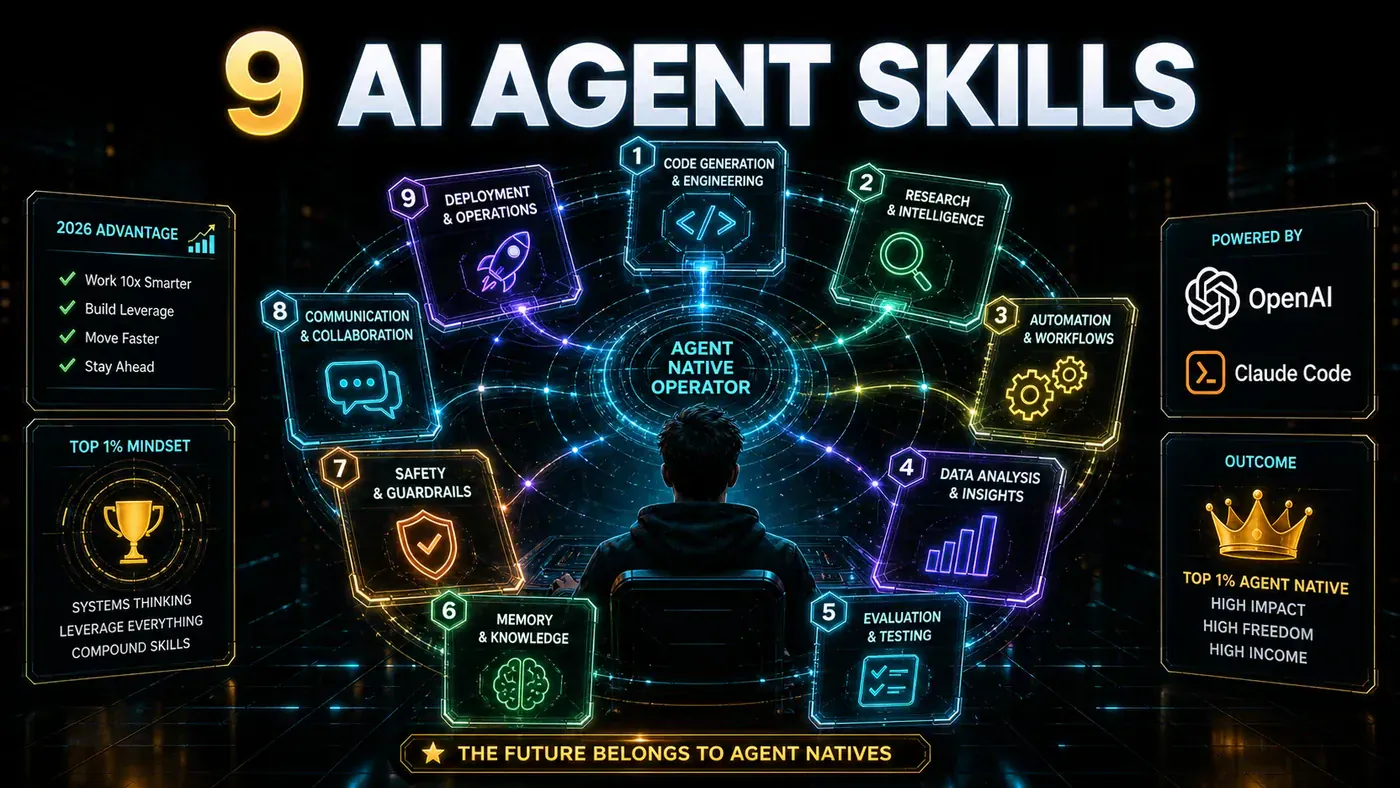
The AI agent landscape is shifting beneath our feet. What passed for cutting-edge automation six months ago already looks quaint, and the gap between those who understand where agents are headed and those still treating AI as a fancy chatbot is widening by the day. In his widely circulated video "9 AI Agent Skills To Get Ahead of 99% of People," Riley Brown maps out nine inevitable trends reshaping how we work with AI agents - from composable skills and super apps to token economics and full computer control.
With over 20,000 views and hundreds of endorsements from the AI community, Brown's framework has become a playbook for professionals determined to become "agent native" - not merely using AI tools, but architecting entire workflows around autonomous agents as first-class collaborators. This is not about prompting ChatGPT to rewrite an email. It is about building an orchestrated digital workforce that operates while you sleep.
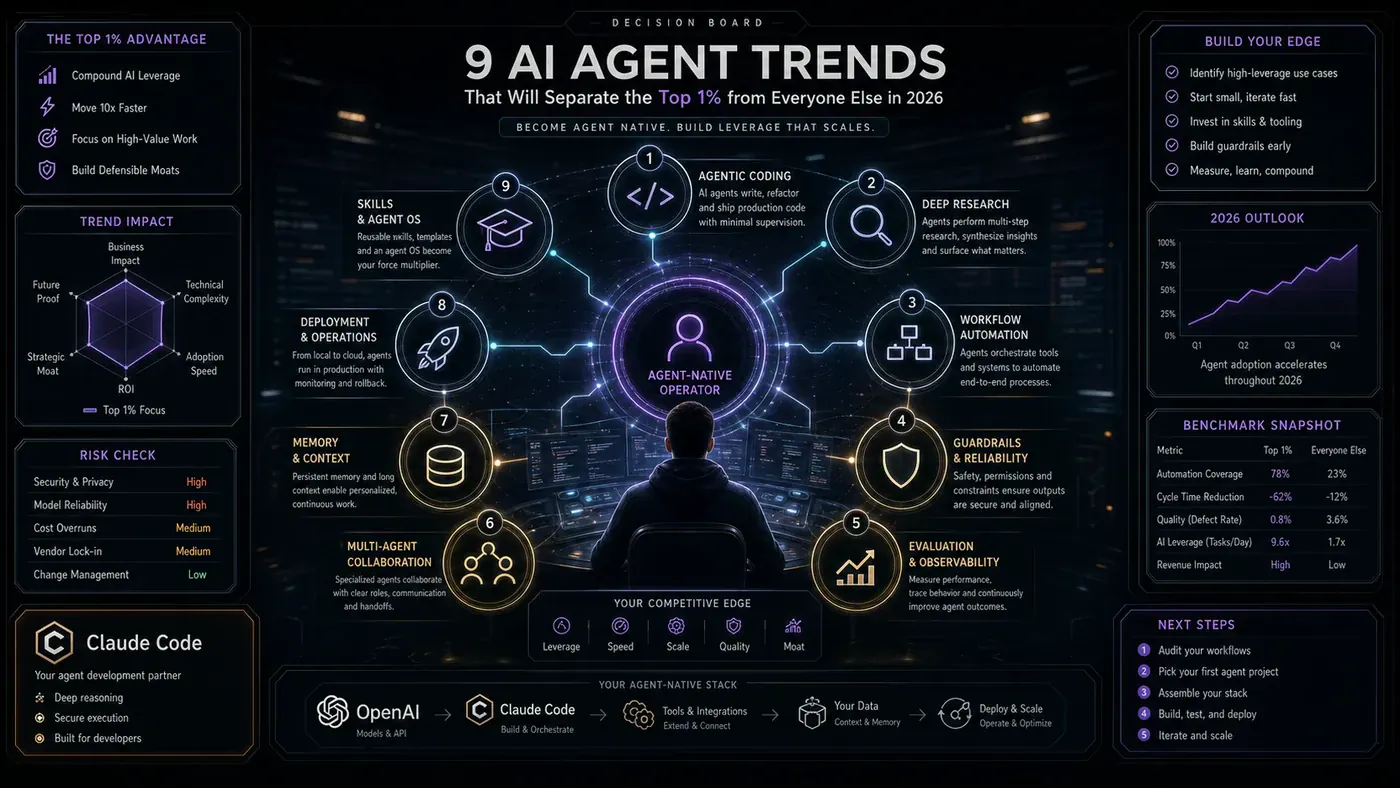
The agentic AI market is projected to reach $52.6 billion by 2030, growing at 46.3% annually. According to PwC's May 2025 AI Agent Survey, 35% of organisations already report broad adoption, with another 27% running limited deployments. The question is no longer whether AI agents will transform work, but who will be ready when they do. Here are the nine trends Brown identifies as essential knowledge for anyone who wants to stay ahead.
Trend 1: AI Agents Are Getting Much Smarter
The first and most fundamental trend is the rapid improvement in agent intelligence itself. The agents of mid-2026 bear little resemblance to their 2025 predecessors. Where early agents followed rigid, pre-defined workflows, today's systems demonstrate genuine reasoning, adaptive planning, and the ability to recover from errors without human intervention.
This leap is driven by several converging factors. Foundation models have grown significantly more capable at multi-step reasoning. Anthropic's Claude, OpenAI's GPT-5 family, and Google's Gemini now power agents that can decompose complex objectives into sub-tasks, execute them in sequence, and backtrack when something goes wrong. The introduction of reasoning models - what the industry calls "System 2" thinking - has given agents the ability to pause, evaluate options, and choose the best course of action rather than simply generating the next most likely token.
The practical implications are substantial. A coding agent that managed simple scripts a year ago can now handle multi-file refactors, architectural decisions, and integration across complex codebases. Research agents can read papers, synthesise insights, and identify contradictions in source material. For knowledge workers, the boundary between "tasks I must do myself" and "tasks I can delegate" is shifting upward dramatically.
As IBM Distinguished Engineer Chris Hay noted, we have moved past the era of single-purpose agents. The email writer and research helper are merging into something more capable - what Hay calls the "super agent."
Trend 2: Skills Are Taking Over and Self-Assembling
Perhaps the most consequential architectural shift is the move from monolithic agents to composable skills. Brown argues that skills - modular, reusable capability packages that agents load on demand - are becoming the fundamental building blocks of agent behaviour.
Anthropic's Claude Skills exemplify this approach. A skill is essentially a directory containing instructions, scripts, and resources that give an agent specialised capabilities without requiring re-prompting each time. Instead of writing a 400-token system prompt explaining your PDF handling process repeatedly, you package that knowledge into a skill that Claude loads when relevant and ignores when not. Skills are composable, portable across platforms, and efficient - only loading what is needed, when it is needed.
The "self-assembling" aspect is where this gets interesting. Modern agent platforms can detect what capabilities a task requires and automatically load the appropriate skills. Brown demonstrates this through OpenAI Codex, where mentioning "@Gmail" in a prompt automatically activates the Gmail plugin with its bundled inbox triage skill. The agent recognises the requirement and assembles the necessary tooling.
This modular architecture mirrors the evolution of software itself. Just as object-oriented programming replaced monolithic codebases with reusable components, skill-based agents replace monolithic prompts with composable capabilities. A "brand deal research" skill might scan incoming emails for sponsorship offers, research each brand, and compile findings into a structured report - all without human intervention.
Trend 3: AI Agent Platforms Are Becoming Super Apps
The third trend is the consolidation of agent capabilities into "super apps" - unified platforms integrating multiple tools, plugins, and workflows into a single environment. OpenAI Codex, Cursor, and platforms like Chorus are leading this charge.
A super app in the AI context is not merely an editor with AI features bolted on. It is a comprehensive environment where agents can write code, browse the web, send emails, update databases, and execute complex multi-step workflows - all from one interface. As one analyst put it: "Whoever owns the front door to the super agent will shape the market."
Codex exemplifies this evolution. What began as a command-line coding tool has expanded into a full platform spanning CLI, IDE extensions, desktop applications, cloud delegation, and Slack integration. The Codex desktop app allows users to run multiple agents in parallel across different projects, each with its own worktree, skills, automations, and Git functionality. It is no longer just a coding assistant; it is an operating system for agentic work.
Cursor has pursued a similar trajectory, evolving from a VS Code fork into a managed platform combining local editing with cloud agents, automations, and multi-model support. The comparison reveals two philosophies: Codex assumes you want to delegate and review later; Cursor assumes you want to collaborate in real time.
Trend 4: AI Agents That Never Turn Off
One of the most transformative trends Brown explores is always-on agents - systems operating continuously in the background, executing tasks, monitoring conditions, and taking action without waiting for human initiation. This is a fundamental departure from the request-response model dominating computing for decades.
Brown demonstrates this through Codex's automation capabilities. A workflow created to research brand deals and compile a spreadsheet can be converted into a skill, then scheduled to run every Friday at 9:00 a.m. The agent wakes up, scans Gmail for new sponsorship offers, researches each brand, updates the spreadsheet, and delivers a summary - all while the user is having breakfast.
This pattern extends far beyond email triage. Monitoring agents can watch system metrics and initiate remediation before outages. Research agents can track competitor movements and deliver morning briefings. Content agents can manage social media schedules and analyse engagement around the clock. As one enterprise analyst noted, we are entering an era where agents operate continuously, often outside human working hours. The limiting factor is governance - ensuring always-on agents stay within guardrails.
Trend 5: Foundation Skills Will Rise to the Top
As the skill ecosystem matures, Brown predicts that certain "foundation skills" - broadly useful capabilities many workflows depend upon - will become dominant. These are skills for web browsing, email management, calendar scheduling, document editing, data analysis, and code execution. Just as a handful of cloud providers dominate internet infrastructure, a small number of well-crafted foundation skills may become standardised building blocks.
The competitive dynamic here is interesting. Platforms offering the most reliable, best-integrated foundation skills will attract more users and developers, creating network effects. This drives adoption of interoperability standards like the Model Context Protocol (MCP), which has been downloaded 97 million times and connects over 1,000 servers.
For individual users, the practical takeaway is to invest time in mastering foundation skills on their chosen platform. Understanding how to chain email skills with research and data analysis skills unlocks workflows requiring hours of manual effort. For developers, creating high-quality, portable skills represents a significant opportunity - the app store model for the agent economy is taking shape.
Trend 6: AI Agents Are Going to Work Asynchronously
Brown's sixth trend addresses a critical UX evolution: the shift from synchronous, real-time interactions to asynchronous, background execution. Early AI tools demanded your attention while they worked - you typed a prompt, waited, evaluated, and iterated. As agents take on complex multi-step tasks, this model breaks down.
A coding task touching twenty files, running tests, and resolving dependencies might take thirty minutes. A research task involving dozens of sources could take hours. Requiring the user to watch throughout misses the point of delegation entirely.
The emerging pattern works more like project management than pair programming. You define the goal, confirm the approach, set a budget in tokens or time, and the agent works independently - reporting at milestones, surfacing questions when blocked, and delivering results when complete. You might kick off three agents on separate tasks and review their outputs over lunch.
This requires new UX patterns: progress dashboards, notification systems, approval gates for high-stakes actions, and the ability to intervene without losing progress. The "slow AI" experience - where tasks take minutes or hours - is becoming the norm for substantive work.
Trend 7: AI Agents Can Fully Control Your Computer
The seventh trend represents the most visceral demonstration of agent capability: full computer control. Agents are no longer confined to chat windows or APIs. They can see your screen, move your mouse, click buttons, type text, and operate any software a human can use.
OpenAI's Operator, Google's Project Mariner, and Anthropic's computer use capabilities have all pushed in this direction. Google's Gemini Computer Use can "control your computer like a human" - clicking buttons, filling forms, navigating websites automatically. Microsoft's Fara-7B, running locally, achieves over 73% success on web benchmarks by looking at screen pixels and deciding where to click.
The open-source community has kept pace. Simular's Agent S2 reached state-of-the-art performance on the OSWorld benchmark - 34.5% on 50-step desktop tasks - edging out OpenAI's Operator at 32.6%. Remarkably, open-source software is matching trillion-dollar companies in autonomous computer control.
Brown's insight is that this changes what can be automated. Previously, automation required an API. Now, if a human can do it through a graphical interface, an agent potentially can too. Legacy applications without APIs, websites without structured data, and desktop software without automation hooks all become accessible.
The governance implications are significant. Permission scoping, logging, audit trails, and kill switches are essential safeguards, not optional features.
Trend 8: Agents Are Getting More Expensive - Token Budgeting Matters
Brown's eighth trend delivers a sobering reality check: AI agents are getting more expensive, and token budgeting is becoming critical. Despite per-token costs falling 280 times over two years, enterprise AI spending increased 320% in the same period. How?
The answer is the agentic loop multiplier. A simple chatbot query triggers one LLM call. An agentic workflow - where the AI reasons iteratively, breaks down tasks, calls tools, verifies outputs, and self-corrects - may trigger 10 to 20 calls for a single request. Gartner's March 2026 analysis found agentic models require 5 to 30 times more tokens per task than standard chatbots. Agentic coding workflows average 1 to 3.5 million tokens per task, including retries.
Always-on agents compound this. An agent monitoring systems 24/7 can cost $50,000 to $200,000 or more per month on frontier model pricing.
Brown's response is to get serious about token budgeting: tracking consumption per workflow, setting spending limits, using cheaper models for simpler sub-tasks, caching repeated context, and implementing model routing. Organisations mastering token budgeting will sustain their deployments; those ignoring it will face budget crises.
Trend 9: Becoming Agent Native
Brown's ninth trend is not technical but a mindset shift: becoming "agent native." This means designing your work and workflows around the assumption that AI agents are primary participants, not optional assistants.
Agent-native applications are built so both humans and AI agents operate the same product through shared actions, data, and permissions. The agent is not bolted on after the fact - it is part of how the system is built from the ground up. As Builder.io's framework explains, this distinction matters enormously: an AI-enabled workflow uses AI to speed up existing processes; an agent-native workflow redesigns the process around what agents do best - continuous monitoring, parallel execution, and tireless iteration.
Becoming agent native requires rethinking roles. The AI-native engineer operates as an orchestrator - someone who turns 10x engineering leverage into 100x output through proper coordination of AI agents. Coding ability remains fundamental, but the emphasis shifts from writing code to reviewing code, from individual productivity to team-plus-agent system design, and from documentation to context engineering.
For organisations, the transition is an operating model transformation. Gartner predicts 40% of custom enterprise applications will be developed on AI-based platforms by 2030, a 20-fold increase from 2025. The organisations that thrive will treat AI literacy and agent confidence as core competencies.
Conclusion
Riley Brown's nine trends paint a clear picture: we are in the early stages of a fundamental restructuring of how work gets done. AI agents are getting smarter, more capable, and more integrated into our digital environments. They are evolving from tools we use into teammates we collaborate with - ones that work while we sleep, assemble their own capabilities, and take on increasingly complex responsibilities.
The gap between those who understand this transition and those who do not will widen rapidly. Being "agent native" - understanding skills, super apps, asynchronous execution, computer control, and token economics - is not about having a competitive edge. It is about remaining relevant in a world where the baseline for productivity is being reset by orders of magnitude.
The good news is that the tools to get started are already here. OpenAI Codex, Cursor, Chorus, and a growing ecosystem of agent platforms have lowered the barrier to entry. The question is not whether you can afford to explore these capabilities. It is whether you can afford not to.
Helpful Resources
Tools and Platforms Mentioned:
- OpenAI Codex (opens in a new tab) - OpenAI's coding agent platform with cloud delegation, desktop app, and automation capabilities
- Cursor (opens in a new tab) - AI-native code editor with embedded agents, cloud agents, and multi-model support
- Chorus (opens in a new tab) - Cloud-based agent platform for running AI agents at scale
Competitor and Alternative Tools:
- Claude Code (opens in a new tab) - Anthropic's terminal-native coding agent
- GitHub Copilot (opens in a new tab) - Microsoft's AI coding assistant with agent features
- Windsurf (opens in a new tab) - AI-native IDE with Cascade multi-step reasoning workflows
- Devin (opens in a new tab) - Fully autonomous cloud AI software engineer
- Agent S2 by Simular (opens in a new tab) - Open-source agent for GUI automation
Industry Analysis and Reports:
- PwC AI Agent Survey (May 2025) (opens in a new tab) - Enterprise adoption data for AI agents
- Gartner AI Predictions 2026 (opens in a new tab) - Market analysis of agentic AI trends
- Salesforce Future of AI Agents 2026 (opens in a new tab) - Enterprise AI agent predictions
- IBM AI Tech Trends 2026 (opens in a new tab) - Expert predictions on AI and technology trends
Community and Learning:
- Riley Brown's YouTube Channel (opens in a new tab) - Original video content on AI agents and workflows
- Original Video - "9 AI Agent Skills To Get Ahead of 99% of People"
- Agent-Native Architecture Framework (opens in a new tab) - Technical guide to building agent-native applications