
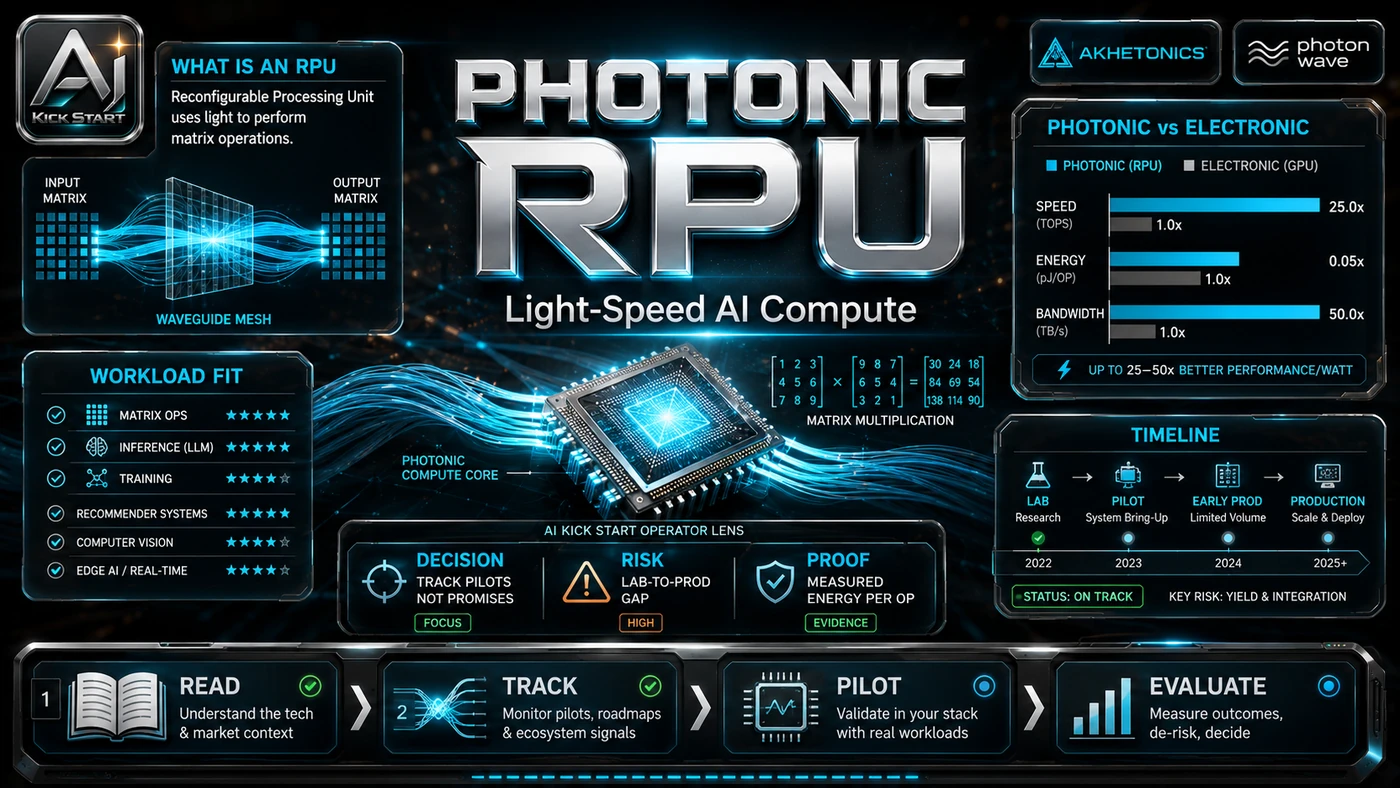


Introduction: Why This One Belongs on the Watchlist
AI workloads are pushing data centre power budgets until energy becomes a binding constraint, and a lower-energy compute paradigm would matter in Australia, where power prices and sustainability reporting shape decisions. The reason it matters for AI Kick Start readers is practical: this is not just another launch to admire from a distance. It changes how founders, operators, and technical teams should think about emerging compute hardware work over the next few months. The source transcript repeatedly centres on photonic computing, RPU and Akhetonics, with the video framing the topic as a practical workflow rather than a detached product announcement. That is the useful lens. The video is worth treating as implementation intelligence: what should be tested, what should be ignored for now, and what should become part of a repeatable operating system. For Australian small businesses and technical teams, the right question is not "is this impressive?" The right question is "where does this reduce friction without creating a larger governance, security, or maintenance problem?"
What the Video Actually Shows
The core pattern is simple: treat photonic compute as a long-range architecture bet, not as a drop-in replacement for Nvidia or AMD this quarter. The video explains the physics case for photonic computing - photons avoid resistance and heat and can be multiplexed - then highlights Akhetonics' February 2024 2-bit CPU demo, its €6 million November 2024 funding round led by Matterway Ventures, and a 2026 target for pilot hardware and "Beast chip" prototype. In practice, that means the update sits inside a broader shift from isolated AI prompts to managed systems. A tool, model, or method only becomes valuable when it has clear inputs, a measurable output, a review path, and a way to repeat the result next week. The video's most useful signal is the workflow shape. The moving parts can be summarised as: Physics case 2024 CPU demo Funding and roadmap Supply-chain framing. That is the level at which teams should evaluate it. A demo can be entertaining, but a workflow must survive messy source files, staff handoff, data boundaries, and real deadlines.
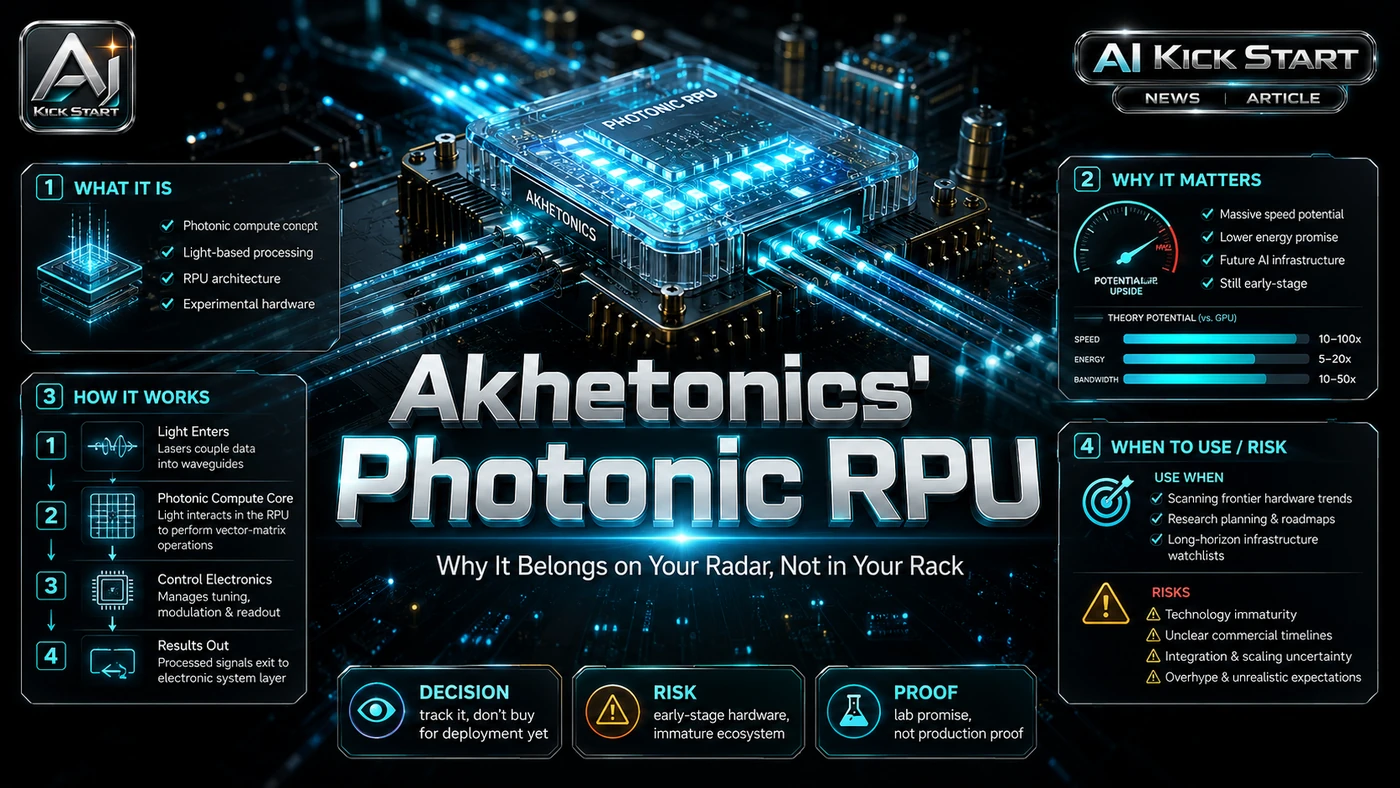
The Implementation Pattern
The first implementation lesson is to narrow the scope. Because Akhetonics is pre-commercial, the pattern is technology-tracking and readiness, so start with one narrow workload where energy and memory bandwidth are the real constraints. Broad adoption is usually where AI systems fail first because nobody knows which decision the tool is allowed to make and which decision still belongs to a human. The second lesson is to create a test harness. Define trigger conditions that would make you evaluate the hardware: a public benchmark on a workload you care about, a priced developer kit, a software stack that compiles your models, or a hostable form factor. A useful harness does not have to be complicated. It can be a short brief, a fixed sample dataset, a few expected outputs, and one person responsible for judging whether the result is good enough. The third lesson is to capture the process. Document how the watchlist is maintained, how vendors are scored, and how review gates are scheduled. When the process is documented, it can become a reusable skill, checklist, prompt pack, repo pattern, or operating procedure. When it is not documented, the team is back to improvising in chat.
Research Update: What To Correct
This update adds a current-source pass rather than treating the original video summary as enough. The important corrections are the product surface, plan or pricing constraints, and what should be verified before a team depends on the workflow. Co-founder and CTO Leonardo Del Bino is not "Del Vecchio" or "Del Bianco," and CEO Michael Kissner's surname is misspelled. The video calls the product an "XPU," but Akhetonics' current positioning is an RPU (Reasoning Processing Unit); the XPU coordinates memory, network, and RFUs internally. It cites 130 nm, yet Akhetonics now discusses 90 nm, 130 nm, and 250 nm mature nodes. The video's "programmable like a real computer" claim lacks detail; Akhetonics has since published a custom ISA, an LLVM/SPIR-V-compatible compiler path, and a C++ toolchain running a Doom demo. It cites total funding around $9 million, but the November 2024 round was €6 million led by Matterway Ventures with 468 Capital, Bayern Kapital, and Runa Capital. There is no public pricing, no pilot customer list, and no developer kit available.
Practical Setup and How-To
The useful next step is a controlled pilot with a named owner, fixed inputs, a measurable output, and a review point. Use the sequence below as the first implementation path before expanding the workflow. Create a one-page vendor dossier covering approach, node strategy, software interface, funding stage, and announced pilots. Map your workloads to find where energy and memory bandwidth are constrained, typically inference, embeddings, or optimisation. Compile a portability check through ONNX Runtime, MLIR, or SPIR-V, noting Akhetonics' LLVM and SPIR-V support. Run an energy baseline for one representative workload. Sign up for updates and assign a watchlist owner.
Pricing, Access, and Comparison Notes
Pricing and access should be checked at implementation time because AI products change quickly. The safer decision is to compare the tool against the job-to-be-done, not against launch hype. There is no public pricing and no general availability; Akhetonics is in the prototype-and-pilot phase, with first-generation hardware expected to reach pilot customers ahead of a fuller prototype in 2026, so Australian teams have nothing to procure and any business case should be scenario planning. Akhetonics is not the only photonic compute play: Lightmatter and Luminous Computing are further along in capital and target optical interconnects and AI accelerators; Optalysys and Q.ANT (the transcript's "Qdot") work on photonic computing for HPC and supercomputing; and traditional silicon remains the only proven and supportable option for production AI today. Akhetonics' distinguishing bet is the general-purpose processor claim and the mature-node, European supply chain, which is also what makes it higher risk as it tries to solve control flow, memory, and programmability in optics. Access Plan, preview status, region, account type, admin controls, and rate limits. Cost Subscription, credits, API tokens, retries, hardware, review time, and support burden. Fit Workflow reliability, data handling, output quality, observability, and human approval needs.
Implementation Notes for Teams
For AI Kick Start readers, this is the production filter: keep the first rollout narrow, make the evidence visible, and do not let the tool cross a business boundary until the review model is clear. Keep your current stack on proven hardware; photonic compute is a future option, not a present requirement. Do document assumptions; ask for workload, benchmark, and supplier contract for 10x claims. Do treat sovereignty as a secondary benefit; the European supply chain is interesting for resilience, but do not over-weight it unless compliance requires non-Asian silicon. Do watch the software interface: a chip that requires rewriting models in a proprietary language is a hard adoption, while one that accepts C++ through LLVM/SPIR-V is a softer landing. Do set a kill date, and drop Akhetonics from active tracking if it has not released a developer kit or relevant public benchmark within your horizon.
Screenshot and Visual Guidance
The second inline image for this article should make the implementation concrete: a clean emerging-technology watchlist with a labelled Akhetonics dossier, an energy-baseline chart, a trigger-condition checklist, and a six-month review gate. If the team is documenting a real rollout, capture setup screens, before/after outputs, permission settings, cost meters, and review evidence rather than decorative screenshots. The most useful visuals are the architecture diagrams on Akhetonics' technology page: the RPU/XPU/RFU hierarchy, the optical memory layout, and the software stack diagram.
Where It Fits for Real Teams
For founders, the opportunity is speed with evidence. This kind of workflow can reduce the time between idea and first useful output, but it should still produce artefacts that a customer, manager, or developer can inspect. For operators, the value is consistency. If the same task is done slightly differently every time, AI can either make the inconsistency worse or help standardise the path; the difference is whether the workflow has rules, examples, and review checkpoints. For technical teams, the value is leverage. A strong setup lets agents, models, or creative systems take on repeatable work while engineers keep control over architecture, security, deployment, and final judgement. The practical fit is strongest when the task has clear source material, a known output format, and a low-cost way to verify quality. It is weaker when the task is vague, politically sensitive, legally risky, or dependent on facts that cannot be checked. For most Australian organisations, Akhetonics belongs in the "monitor" bucket.
Trade-offs and Risks
The main risk is over-optimistic scaling from a 2-bit proof of concept to a competitive general-purpose processor. That risk can be managed, but only if it is named before the workflow becomes normal. A second risk is benchmark inflation. AI systems often look better in a screen recording than they feel inside a production workflow. The test is whether the result is repeatable when the source material changes, the operator changes, and the deadline is real. A third risk is ecosystem immaturity. This is why AI Kick Start generally recommends a staged rollout: sandbox first, internal use second, customer-facing deployment last.
The Next Sensible Test
The next sensible test is a small controlled implementation. Pick one workflow, one owner, one expected output, and one acceptance check. Run it twice. If the second run is easier than the first, the pattern is worth keeping. Do not judge the workflow by the best possible demo. Judge it by the worst acceptable production case. Ask: what happens when the source file is incomplete, the tool is unavailable, the output is wrong, or a staff member needs to explain the result to a customer? If those answers are clear, this belongs in the roadmap. If they are not, it belongs in the lab until the operating model catches up.