


Analysis
The most-used AI tool on the planet probably isn't the one you'd guess. It isn't ChatGPT, and it isn't a search engine. It's the coding assistant that quietly sits inside a developer's editor and finishes their work as they type.
If you run a business, this matters even if nobody on your team writes code. The tools that build your software are getting cheaper to operate, faster to ship with, and harder for any one vendor to own. That changes who you buy from, how much you pay, and how quickly your suppliers can turn an idea into a working feature.
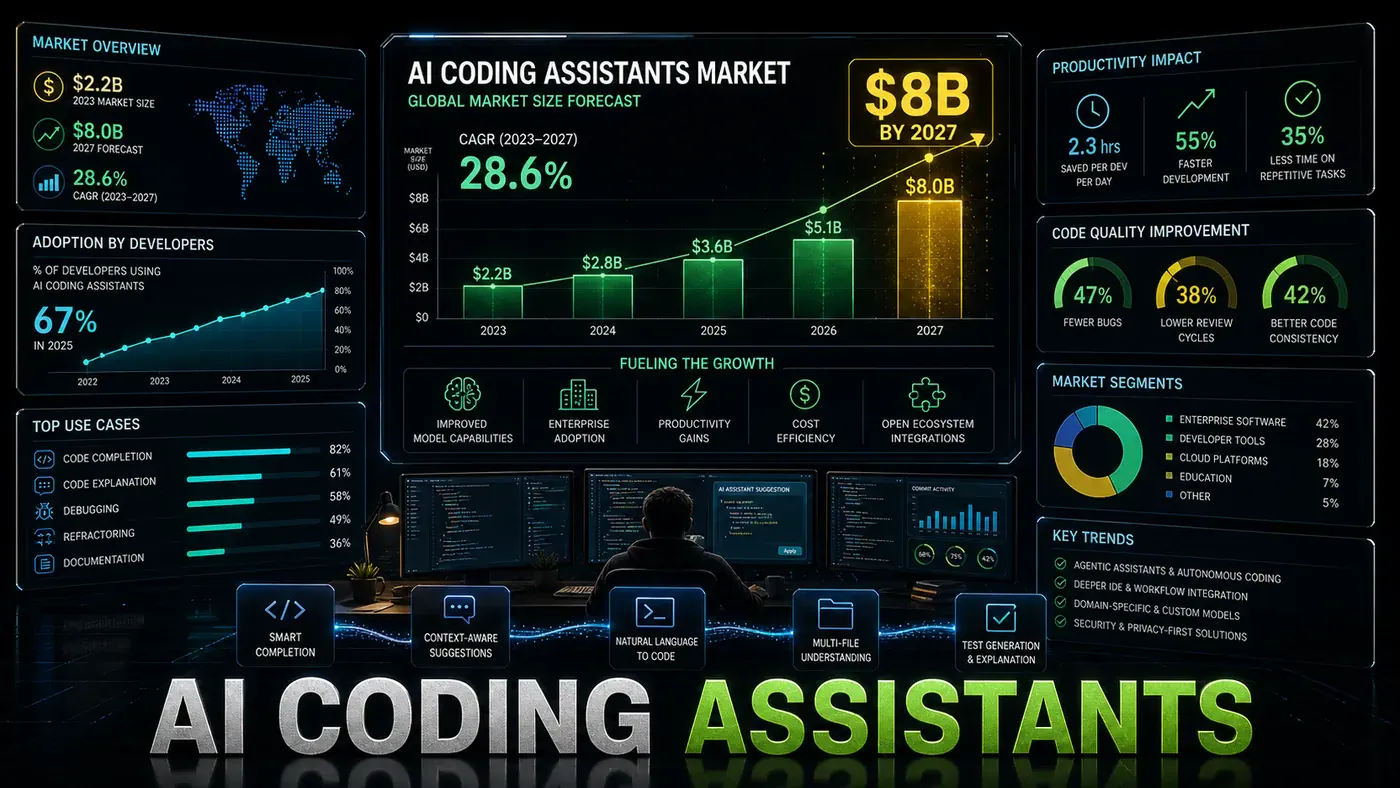
Here's the short version of the story: a market that was barely a rounding error two years ago is now worth billions, and the big platform owners (Microsoft, Google, Amazon, Apple) are racing to fold this capability into products you already use. The numbers below come with caveats, and we'll flag them as we go. But the direction is not in dispute.
The Adoption Drivers
A few things are behind the jump. The first is that the models got a lot better. Two years ago, coding assistants were glorified autocomplete: handy for finishing a line, occasionally useful on a small function, and wrong often enough that you couldn't trust them on anything hard. The newer models are a different animal. Tools built on Claude Opus 4.8 (opens in a new tab), which scores 69.2% on the SWE-bench Pro benchmark (SWE-bench Pro Leaderboard, morphllm (opens in a new tab)), Kimi K2.7-Code, and GPT-5.5 (opens in a new tab) at 58.6% on the same benchmark (Introducing GPT-5.5, OpenAI (opens in a new tab)) can write whole functions from a plain description, chase a bug across several files, and walk you through legacy code the way a senior engineer would. Worth noting: Kimi K2.7-Code's own published SWE-bench Pro figure is 58.6%, not the 64.8% sometimes quoted (Kimi K2.7-Code benchmarks, digitalapplied (opens in a new tab)), and all three scores are vendor-reported rather than independently audited, so treat them as a rough capability signal, not gospel.
The second driver is that enterprise buyers have moved from dabbling to committing. Back in 2024, most of the usage came from individual developers or small teams paying out of pocket. By 2026, a reported majority of large enterprises have rolled these tools out across whole organisations rather than leaving it to individuals. (The widely cited "over 60% of Fortune 500 with organisation-wide deployments" figure isn't directly confirmed; related numbers exist, such as Cursor's claim that 67% of the Fortune 500 use it, but they measure slightly different things, per Sacra (opens in a new tab).) Either way, the purchase decision has shifted from a developer expensing a $20-a-month subscription to a CTO signing a six-figure annual contract.
The third is how deep the integration now runs. Early assistants lived in a separate window. The current crop sit inside the editor, the code review process, the build pipeline, and the documentation. That's what turns them from a nice-to-have into something a team would feel the loss of. A developer with an integrated assistant is measurably faster than one without.
The Key Players
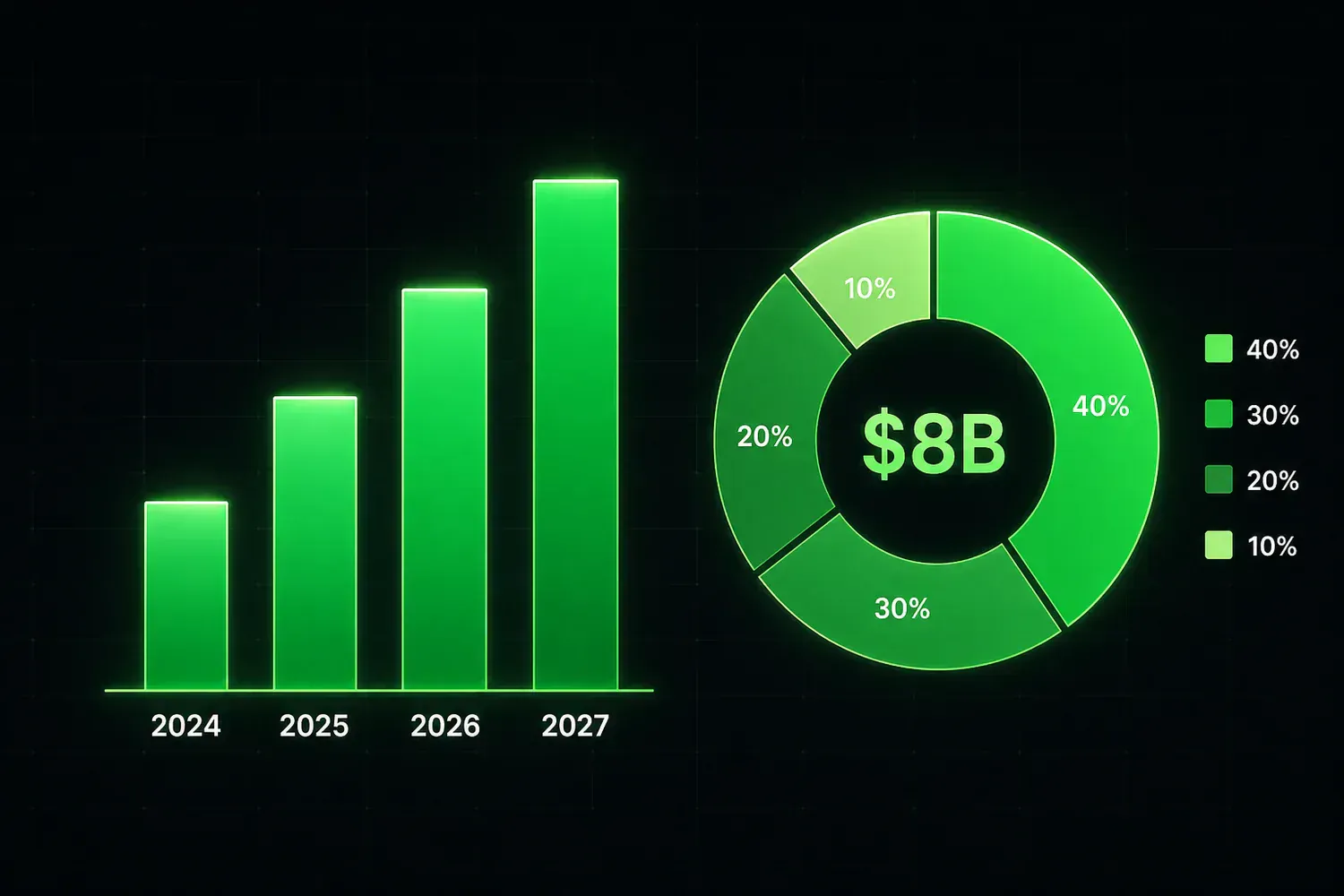
GitHub Copilot (opens in a new tab), running on OpenAI models, is still out front with an estimated 45% of the market, though most 2026 sources land closer to 42% (GitHub Copilot Statistics 2026, getpanto (opens in a new tab)). Microsoft's distribution is the reason: GitHub's 100 million-plus developers and VS Code's dominant share of editors give it a head start rivals find hard to close (GitHub Copilot Statistics 2026, getpanto (opens in a new tab)). Copilot's annual revenue is often quoted at $2.5-3.0 billion, but that figure blends products together; analyst estimates put GitHub Copilot itself at around $1 billion in annual recurring revenue, with the larger number covering all of Microsoft's Copilot lines (GitHub Copilot Statistics 2026, getpanto (opens in a new tab)).
Cursor (opens in a new tab), the AI-native editor, has become the strongest challenger. Estimates put it near 18% of the market, and its pitch is deeper AI integration, support for several model providers including Claude, GPT, and Gemini, and an experience built around AI assistance from the start (Sacra (opens in a new tab)). On funding, be careful with the numbers floating around: reporting from April 2026 had Cursor's parent, Anysphere, in talks to raise $2 billion-plus at a valuation near $50 billion, not the $200 million at a $2.6 billion valuation that sometimes gets cited (Cursor in talks to raise $2B+ at $50B valuation, TechCrunch (opens in a new tab)). The $2.6 billion figure was an older Series B valuation from December 2024.
After that the picture gets murkier. Sourcegraph Cody (opens in a new tab) and the tool formerly known as Codeium, now Windsurf (opens in a new tab), are usually placed third and fourth, with rough shares of around 10% and 8%, though those percentages aren't backed by a clear source. Their framing is also dated: Sourcegraph moved Cody to enterprise-only in July 2025, and Codeium rebranded to Windsurf the same year. Both have leaned into enterprise needs: codebase-wide search, security and compliance controls, and fitting into existing toolchains.
The Market Structure Shift
The biggest change isn't who's winning today. It's that the platform owners are building this capability in by default. Google has put AI coding help directly into Android Studio and its cloud IDEs through Gemini Code Assist (ts2.tech (opens in a new tab)). Amazon has folded its assistant deeper into AWS, now under the Amazon Q Developer (opens in a new tab) name (the old "CodeWhisperer" branding was retired back in April 2024). And Apple has added AI coding features to Xcode, opening its tooling to MLX and open-source models at WWDC 2026 (Apple Outlines Major AI and Developer Tool Updates, MacRumors (opens in a new tab); the MLX framework (opens in a new tab) is open source).
That's a problem for the standalone vendors. If every editor and platform ships a capable assistant for free, the market for buying one separately shrinks to teams with needs the defaults can't meet. The standalone tools have two options: match the platforms on integration, or pull ahead on capabilities the platform owners can't easily copy.
AI Coding Assistants: answer-first summary
AI Coding Assistants matters because it can change how Founders and operators plan, build, or govern an tool evaluation workflow. The AI coding assistant market is growing faster than analysts predicted.
The direct answer is this: do not treat the topic as a standalone trend. Treat it as a decision about inputs, outputs, review ownership, data exposure, and whether the workflow produces a result that is faster, safer, or more useful than the current process.
AI Coding Assistants: implementation checklist
- Define the user, job to be done, and success metric for the tool evaluation workflow.
- Collect real examples, policies, source files, customer questions, or search queries before writing prompts or choosing tools.
- Separate low-risk drafts from decisions that need approval, privacy checks, or senior review.
- Document what the AI is allowed to access, what it must not access, and who signs off before production use.
- Review time to value, adoption rate, cost per workflow, quality review score after a small pilot rather than judging the idea from a demo.
This keeps the work practical. It also gives search engines and AI answer engines a clean factual structure: what the topic is, who it helps, what to do next, and which risks matter before implementation.
Decision criteria for AI Coding Assistants
| Decision area | What to check | Production signal |
|---|---|---|
| Intent | Does AI Coding Assistants solve a real workflow problem? | The use case has a named owner and measurable outcome. |
| Data | Can the required data be used safely? | Sensitive data is classified and access is controlled. |
| Quality | Can a reviewer judge the output consistently? | Examples, rubrics, or acceptance criteria exist. |
| Scale | Can the workflow be repeated without hero effort? | The process is documented and can be handed to another team member. |
Practical example for AI Coding Assistants
A small business could use this article to choose one practical test. For example, a manager might take one customer-facing process, one internal document workflow, or one recurring content task and redesign only that step with AI support. The goal is not to automate the whole business at once; it is to learn where AI News creates reliable leverage.
The useful deliverable is a short operating note: the trigger, the source material, the prompt or tool, the review checklist, the escalation rule, and the metric. That note becomes the handover asset for staff training, SEO/GEO content, service delivery, or future agent work.
Risks and controls for AI Coding Assistants
The common failure pattern is moving too quickly from a promising idea into an unmanaged workflow. For AI Coding Assistants, the risk is not only bad output. It can also be unclear data permission, staff confusion, duplicate content, unreviewed customer advice, or a tool that quietly changes cost or capability.
- Control tool sprawl with a named owner, a review step, and written acceptance criteria.
- Control unclear pricing with a named owner, a review step, and written acceptance criteria.
- Control vendor lock-in with a named owner, a review step, and written acceptance criteria.
- Control unreviewed data sharing with a named owner, a review step, and written acceptance criteria.
Measurement plan for AI Coding Assistants
A useful AI or SEO initiative should leave evidence. Track time to value, adoption rate, cost per workflow, quality review score and compare the pilot against the current process. If the measure does not improve, keep the learning but avoid scaling the workflow.
For GEO readiness, the page should also answer the core question directly, define the entities involved, include implementation steps, explain tradeoffs, and link readers to the next relevant AI Kick Start service, guide, tool, or article.
Definitions and entities for AI Coding Assistants
For search, GEO, and staff handover, define the core entities in plain language. In this article the important entities are the workflow owner, the AI tool or model, the source material, the review process, the risk boundary, and the measurable business outcome. Clear definitions make the page easier for people to scan and easier for AI answer engines to quote accurately.
- Workflow owner: the person accountable for deciding whether AI Coding Assistants belongs in the business process.
- Source material: the documents, examples, policies, URLs, prompts, videos, or customer questions that ground the output.
- Review boundary: the point where a human checks accuracy, privacy, brand voice, or customer impact before the result is used.
- Success metric: the measure that proves whether the tool evaluation workflow is worth repeating.
AI Coding Assistants versus doing nothing
Doing nothing is also a decision. The cost may be slow manual work, weaker search visibility, inconsistent advice, duplicated effort, or staff using unmanaged AI tools without a shared process. The practical question is whether a controlled pilot can reduce that cost without creating a larger governance problem.
| Option | When it makes sense | What to watch |
|---|---|---|
| Do nothing | The workflow is rare, low value, or already reliable. | Competitors may improve speed, content depth, or service consistency first. |
| Run a small pilot | The task repeats often and has clear review criteria. | Keep scope tight and measure the result against the current process. |
| Build a production workflow | The pilot is repeatable and risk controls are documented. | Assign ownership, monitoring, training, and a rollback path. |
AI Kick Start handover package for AI Coding Assistants
A production handover should be concrete enough that another person can run it. For AI Coding Assistants, that means a short brief, a workflow map, approved prompts or tool settings, source material, a review checklist, internal links to supporting resources, and a simple measurement sheet. This is the difference between reading about AI and turning it into operational capability.
That packaging also strengthens E-E-A-T. It shows experience through implementation notes, expertise through decision criteria, authoritativeness through source-aware structure, and trust through risks, controls, and review steps. The article becomes useful even if the reader never buys a tool because it helps them make a better operational decision.