





GEO, defined
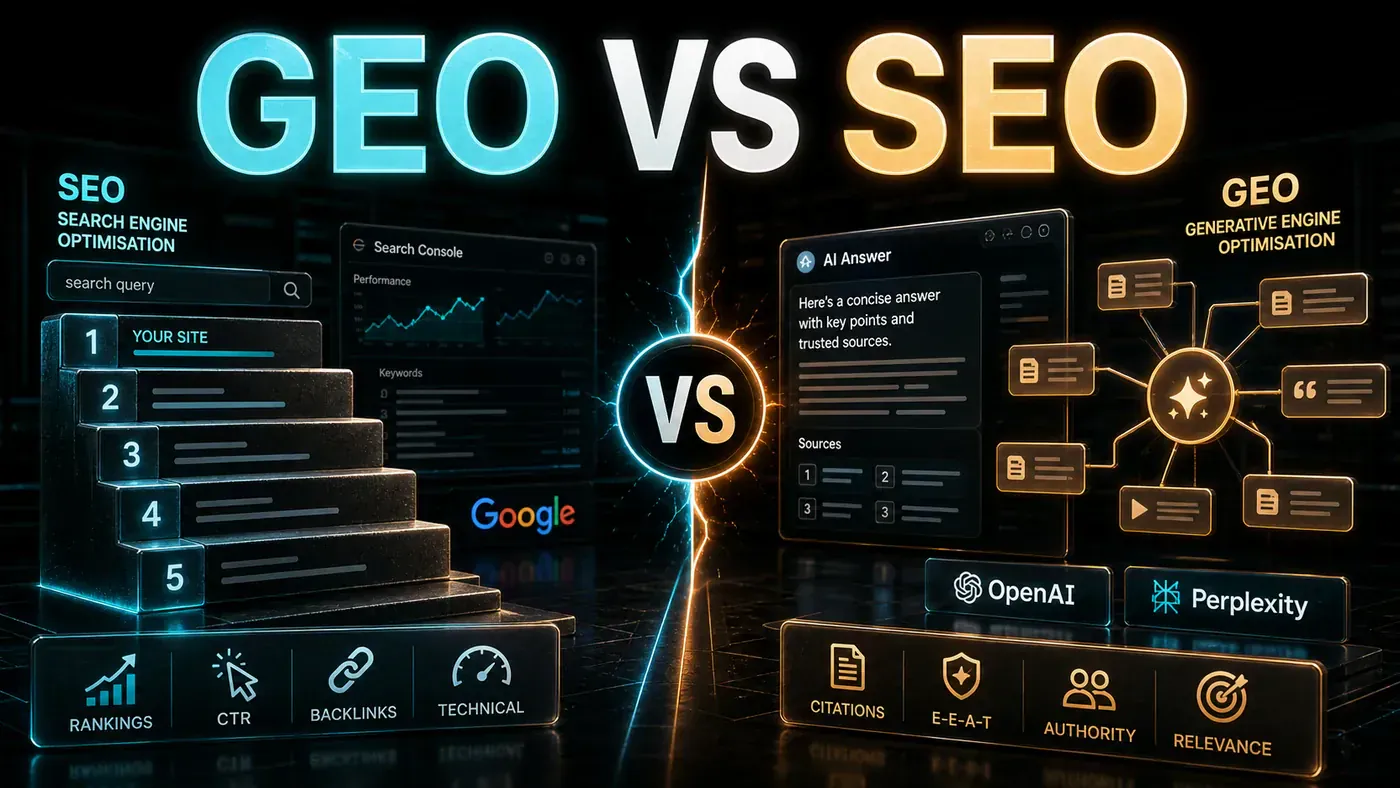
Generative engine optimisation (GEO) is the discipline of structuring a business's content, facts, and online presence so that AI answer engines, ChatGPT, Google AI Overviews, Perplexity, Microsoft Copilot, and Claude, can understand it, trust it, and quote it inside generated answers. The goal is to be a named source in the response a buyer reads, not just a link in a list they may never see.
Why GEO matters for Australian businesses
Adoption is no longer fringe. QuickBooks reports that 69% of Australian small and medium businesses now use AI regularly, 79% of Australian SMBs using AI report productivity gains, and 43% report increased revenue since adopting AI. As those tools sit between buyers and businesses, the answer engine becomes a gatekeeper. When a Wollongong buyer asks an AI assistant to recommend a supplier or explain a service, the businesses that have done GEO well are the ones that get named. For local and national firms alike, this is early-stage visibility that shapes a shortlist before any website visit, which is why we treat it as a core pillar of our SEO/GEO growth service.
Source notes: QuickBooks 2026 AI Impact Report Australia
How AI engines choose and cite sources
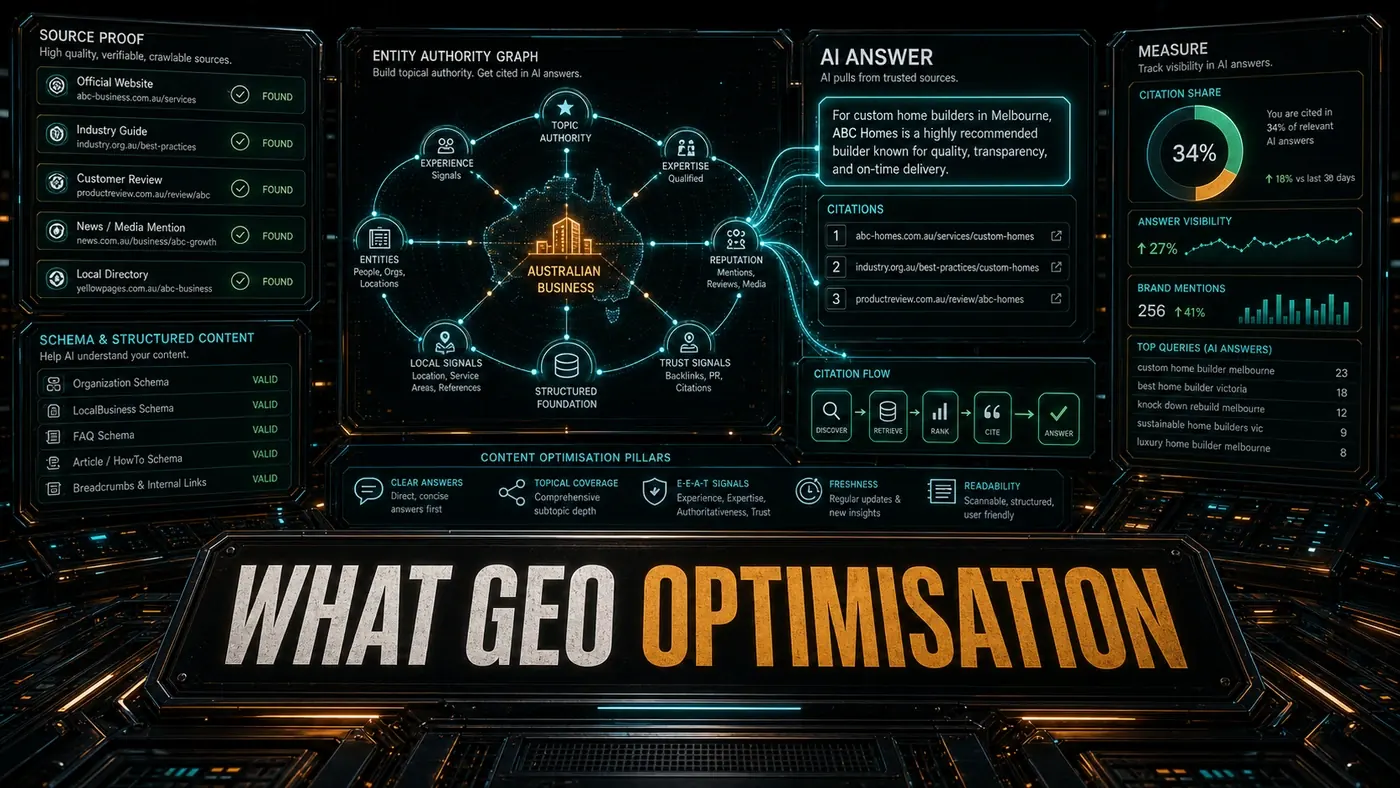
Generative engines do not rank pages the way classic search does. They read a set of candidate sources, often retrieved live from the web, and compose an answer by selecting the passages that are clearest, most specific, and most credibly attributed. Three things drive selection. First, extractability: the engine favours content where the answer is stated plainly and can be lifted without reinterpretation. Second, corroboration: claims that appear consistently across multiple reputable sources are safer to repeat. Third, trust signals: a named author with real expertise, a recognised organisation, and consistent identity information across the web all raise the odds of being quoted. The providers' own developer documentation describes how these retrieval and tool-using systems assemble answers, useful background for anyone shaping content for them.
Source notes: OpenAI platform documentation, Anthropic Claude documentation
Content formats that get cited
Four formats reliably earn citations. Definitions: a crisp, self-contained explanation of a term in the first one or two sentences of a section gives the engine a clean block to quote. Statistics: a specific figure with context, such as an adoption rate, is far more quotable than a vague claim, because the engine can repeat it with attribution. Comparison tables and structured comparisons: when a buyer asks which option is better, the engine reaches for content that has already done the structured comparison. FAQ blocks: a question followed by a direct, complete answer maps exactly onto how a user phrases a query, making it one of the highest-yield formats for GEO. The common thread is that each format hands the engine a finished, attributable answer rather than asking it to synthesise one.
Building your entity
AI engines reason about entities, the recognised thing your business is, not just keywords. Entity building is the work of making that thing unambiguous and consistent everywhere it appears. That means a stable business name, address, and description across your website, Google Business Profile, directories, and social profiles; clear authorship with real credentials, in our case 20-plus years of enterprise IT and a CompTIA A+ background, attached to the content; structured data that tells engines who you are and what you offer; and a consistent narrative about your specialisation. When the same facts about a business appear reliably across many independent sources, an answer engine can quote it with confidence. When they conflict, the engine hedges or picks a competitor whose story is cleaner.
GEO and SEO are one system
GEO does not run on a separate set of pages. The technical SEO foundation, crawlability, fast pages, sound internal linking, and valid structured data, is also what lets answer engines retrieve and understand your content. Google Search Central remains the reference for that foundation, and the structured data it documents does double duty: it helps Search and it helps generative engines parse your facts. Treat GEO as a way of writing and structuring the SEO content you were already going to publish, leading with the extractable answer, then earning the read.
Source notes: Google Search Central helpful content guidance, Google Search Central structured data guide
How to measure GEO
Measurement is younger than SEO analytics, so set honest expectations. Track four things. Citation presence: for your priority queries, how often does your brand appear in the major AI engines' answers? Citation accuracy: when you are cited, is the information correct and current? Answer share of voice: in a given answer, how prominent is your mention against competitors? Referral traffic: what visits do AI engines actually send, increasingly visible in analytics as a distinct source. Sample the major engines regularly for your most important queries, log what you see, and watch the trend over months. The tooling is maturing quickly, but disciplined manual sampling already tells you whether the work is landing.
A practical first 90 days
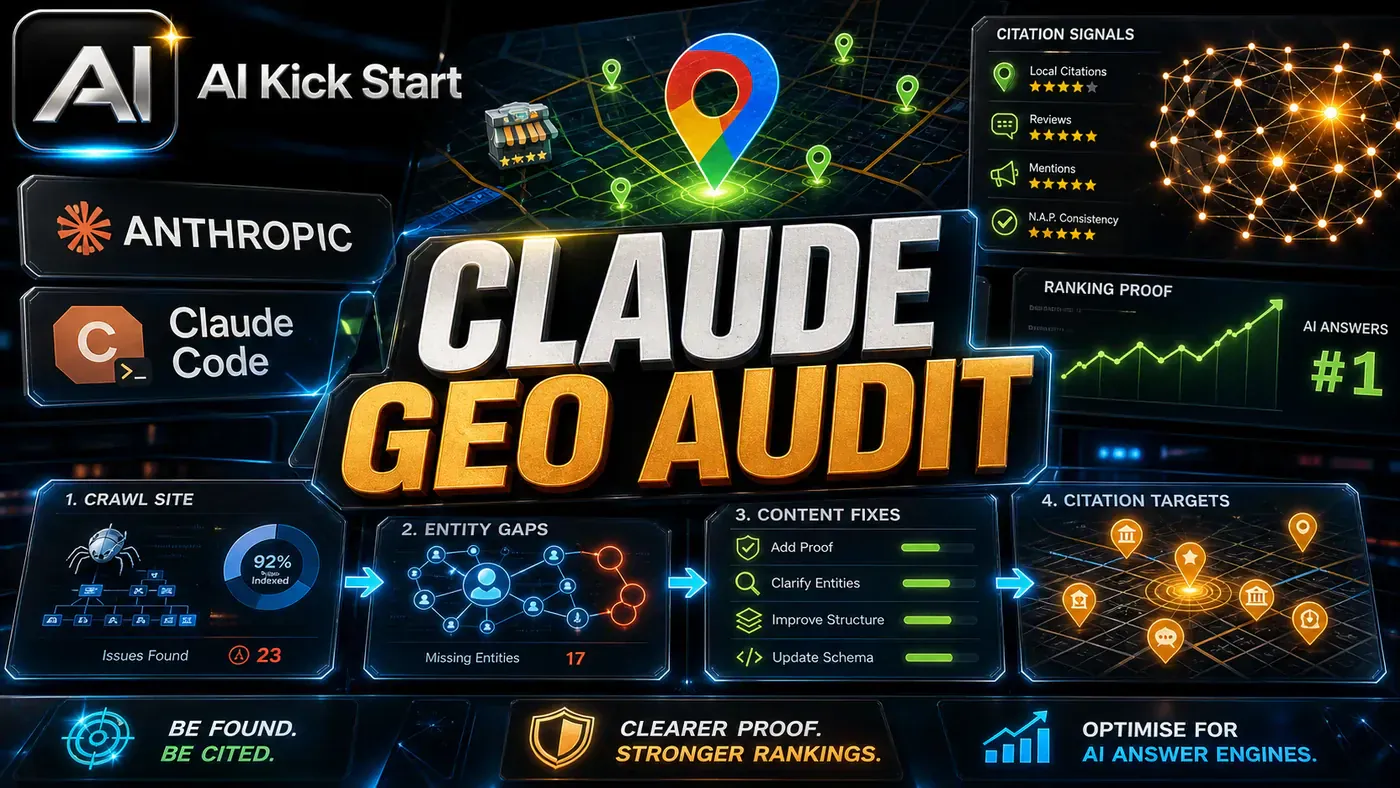
Start narrow. Pick the ten queries that matter most to your business and check how the major AI engines answer them today, recording who gets cited. Rewrite your top commercial pages to lead with a quotable definition, add a credible statistic, include a structured comparison where relevant, and finish with a self-contained FAQ block. Fix your entity basics: consistent name and description everywhere, a real author with credentials, and valid structured data. Then re-sample those ten queries monthly. This is enough to prove the pattern before scaling it across the rest of the site, the same sequencing we use when building an AI roadmap for a business.
What is GEO optimisation? The complete guide for Australian businesses: answer-first summary
What is GEO optimisation? The complete guide for Australian businesses matters because it can change how Australian business owners plan, build, or govern an search and AI-answer workflow. A practical guide to generative engine optimisation: how AI engines cite sources, which content formats get quoted, how to build entity authority, and how to measure it.
The direct answer is this: do not treat the topic as a standalone trend. Treat it as a decision about inputs, outputs, review ownership, data exposure, and whether the workflow produces a result that is faster, safer, or more useful than the current process.
What is GEO optimisation? The complete guide for Australian businesses: implementation checklist
- Define the user, job to be done, and success metric for the search and AI-answer workflow.
- Collect real examples, policies, source files, customer questions, or search queries before writing prompts or choosing tools.
- Separate low-risk drafts from decisions that need approval, privacy checks, or senior review.
- Document what the AI is allowed to access, what it must not access, and who signs off before production use.
- Review indexed pages, qualified clicks, AI citation visibility, conversion paths after a small pilot rather than judging the idea from a demo.
This keeps the work practical. It also gives search engines and AI answer engines a clean factual structure: what the topic is, who it helps, what to do next, and which risks matter before implementation.
Decision criteria for What is GEO optimisation? The complete guide for Australian businesses
| Decision area | What to check | Production signal |
|---|---|---|
| Intent | Does What is GEO optimisation? The complete guide for Australian businesses solve a real workflow problem? | The use case has a named owner and measurable outcome. |
| Data | Can the required data be used safely? | Sensitive data is classified and access is controlled. |
| Quality | Can a reviewer judge the output consistently? | Examples, rubrics, or acceptance criteria exist. |
| Scale | Can the workflow be repeated without hero effort? | The process is documented and can be handed to another team member. |
Practical example for What is GEO optimisation? The complete guide for Australian businesses
A small business could use this article to choose one practical test. For example, a manager might take one customer-facing process, one internal document workflow, or one recurring content task and redesign only that step with AI support. The goal is not to automate the whole business at once; it is to learn where SEO/GEO creates reliable leverage.
The useful deliverable is a short operating note: the trigger, the source material, the prompt or tool, the review checklist, the escalation rule, and the metric. That note becomes the handover asset for staff training, SEO/GEO content, service delivery, or future agent work.
Risks and controls for What is GEO optimisation? The complete guide for Australian businesses
The common failure pattern is moving too quickly from a promising idea into an unmanaged workflow. For What is GEO optimisation? The complete guide for Australian businesses, the risk is not only bad output. It can also be unclear data permission, staff confusion, duplicate content, unreviewed customer advice, or a tool that quietly changes cost or capability.
- Control thin summaries with a named owner, a review step, and written acceptance criteria.
- Control duplicate intent with a named owner, a review step, and written acceptance criteria.
- Control weak entity coverage with a named owner, a review step, and written acceptance criteria.
- Control missing internal links with a named owner, a review step, and written acceptance criteria.
Measurement plan for What is GEO optimisation? The complete guide for Australian businesses
A useful AI or SEO initiative should leave evidence. Track indexed pages, qualified clicks, AI citation visibility, conversion paths and compare the pilot against the current process. If the measure does not improve, keep the learning but avoid scaling the workflow.
For GEO readiness, the page should also answer the core question directly, define the entities involved, include implementation steps, explain tradeoffs, and link readers to the next relevant AI Kick Start service, guide, tool, or article.
Definitions and entities for What is GEO optimisation? The complete guide for Australian businesses
For search, GEO, and staff handover, define the core entities in plain language. In this article the important entities are the workflow owner, the AI tool or model, the source material, the review process, the risk boundary, and the measurable business outcome. Clear definitions make the page easier for people to scan and easier for AI answer engines to quote accurately.
- Workflow owner: the person accountable for deciding whether What is GEO optimisation? The complete guide for Australian businesses belongs in the business process.
- Source material: the documents, examples, policies, URLs, prompts, videos, or customer questions that ground the output.
- Review boundary: the point where a human checks accuracy, privacy, brand voice, or customer impact before the result is used.
- Success metric: the measure that proves whether the search and AI-answer workflow is worth repeating.
What is GEO optimisation? The complete guide for Australian businesses versus doing nothing
Doing nothing is also a decision. The cost may be slow manual work, weaker search visibility, inconsistent advice, duplicated effort, or staff using unmanaged AI tools without a shared process. The practical question is whether a controlled pilot can reduce that cost without creating a larger governance problem.
| Option | When it makes sense | What to watch |
|---|---|---|
| Do nothing | The workflow is rare, low value, or already reliable. | Competitors may improve speed, content depth, or service consistency first. |
| Run a small pilot | The task repeats often and has clear review criteria. | Keep scope tight and measure the result against the current process. |
| Build a production workflow | The pilot is repeatable and risk controls are documented. | Assign ownership, monitoring, training, and a rollback path. |
AI Kick Start handover package for What is GEO optimisation? The complete guide for Australian businesses
A production handover should be concrete enough that another person can run it. For What is GEO optimisation? The complete guide for Australian businesses, that means a short brief, a workflow map, approved prompts or tool settings, source material, a review checklist, internal links to supporting resources, and a simple measurement sheet. This is the difference between reading about AI and turning it into operational capability.
That packaging also strengthens E-E-A-T. It shows experience through implementation notes, expertise through decision criteria, authoritativeness through source-aware structure, and trust through risks, controls, and review steps. The article becomes useful even if the reader never buys a tool because it helps them make a better operational decision.