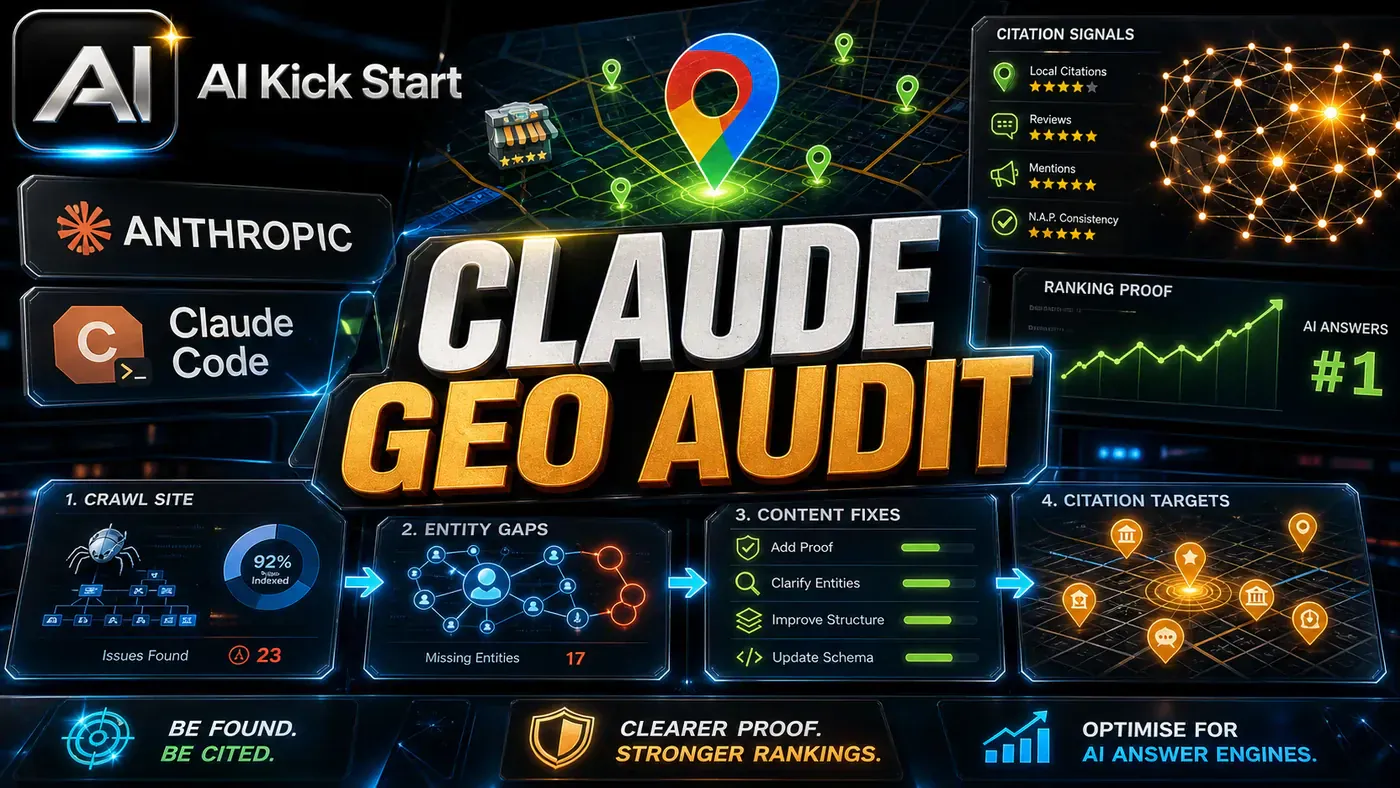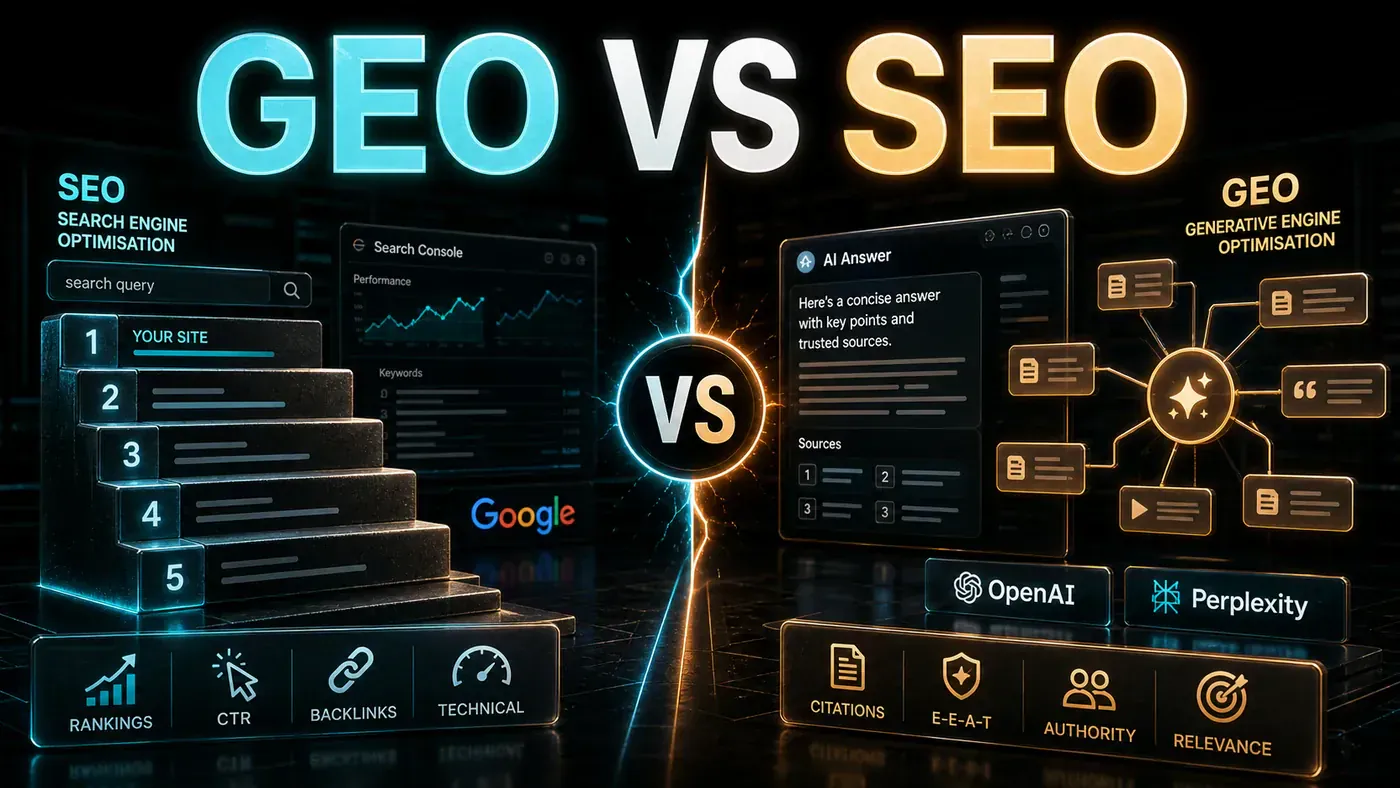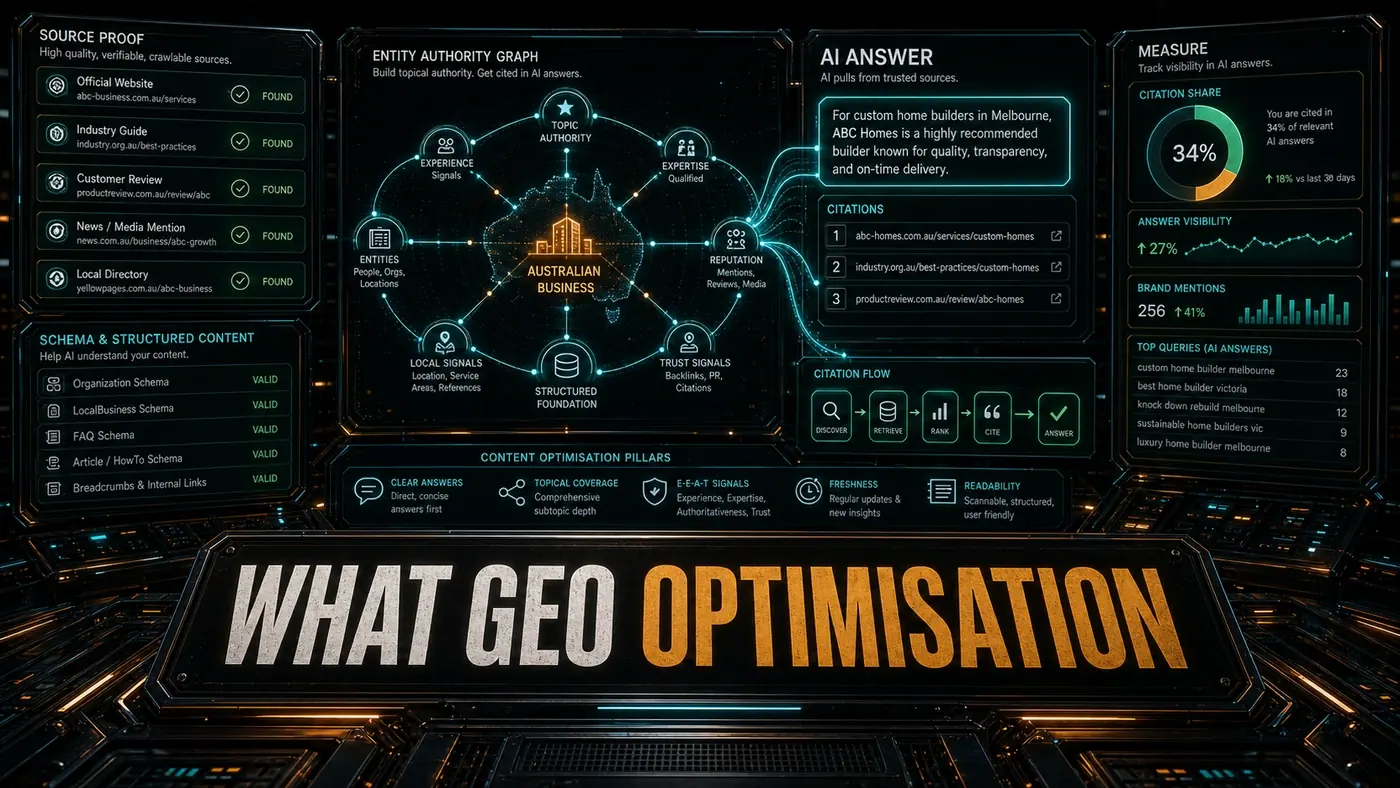

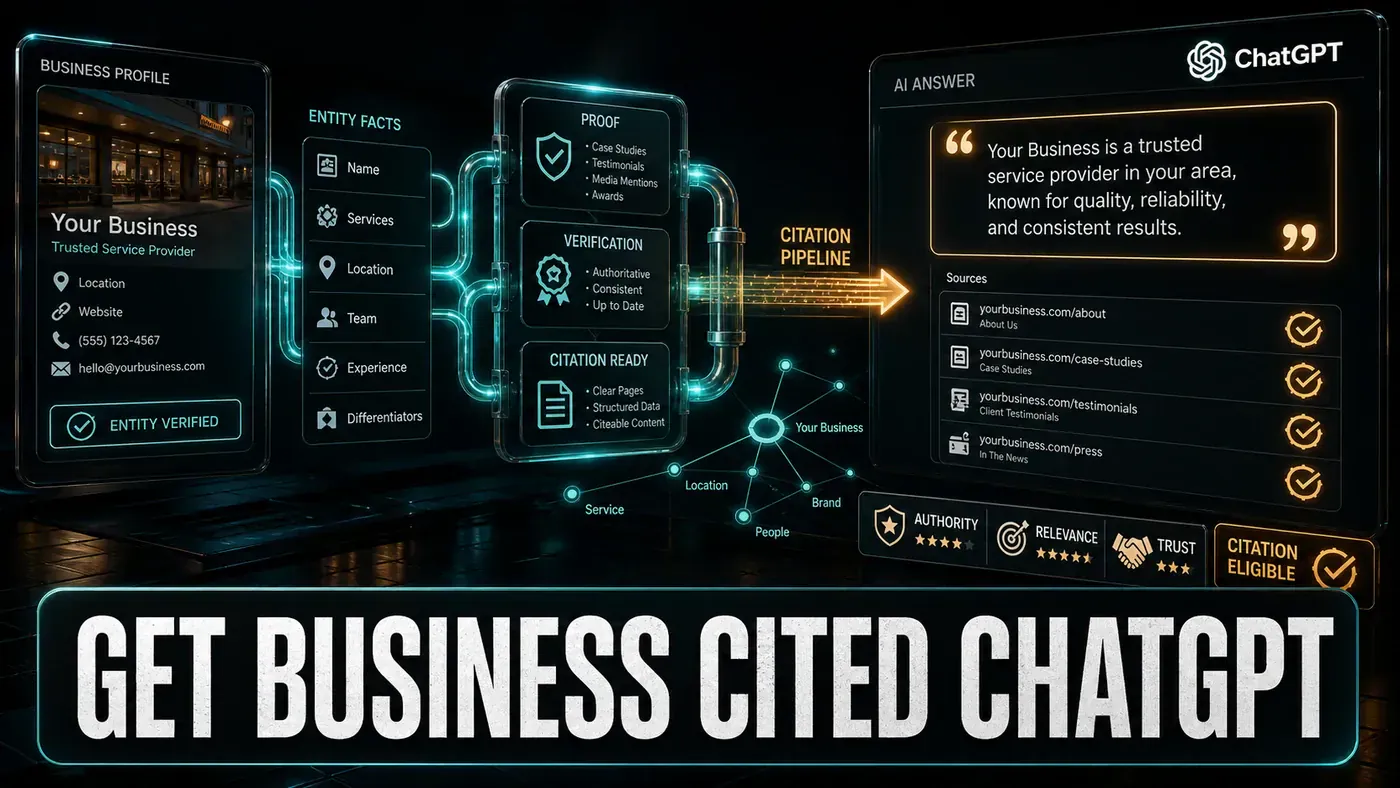





Start with the question customers ask
Your future customer may not search Google first. They may ask ChatGPT, Claude, Gemini, or Perplexity something like: who is the best AI automation consultant in Australia, which agency builds secure document AI, or what local provider can help with n8n automations. The work is to make your business easy to describe accurately when an answer engine tries to assemble a recommendation.
Build a clear entity profile
AI systems need consistent facts. Put the same business name, location, services, founder details, industries served, proof points, contact details, and service areas across your own site, directory profiles, social bios, and public references. Do not bury the basics in vague brand copy. A clear entity profile helps machines connect AI Kick Start, Daniel Fleuren, Wollongong, Sydney, AI automation, secure local AI, training, and SEO/GEO into one coherent business.
Create definition-ready content
Write pages that answer the obvious definition questions in plain language: what is secure document AI, what is generative engine optimisation, what is an AI workflow audit, what is an AI agent system. The best pages explain the concept, who it is for, when it is risky, how it is implemented, and what a first step looks like. Answer engines often cite content that can be lifted into a concise explanation without needing a sales translation.
Source notes: Google Search Central helpful content guidance
Use comparison tables
Comparison tables help both readers and AI systems understand your category. Compare cloud AI with secure local AI, chatbot with single agent and multi-agent system, Zapier with Make and n8n, or DIY tools with a guided implementation sprint. Make the differences concrete: data location, governance, cost shape, maintenance owner, review process, and best-fit use case. This gives the answer engine useful structure instead of generic claims.
Publish statistics and first-hand proof
AI answer engines reward specific, attributable detail. Publish measured results, screenshots, case-study facts, workflow counts, time saved, page families, and lessons learned from real builds. Avoid pretending every result is universal. A credible sentence such as a reporting workflow dropped from five hours to under one hour is more useful than a vague promise to transform productivity.
Get listed everywhere that makes sense
Your own website is only one source. Keep LinkedIn, Google Business Profile, local directories, partner pages, tool directories, podcast notes, event bios, GitHub profiles, and client references consistent. The goal is not spam. The goal is a healthy public footprint where independent references describe the same services and expertise in similar language.
Generate natural mentions
Useful mentions come from doing visible work: publishing practical guides, contributing to communities, building public templates, speaking at events, sharing real implementation notes, and earning client references. GEO is not a trick for forcing citations. It is a discipline for making the business clearer, more useful, and easier to verify.
Make the page easy to cite
Every GEO page should have a clear title, a concise summary, a useful H1, structured sections, FAQs, internal links, author details, updated dates, and links to relevant source material where claims need support. Keep the copy specific enough for humans and structured enough for machines. That is the overlap where citations start to happen.
Source notes: Google Search Central structured data guide
How to get your business cited in ChatGPT and Claude: answer-first summary
How to get your business cited in ChatGPT and Claude matters because it can change how Founders, marketers, and service businesses plan, build, or govern an search and AI-answer workflow. A practical GEO guide for becoming easier for AI answer engines to understand, compare, and cite when customers ask for recommendations.
The direct answer is this: do not treat the topic as a standalone trend. Treat it as a decision about inputs, outputs, review ownership, data exposure, and whether the workflow produces a result that is faster, safer, or more useful than the current process.
How to get your business cited in ChatGPT and Claude: implementation checklist
- Define the user, job to be done, and success metric for the search and AI-answer workflow.
- Collect real examples, policies, source files, customer questions, or search queries before writing prompts or choosing tools.
- Separate low-risk drafts from decisions that need approval, privacy checks, or senior review.
- Document what the AI is allowed to access, what it must not access, and who signs off before production use.
- Review indexed pages, qualified clicks, AI citation visibility, conversion paths after a small pilot rather than judging the idea from a demo.
This keeps the work practical. It also gives search engines and AI answer engines a clean factual structure: what the topic is, who it helps, what to do next, and which risks matter before implementation.
Decision criteria for How to get your business cited in ChatGPT and Claude
| Decision area | What to check | Production signal |
|---|---|---|
| Intent | Does How to get your business cited in ChatGPT and Claude solve a real workflow problem? | The use case has a named owner and measurable outcome. |
| Data | Can the required data be used safely? | Sensitive data is classified and access is controlled. |
| Quality | Can a reviewer judge the output consistently? | Examples, rubrics, or acceptance criteria exist. |
| Scale | Can the workflow be repeated without hero effort? | The process is documented and can be handed to another team member. |
Practical example for How to get your business cited in ChatGPT and Claude
A small business could use this article to choose one practical test. For example, a manager might take one customer-facing process, one internal document workflow, or one recurring content task and redesign only that step with AI support. The goal is not to automate the whole business at once; it is to learn where SEO/GEO creates reliable leverage.
The useful deliverable is a short operating note: the trigger, the source material, the prompt or tool, the review checklist, the escalation rule, and the metric. That note becomes the handover asset for staff training, SEO/GEO content, service delivery, or future agent work.
Risks and controls for How to get your business cited in ChatGPT and Claude
The common failure pattern is moving too quickly from a promising idea into an unmanaged workflow. For How to get your business cited in ChatGPT and Claude, the risk is not only bad output. It can also be unclear data permission, staff confusion, duplicate content, unreviewed customer advice, or a tool that quietly changes cost or capability.
- Control thin summaries with a named owner, a review step, and written acceptance criteria.
- Control duplicate intent with a named owner, a review step, and written acceptance criteria.
- Control weak entity coverage with a named owner, a review step, and written acceptance criteria.
- Control missing internal links with a named owner, a review step, and written acceptance criteria.
Measurement plan for How to get your business cited in ChatGPT and Claude
A useful AI or SEO initiative should leave evidence. Track indexed pages, qualified clicks, AI citation visibility, conversion paths and compare the pilot against the current process. If the measure does not improve, keep the learning but avoid scaling the workflow.
For GEO readiness, the page should also answer the core question directly, define the entities involved, include implementation steps, explain tradeoffs, and link readers to the next relevant AI Kick Start service, guide, tool, or article.
Definitions and entities for How to get your business cited in ChatGPT and Claude
For search, GEO, and staff handover, define the core entities in plain language. In this article the important entities are the workflow owner, the AI tool or model, the source material, the review process, the risk boundary, and the measurable business outcome. Clear definitions make the page easier for people to scan and easier for AI answer engines to quote accurately.
- Workflow owner: the person accountable for deciding whether How to get your business cited in ChatGPT and Claude belongs in the business process.
- Source material: the documents, examples, policies, URLs, prompts, videos, or customer questions that ground the output.
- Review boundary: the point where a human checks accuracy, privacy, brand voice, or customer impact before the result is used.
- Success metric: the measure that proves whether the search and AI-answer workflow is worth repeating.
How to get your business cited in ChatGPT and Claude versus doing nothing
Doing nothing is also a decision. The cost may be slow manual work, weaker search visibility, inconsistent advice, duplicated effort, or staff using unmanaged AI tools without a shared process. The practical question is whether a controlled pilot can reduce that cost without creating a larger governance problem.
| Option | When it makes sense | What to watch |
|---|---|---|
| Do nothing | The workflow is rare, low value, or already reliable. | Competitors may improve speed, content depth, or service consistency first. |
| Run a small pilot | The task repeats often and has clear review criteria. | Keep scope tight and measure the result against the current process. |
| Build a production workflow | The pilot is repeatable and risk controls are documented. | Assign ownership, monitoring, training, and a rollback path. |
AI Kick Start handover package for How to get your business cited in ChatGPT and Claude
A production handover should be concrete enough that another person can run it. For How to get your business cited in ChatGPT and Claude, that means a short brief, a workflow map, approved prompts or tool settings, source material, a review checklist, internal links to supporting resources, and a simple measurement sheet. This is the difference between reading about AI and turning it into operational capability.
That packaging also strengthens E-E-A-T. It shows experience through implementation notes, expertise through decision criteria, authoritativeness through source-aware structure, and trust through risks, controls, and review steps. The article becomes useful even if the reader never buys a tool because it helps them make a better operational decision.