







Briefing
For most of the last year and a half, if you wanted an AI coding agent that lived in your terminal rather than your editor, Claude Code was effectively the only grown-up in the room. GitHub Copilot rides inside your editor. Cursor wraps a whole IDE around the model. Neither is the same kind of tool. Then a project called the Pi Coding Agent turned up, and suddenly the category had a second name worth saying out loud.
A quick but important caveat before we go further. There has been confusion about who actually makes Pi. The Pi Coding Agent that developers are talking about is an open-source terminal harness built by Armin Ronacher and Mario Zechner, hosted on GitHub under earendil-works/pi (opens in a new tab). It is not, despite some early reporting, a product from Inflection AI. Inflection has its own unrelated "Pi", an empathetic consumer chatbot, and the two get muddled constantly. Where the original version of this piece tied Pi to an "Inflection Flow" team, treat that as unconfirmed at best: we found no evidence such a division or platform exists.
So the honest framing is simpler than the rumour mill. A small, opinionated open-source tool has shown up in the same space as a polished commercial one, and the comparison is genuinely useful for anyone deciding how to put an AI agent to work. Here is how the two differ in practice.
The Pi Approach
Pi is deliberately minimal and opinionated. Its maintainers have written openly about building a small, focused coding agent (opens in a new tab) rather than a kitchen-sink platform. That philosophy shows up everywhere, from how it manages context to how it handles errors.
One way to feel the difference: Claude Code is built to execute and show you the result. Reportedly Pi leans more toward narrating what it is doing as it goes, telling you why it picked one approach, asking when something is ambiguous, and summarising what changed. Some engineers find that verbose. Others find it transparent in a way that earns trust. Worth noting, though, that the real Pi explicitly skips some of Claude Code's heavier machinery, including plan mode and sub-agents, so "more conversational" and "fewer guardrails" can be the same trade.
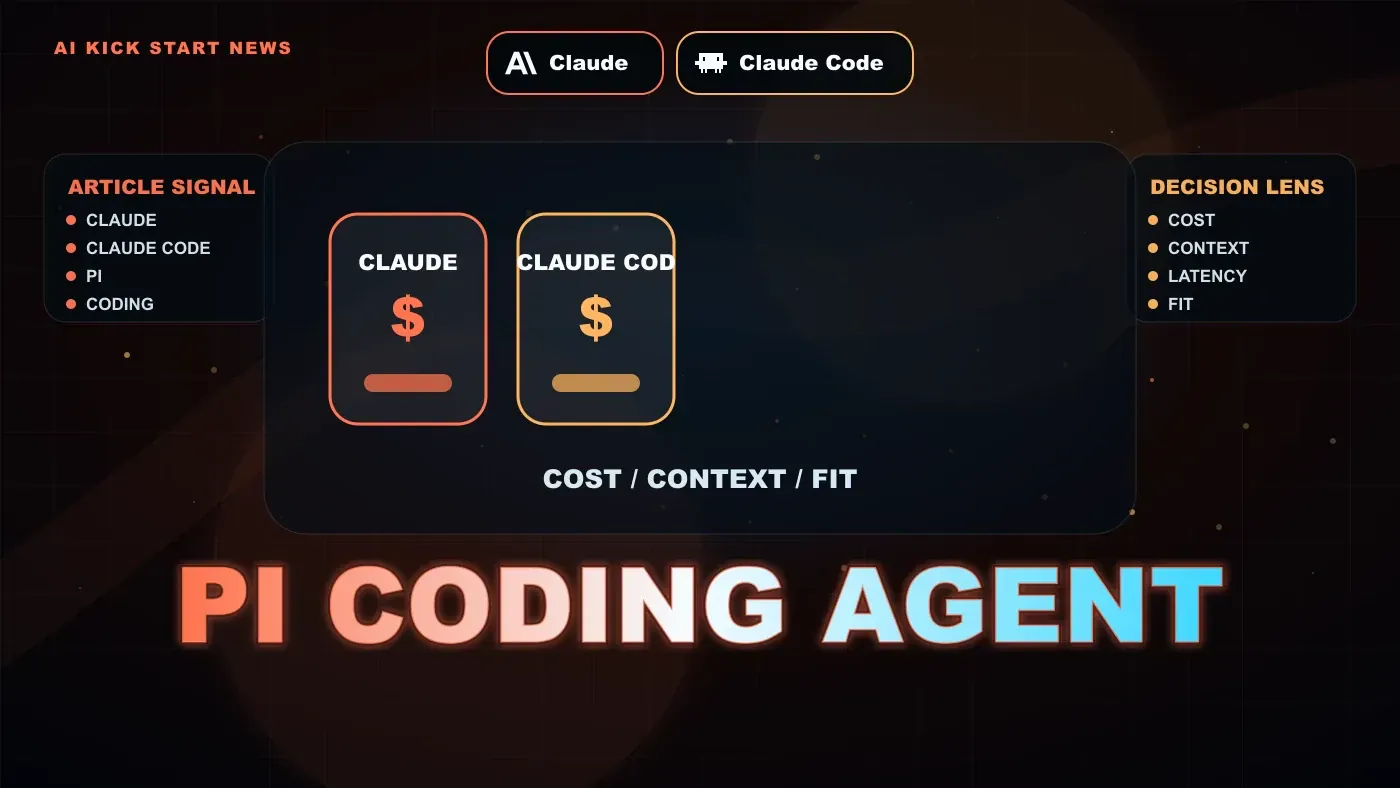
Context Management: Conversation vs. State
Claude Code manages context through a documented Plan Mode (opens in a new tab) workflow plus task and agent systems that track state, alongside explicit file references. The practical upshot is that Claude Code tends to do well on long, complex jobs where keeping precise state matters. A tool built around lighter, conversation-style context does better on exploratory work where the goal shifts as you talk.
Take a migration touching 30 files. A structured task system can track exactly which files were changed, which tests were updated, and what is left. A more conversational approach leans on summarising history, which can lose precision at that scale. Flip it around to a brainstorming session on API design and the conversational style wins, because the back-and-forth surfaces trade-offs you would not have prompted for.
Tool Use and Integration
Pi ships a deliberately small tool core. Per its coding-agent README (opens in a new tab), that core is essentially four tools, Read, Write, Edit, and Bash, with the agent extending itself through TypeScript extensions and skills. That roughly lines up with what Claude Code offers at the basic level: file read/write, shell execution, code search, and test running.
Pi's tool calling is reportedly compatible with the Model Context Protocol (MCP), and an MCP registry reference does appear in its ecosystem, which suggests MCP-style tools built for one agent can often work with the other with little change.
The original article also claimed Pi could reach outside the codebase into calendar, email, and documents through an "Inflection Flow platform". We could not verify any such platform or capability, and the real Pi is a local terminal harness that talks to LLM providers. Treat the cross-context feature as unconfirmed; there is no evidence it exists.
Terminal Experience
Both agents live in the terminal, but they feel different to use. Claude Code's interface is compact and command-oriented, built for speed. Pi's is more verbose and chat-like, built for clarity. If you are used to typing claude "fix the bug" and reading a diff, Pi will feel slow. If you are used to explaining a problem in full sentences, the command-style approach will feel abrupt.
# Claude Code: compact, imperative
claude "refactor auth.ts to use async/await"

# Pi: conversational, exploratory
pi "I'm thinking about refactoring auth.ts to use async/await. The current
 callback pattern is causing promise chain issues in the middleware.
 What do you think?"
Pricing and Availability
This is where the original framing breaks down hardest, so be careful. The real Pi Coding Agent is open-source and provider-agnostic, meaning it works across Anthropic, OpenAI, Google, xAI and others rather than bundling one vendor's models. Claims that Pi has a paid "individual plan" with "Inflection's latest models", or a "team plan expected in Q3 2026", are unconfirmed and appear to be invented; there is no evidence of any such subscription. If you want to look at the project directly, start at its GitHub repository (opens in a new tab).
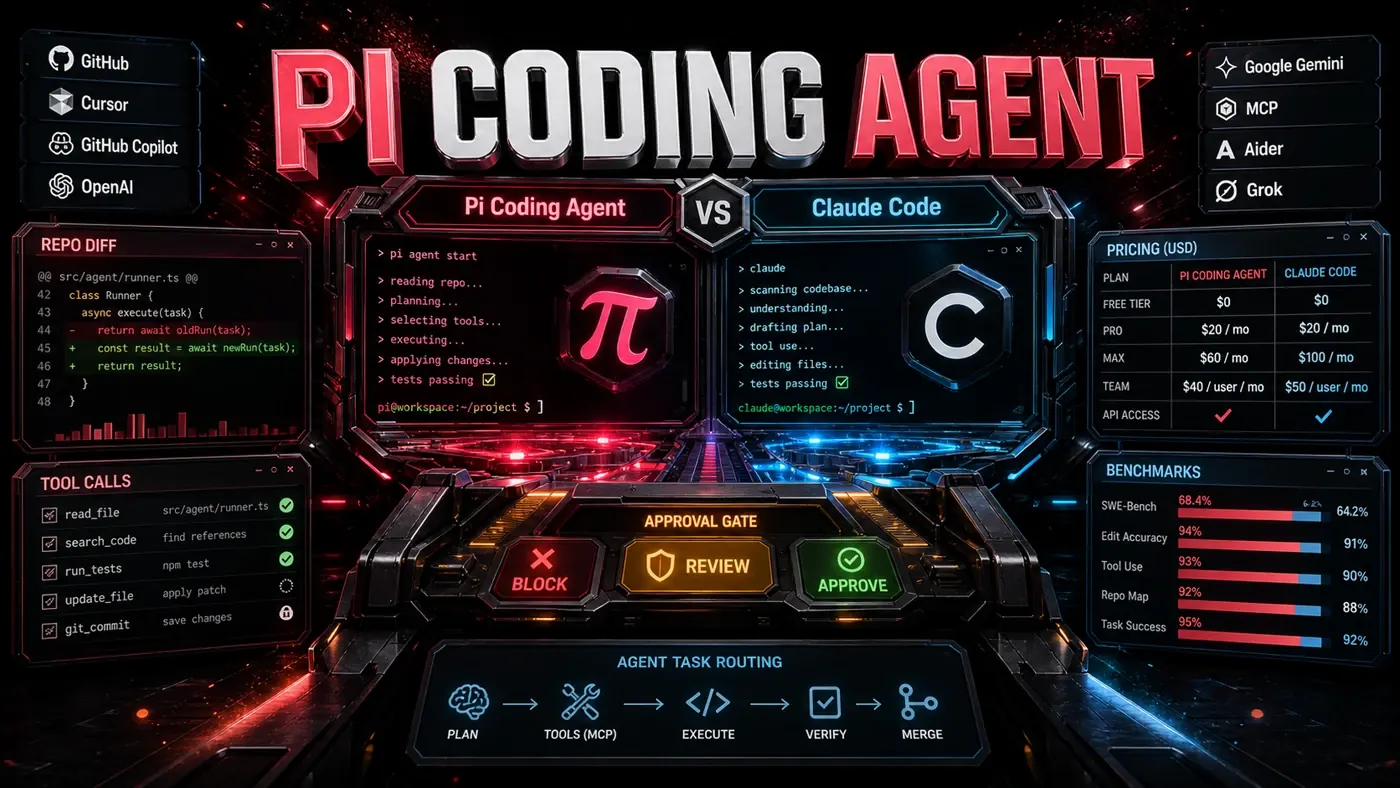
For comparison on the commercial side, Claude Code does have paid tiers. Pricing roundups put a Claude Code team plan at roughly $100 per seat per month in 2026 (Source: Claude Code Pricing in 2026, SSD Nodes (opens in a new tab)), though the exact figure shifts by source and tier. Anthropic's own cost documentation (opens in a new tab) is the place to confirm current numbers.
When to Choose Which
Choose Claude Code when:
- Tasks are complex and well-defined (migrations, refactors, large features)
- You want Plan Mode's structured approval workflow
- Your team already uses Anthropic models
- You value speed and compactness over narration
Choose Pi when:
- Tasks are exploratory or ambiguous (API design, architecture calls)
- You want a small, open-source, provider-agnostic tool you can extend yourself
- You prefer conversational interaction over command-based
- You value reasoning transparency over execution speed
A worthwhile correction to the "no real competition" line: by 2026 the terminal had plenty of coding agents, including Gemini CLI, OpenAI's Codex CLI, opencode, Aider and Goose, so the idea that Claude Code stood alone for eighteen months is editorial more than fact. Either way, competition has clearly done its job. Both projects keep sharpening their strengths, and the terminal coding agent space is more interesting for it.
The Pi Coding Agent: answer-first summary
The Pi Coding Agent matters because it can change how Founders and operators plan, build, or govern an tool evaluation workflow. Inflection's Flow built a terminal coding agent that rivals Claude Code.
The direct answer is this: do not treat the topic as a standalone trend. Treat it as a decision about inputs, outputs, review ownership, data exposure, and whether the workflow produces a result that is faster, safer, or more useful than the current process.
The Pi Coding Agent: implementation checklist
- Define the user, job to be done, and success metric for the tool evaluation workflow.
- Collect real examples, policies, source files, customer questions, or search queries before writing prompts or choosing tools.
- Separate low-risk drafts from decisions that need approval, privacy checks, or senior review.
- Document what the AI is allowed to access, what it must not access, and who signs off before production use.
- Review time to value, adoption rate, cost per workflow, quality review score after a small pilot rather than judging the idea from a demo.
This keeps the work practical. It also gives search engines and AI answer engines a clean factual structure: what the topic is, who it helps, what to do next, and which risks matter before implementation.
Decision criteria for The Pi Coding Agent
| Decision area | What to check | Production signal |
|---|---|---|
| Intent | Does The Pi Coding Agent solve a real workflow problem? | The use case has a named owner and measurable outcome. |
| Data | Can the required data be used safely? | Sensitive data is classified and access is controlled. |
| Quality | Can a reviewer judge the output consistently? | Examples, rubrics, or acceptance criteria exist. |
| Scale | Can the workflow be repeated without hero effort? | The process is documented and can be handed to another team member. |
Practical example for The Pi Coding Agent
A small business could use this article to choose one practical test. For example, a manager might take one customer-facing process, one internal document workflow, or one recurring content task and redesign only that step with AI support. The goal is not to automate the whole business at once; it is to learn where AI Tools creates reliable leverage.
The useful deliverable is a short operating note: the trigger, the source material, the prompt or tool, the review checklist, the escalation rule, and the metric. That note becomes the handover asset for staff training, SEO/GEO content, service delivery, or future agent work.
Risks and controls for The Pi Coding Agent
The common failure pattern is moving too quickly from a promising idea into an unmanaged workflow. For The Pi Coding Agent, the risk is not only bad output. It can also be unclear data permission, staff confusion, duplicate content, unreviewed customer advice, or a tool that quietly changes cost or capability.
- Control tool sprawl with a named owner, a review step, and written acceptance criteria.
- Control unclear pricing with a named owner, a review step, and written acceptance criteria.
- Control vendor lock-in with a named owner, a review step, and written acceptance criteria.
- Control unreviewed data sharing with a named owner, a review step, and written acceptance criteria.
Measurement plan for The Pi Coding Agent
A useful AI or SEO initiative should leave evidence. Track time to value, adoption rate, cost per workflow, quality review score and compare the pilot against the current process. If the measure does not improve, keep the learning but avoid scaling the workflow.
For GEO readiness, the page should also answer the core question directly, define the entities involved, include implementation steps, explain tradeoffs, and link readers to the next relevant AI Kick Start service, guide, tool, or article.
Definitions and entities for The Pi Coding Agent
For search, GEO, and staff handover, define the core entities in plain language. In this article the important entities are the workflow owner, the AI tool or model, the source material, the review process, the risk boundary, and the measurable business outcome. Clear definitions make the page easier for people to scan and easier for AI answer engines to quote accurately.
- Workflow owner: the person accountable for deciding whether The Pi Coding Agent belongs in the business process.
- Source material: the documents, examples, policies, URLs, prompts, videos, or customer questions that ground the output.
- Review boundary: the point where a human checks accuracy, privacy, brand voice, or customer impact before the result is used.
- Success metric: the measure that proves whether the tool evaluation workflow is worth repeating.
The Pi Coding Agent versus doing nothing
Doing nothing is also a decision. The cost may be slow manual work, weaker search visibility, inconsistent advice, duplicated effort, or staff using unmanaged AI tools without a shared process. The practical question is whether a controlled pilot can reduce that cost without creating a larger governance problem.
| Option | When it makes sense | What to watch |
|---|---|---|
| Do nothing | The workflow is rare, low value, or already reliable. | Competitors may improve speed, content depth, or service consistency first. |
| Run a small pilot | The task repeats often and has clear review criteria. | Keep scope tight and measure the result against the current process. |
| Build a production workflow | The pilot is repeatable and risk controls are documented. | Assign ownership, monitoring, training, and a rollback path. |
AI Kick Start handover package for The Pi Coding Agent
A production handover should be concrete enough that another person can run it. For The Pi Coding Agent, that means a short brief, a workflow map, approved prompts or tool settings, source material, a review checklist, internal links to supporting resources, and a simple measurement sheet. This is the difference between reading about AI and turning it into operational capability.
That packaging also strengthens E-E-A-T. It shows experience through implementation notes, expertise through decision criteria, authoritativeness through source-aware structure, and trust through risks, controls, and review steps. The article becomes useful even if the reader never buys a tool because it helps them make a better operational decision.