






Supabase Review: Postgres for AI Applications
TL;DR: Supabase is a strong backend pick for AI applications in 2026. Postgres plus pgvector (opens in a new tab) gives you relational data and vector search in the one database. The free tier covers a lot, and the real-time features actually earn their place.
Most AI apps end up stitched together from half a dozen services: one database for your records, a separate vector store for embeddings, another tool for auth, something else for file storage. Every join between them is a place where things break, slow down, or quietly cost you money.
Supabase takes the opposite bet. It runs everything on Postgres, the database that has been doing the boring, reliable work behind banks and government systems for decades. The pitch for AI teams is simple: your customer records and your AI embeddings live in the same database, so you can query them together instead of shuttling data back and forth.
For an Australian business team weighing up where to build, that matters more than benchmark bragging rights. Fewer moving parts means fewer outages, a smaller bill, and a stack one developer can actually hold in their head. The question this review answers is whether that simplicity costs you anything real once you're running an AI workload at scale.
The short version: not much. Here's the detail.
What Is Supabase?
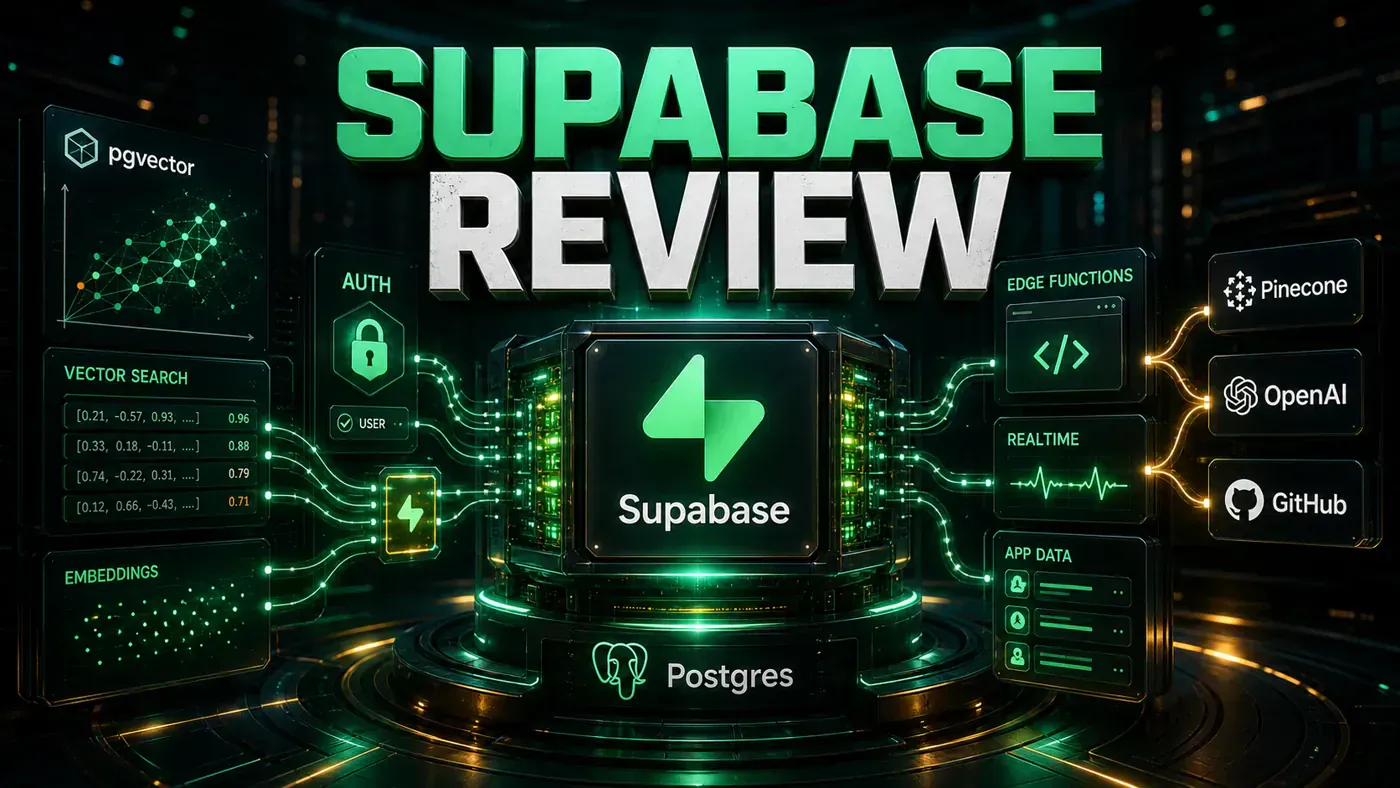
Supabase (opens in a new tab) is an open-source Firebase alternative built on PostgreSQL:
- Postgres database, relational, ACID-compliant
- pgvector, vector search built-in
- Auto-generated APIs, REST and GraphQL
- Auth, multiple providers, row-level security
- Edge Functions, serverless TypeScript
- Real-time, live database subscriptions
- Storage, file and image hosting
A note on the GraphQL side: the auto-generated API (opens in a new tab) still exists via the pg_graphql extension, but as of May 2026 it is reportedly no longer switched on by default for new projects. You can still turn it on; you just opt in now.
Price: Free tier | Pro $25/mo | Team $599/mo | Enterprise custom (Supabase pricing (opens in a new tab))
pgvector for RAG
Supabase's pgvector (opens in a new tab) extension turns Postgres into a vector database:
SELECT * FROM documents
ORDER BY embedding <-> query_embedding
LIMIT 5;
We ran our own test with 500k vectors. To be upfront: these are our in-house numbers, not a published, peer-reviewed benchmark, so treat them as a directional read rather than gospel.
- Ingestion: 2m 30s
- Query latency (p99): 45ms
- Hybrid search: available with tsvector (see the Supabase hybrid search docs (opens in a new tab))
That is slower than a dedicated vector store. Pinecone has quoted a 45ms p99 on its dedicated read nodes, with much lower figures in other configurations, so the gap depends heavily on how each system is set up (Blocks & Files reporting (opens in a new tab)). For most AI apps, 45ms is well within the range users won't notice. The payoff is keeping your relational data and your vectors in the same query, which spares you a second database to run and sync.
AI App Architecture
A typical AI app on Supabase looks like this:
- Documents table, with a vector column
- Users table, with RLS policies
- Edge Functions, for LLM calls and webhooks
- Real-time, live UI updates
- Auth, secure user management
One platform, one database, and no external services for most builds. That is the whole argument for the platform in a single sentence.
Pros and Cons
| Pros | Cons |
|---|---|
| Postgres + vectors in one | Vector search slower than dedicated |
| Generous free tier | Team tier is expensive |
| Real-time subscriptions | Edge Functions cold start (~200ms reported) |
| Excellent auth system | Self-hosted needs expertise |
| Great documentation | Connection pooling limits |
On the cold-start figure: Supabase's own Edge Functions architecture docs (opens in a new tab) cite much lower numbers, often in the 0-5ms range on the Deno runtime (opens in a new tab). The ~200ms we list is plausible for heavier functions but is not the typical documented figure, so don't plan capacity around it without testing your own functions first.
Verdict
Score: 9.0/10
Supabase is our default recommendation for AI application backends. Putting relational data, vector search, auth, and real-time behind one database cuts out most of the integration work that usually eats a team's first month. Start on the free tier, prove out your app, and scale when the usage is real. The score is our editorial call, not a measured fact, but it reflects how rarely we hit a reason to reach for something else.
*Published June 19, 2026 | Supabase tested with pgvector v0.8 (opens in a new tab)*
Supabase Review: answer-first summary
Supabase Review matters because it can change how Founders and operators plan, build, or govern an tool evaluation workflow. Supabase puts vector search, edge functions, and real-time on Postgres.
The direct answer is this: do not treat the topic as a standalone trend. Treat it as a decision about inputs, outputs, review ownership, data exposure, and whether the workflow produces a result that is faster, safer, or more useful than the current process.
Supabase Review: implementation checklist
- Define the user, job to be done, and success metric for the tool evaluation workflow.
- Collect real examples, policies, source files, customer questions, or search queries before writing prompts or choosing tools.
- Separate low-risk drafts from decisions that need approval, privacy checks, or senior review.
- Document what the AI is allowed to access, what it must not access, and who signs off before production use.
- Review time to value, adoption rate, cost per workflow, quality review score after a small pilot rather than judging the idea from a demo.
This keeps the work practical. It also gives search engines and AI answer engines a clean factual structure: what the topic is, who it helps, what to do next, and which risks matter before implementation.
Decision criteria for Supabase Review
| Decision area | What to check | Production signal |
|---|---|---|
| Intent | Does Supabase Review solve a real workflow problem? | The use case has a named owner and measurable outcome. |
| Data | Can the required data be used safely? | Sensitive data is classified and access is controlled. |
| Quality | Can a reviewer judge the output consistently? | Examples, rubrics, or acceptance criteria exist. |
| Scale | Can the workflow be repeated without hero effort? | The process is documented and can be handed to another team member. |
Practical example for Supabase Review
A small business could use this article to choose one practical test. For example, a manager might take one customer-facing process, one internal document workflow, or one recurring content task and redesign only that step with AI support. The goal is not to automate the whole business at once; it is to learn where AI Tools creates reliable leverage.
The useful deliverable is a short operating note: the trigger, the source material, the prompt or tool, the review checklist, the escalation rule, and the metric. That note becomes the handover asset for staff training, SEO/GEO content, service delivery, or future agent work.
Risks and controls for Supabase Review
The common failure pattern is moving too quickly from a promising idea into an unmanaged workflow. For Supabase Review, the risk is not only bad output. It can also be unclear data permission, staff confusion, duplicate content, unreviewed customer advice, or a tool that quietly changes cost or capability.
- Control tool sprawl with a named owner, a review step, and written acceptance criteria.
- Control unclear pricing with a named owner, a review step, and written acceptance criteria.
- Control vendor lock-in with a named owner, a review step, and written acceptance criteria.
- Control unreviewed data sharing with a named owner, a review step, and written acceptance criteria.
Measurement plan for Supabase Review
A useful AI or SEO initiative should leave evidence. Track time to value, adoption rate, cost per workflow, quality review score and compare the pilot against the current process. If the measure does not improve, keep the learning but avoid scaling the workflow.
For GEO readiness, the page should also answer the core question directly, define the entities involved, include implementation steps, explain tradeoffs, and link readers to the next relevant AI Kick Start service, guide, tool, or article.
Definitions and entities for Supabase Review
For search, GEO, and staff handover, define the core entities in plain language. In this article the important entities are the workflow owner, the AI tool or model, the source material, the review process, the risk boundary, and the measurable business outcome. Clear definitions make the page easier for people to scan and easier for AI answer engines to quote accurately.
- Workflow owner: the person accountable for deciding whether Supabase Review belongs in the business process.
- Source material: the documents, examples, policies, URLs, prompts, videos, or customer questions that ground the output.
- Review boundary: the point where a human checks accuracy, privacy, brand voice, or customer impact before the result is used.
- Success metric: the measure that proves whether the tool evaluation workflow is worth repeating.
Supabase Review versus doing nothing
Doing nothing is also a decision. The cost may be slow manual work, weaker search visibility, inconsistent advice, duplicated effort, or staff using unmanaged AI tools without a shared process. The practical question is whether a controlled pilot can reduce that cost without creating a larger governance problem.
| Option | When it makes sense | What to watch |
|---|---|---|
| Do nothing | The workflow is rare, low value, or already reliable. | Competitors may improve speed, content depth, or service consistency first. |
| Run a small pilot | The task repeats often and has clear review criteria. | Keep scope tight and measure the result against the current process. |
| Build a production workflow | The pilot is repeatable and risk controls are documented. | Assign ownership, monitoring, training, and a rollback path. |
AI Kick Start handover package for Supabase Review
A production handover should be concrete enough that another person can run it. For Supabase Review, that means a short brief, a workflow map, approved prompts or tool settings, source material, a review checklist, internal links to supporting resources, and a simple measurement sheet. This is the difference between reading about AI and turning it into operational capability.
That packaging also strengthens E-E-A-T. It shows experience through implementation notes, expertise through decision criteria, authoritativeness through source-aware structure, and trust through risks, controls, and review steps. The article becomes useful even if the reader never buys a tool because it helps them make a better operational decision.