










Briefing
Ask a room of engineers whether they trust an AI agent to touch their codebase and you will not get one answer. You will get a spread. Some hand over whole tasks and barely look. Some read every line the agent writes, twice. Most sit somewhere in between, and where they sit has very little to do with how good the agent actually is.
That gap is the real story for any team rolling out agentic coding. The tools are now capable enough that the bottleneck is no longer the model. It is the human deciding whether to believe it. Trust gets built slowly, breaks in a single bad afternoon, and takes weeks to rebuild. Teams that understand the shape of that curve adopt agents far more smoothly than teams that treat trust as a switch you flip on day one.
The 15% of one Reddit community that reportedly distrusts the Hermes agent is not being irrational. Neither is the 35% that reportedly leans on OpenClaw despite its security troubles. Both groups are reacting to how trust forms, breaks, and gets repaired. Those splits are uncited community sentiment rather than a measured survey, so read them as the mood of a forum, not a market share. The underlying point holds: trust in agents is a psychological thing before it is a technical one, and that is what teams keep getting wrong.
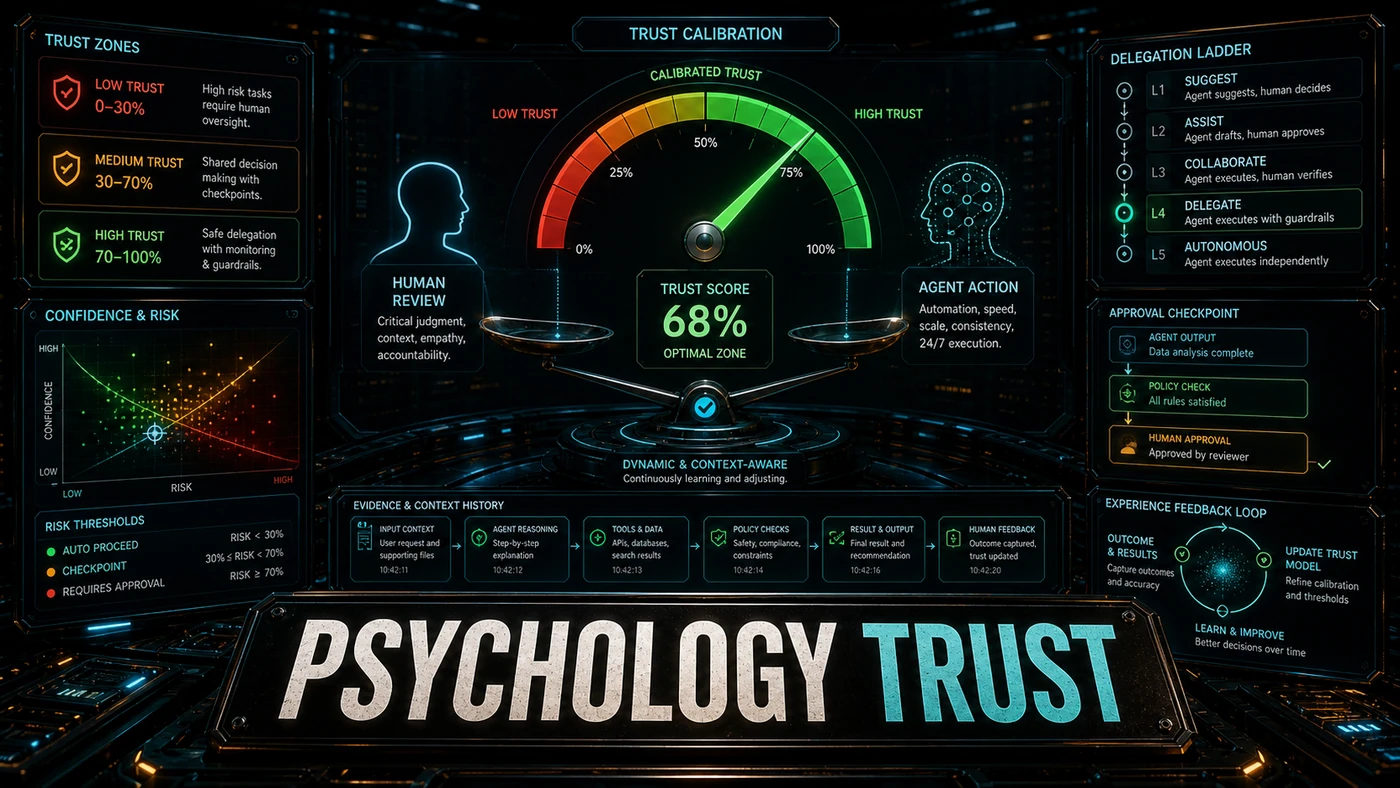
The Trust Calibration Model
The framework below is our read on how teams settle in with agents, not a measured finding. With that caveat, trust tends to move through four stages, and it follows a fairly predictable path:
- Skepticism (0-2 weeks): Engineers check every line the agent produces. The agent feels slower than doing the work by hand, because all that verification has to go somewhere.
- Cautious acceptance (2-4 weeks): Engineers spot-check the output instead of reading all of it. The checking is lighter but still systematic, and the speed gains start to show.
- Comfortable reliance (1-3 months): Engineers trust the agent with routine work and reserve close review for complex or risky changes. The productivity gains get hard to ignore.
- Full delegation (3+ months): Engineers hand whole tasks to the agent and step in only on exceptions. At this point the agent feels like a junior team member who keeps getting better.
The teams that skip the first two stages and jump straight to full delegation are the ones who hit the 'the agent broke production' incident that wipes out trust overnight.
Factors That Build Trust
Transparency: Agents that show their reasoning earn trust faster than ones that work in the dark. Pi Agent's narration is one example, and Claude Code's Plan Mode is another (Plan Mode is a documented feature; the narration claim is plausible but unconfirmed here). Consistency: An agent that gets familiar tasks right earns the benefit of the doubt on unfamiliar ones. Recoverability: When an agent does fail, fast recovery through rollbacks and clear error messages keeps trust from leaking away. Control: Approval gates and sandboxing leave engineers feeling like they, not the agent, are running the show. Attribution: Clear logs of what the agent did make accountability possible without turning it into blame.
Factors That Destroy Trust
Silent failures: The agent reports success but the output is wrong. This is the single most damaging way an agent can fail. Security incidents: The OpenClaw ecosystem took a real hit here. The critical one-click remote-code-execution flaw CVE-2026-25253 hit the OpenClaw Control UI, and the ClawHub skills registry had a separate supply-chain mess in which hundreds of malicious skills were found pushing the Atomic macOS Stealer. The two are often lumped together, but they were distinct incidents, and both dented trust for months. Unpredictability: An agent that produces excellent work one day and rubbish the next breeds anxiety. Loss of control: Agents that change things without asking feel threatening. Opacity: An agent that cannot explain why it did something reads as untrustworthy no matter how good the output looks.
The Reddit Community Split Analysed
The roughly 35% OpenClaw / 30% Hermes / 20% both / 15% distrust-Hermes split (reported community sentiment, not a verified figure) maps neatly onto those trust factors:
- OpenClaw 35%: They trust the open foundation model, the broad channel support, and the project's community building. Some of that trust was lost after the CVE, but the response rebuilt it. (Worth noting: the article these numbers came from credited 'Cole Steinberger' for that community work, but the actual creator of OpenClaw is Peter Steinberger, the Austrian developer behind PSPDFKit, as confirmed by Fast Company.)
- Hermes 30%: They trust Nous Research's technical work, the way the learning loop compounds quality over time, and Honcho's personalised memory. This group values an agent-first setup over a gateway-first one.
- Both 20%: They have not committed to either and are hedging. Many run the three-agent stack covered in article 12.
- Distrust Hermes 15%: They worry about Nous Research's data practices, the central control of agentskills.io, and where the Hermes ecosystem is heading philosophically. A lot of them prefer OpenHuman's local-first model instead.
Building Trust in Your Team
If you are an engineering manager bringing agents in, here is what tends to work:
- Start with visible, low-risk tasks: documentation, test scaffolding, lint fixes. Bank some wins before you reach for the hard stuff.
- Show the work: Plan Mode, reasoning traces, and diff reviews let engineers watch how the agent thinks instead of guessing.
- Make rollback trivial: a one-command undo takes the fear out of letting an agent have a go.
- Celebrate catches: when an engineer spots an agent mistake, treat it as a win for the process, not a strike against the tool.
- Measure and share: track success rates, time saved, and quality. Numbers earn trust faster than stories around the kitchen.
- Respect opt-outs: some engineers will never trust agents. Forcing it breeds resentment and, ironically, mistakes.
Trust is what agent adoption actually runs on. You cannot buy it with features. You earn it through consistency, transparency, and respect for human judgment.