
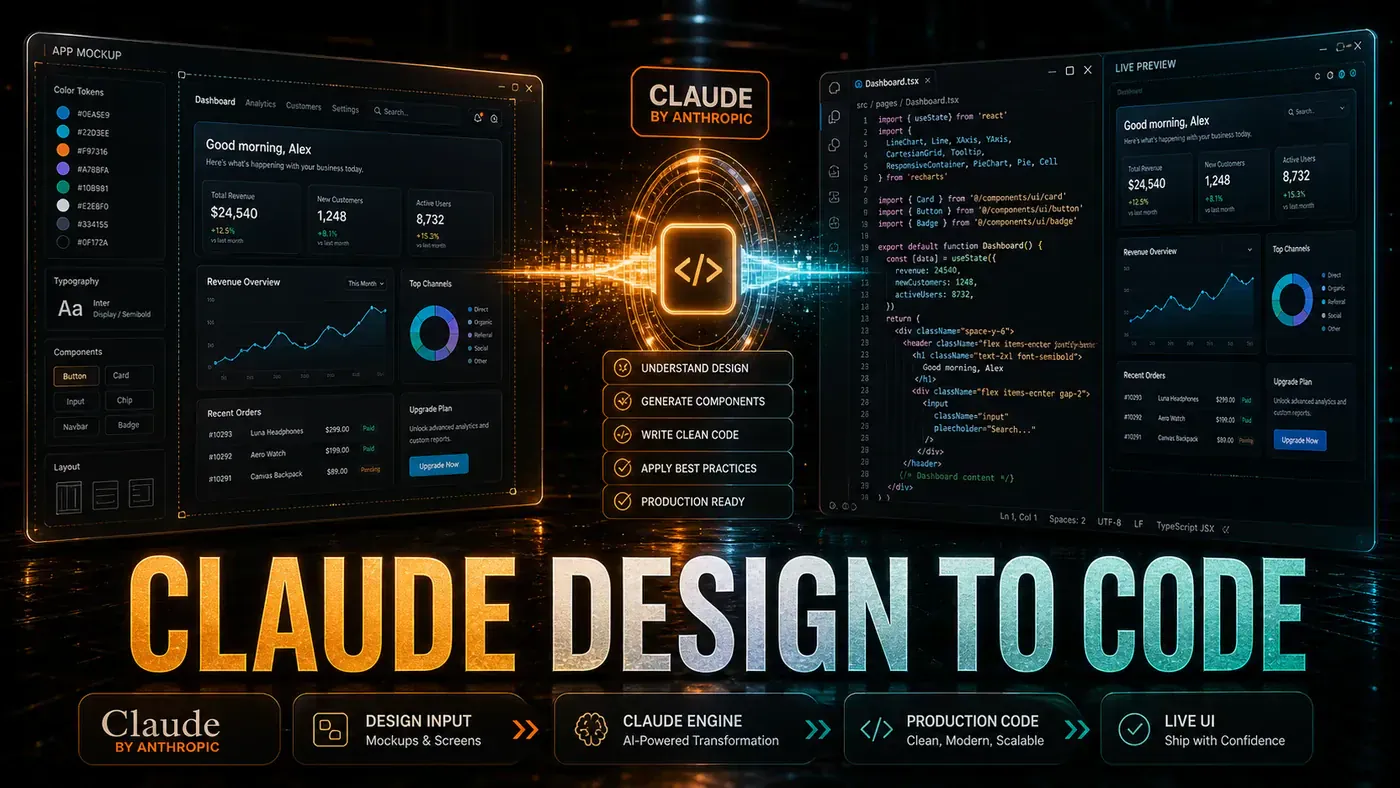



Anthropic's latest Claude upgrade merges design, brand memory, and live coding into a single seamless workflow. Here's why this could change how every business builds software.

Introduction: The Moment Design and Development Became One
There is a moment in every technology cycle when separate tools suddenly collapse into one. The camera and the phone. The browser and the operating system. The design tool and the code editor. Anthropic's latest Claude update may well mark one of those moments.
Released in mid-June 2026, the new Claude Design upgrade does something that would have sounded like science fiction barely two years ago: it allows a single AI assistant to design visual interfaces, remember your brand identity, let you edit directly on a canvas, and then transform that design into working, deployable code - all within one continuous chat conversation. No handoffs. No rebuilding. No weeks of back-and-forth between designers and developers.
Julian Goldie, CEO of Goldie Agency and host of the popular "Julian Goldie SEO" YouTube channel, broke down the update in a recent video that walks through each new feature and explains exactly what it means for business owners, marketers, and entrepreneurs who have never written a line of code. His verdict? "This used to take a whole team. Now it takes you and a chat box."
That is not hyperbole. It is an increasingly accurate description of where AI-powered product development is heading. In this article, we will unpack every major feature in this Claude update, examine what makes each one significant, and explore why the broader shift toward "one-prompt products" could reshape the software creation landscape.
What Is Claude Design, and Why Does This Update Matter?
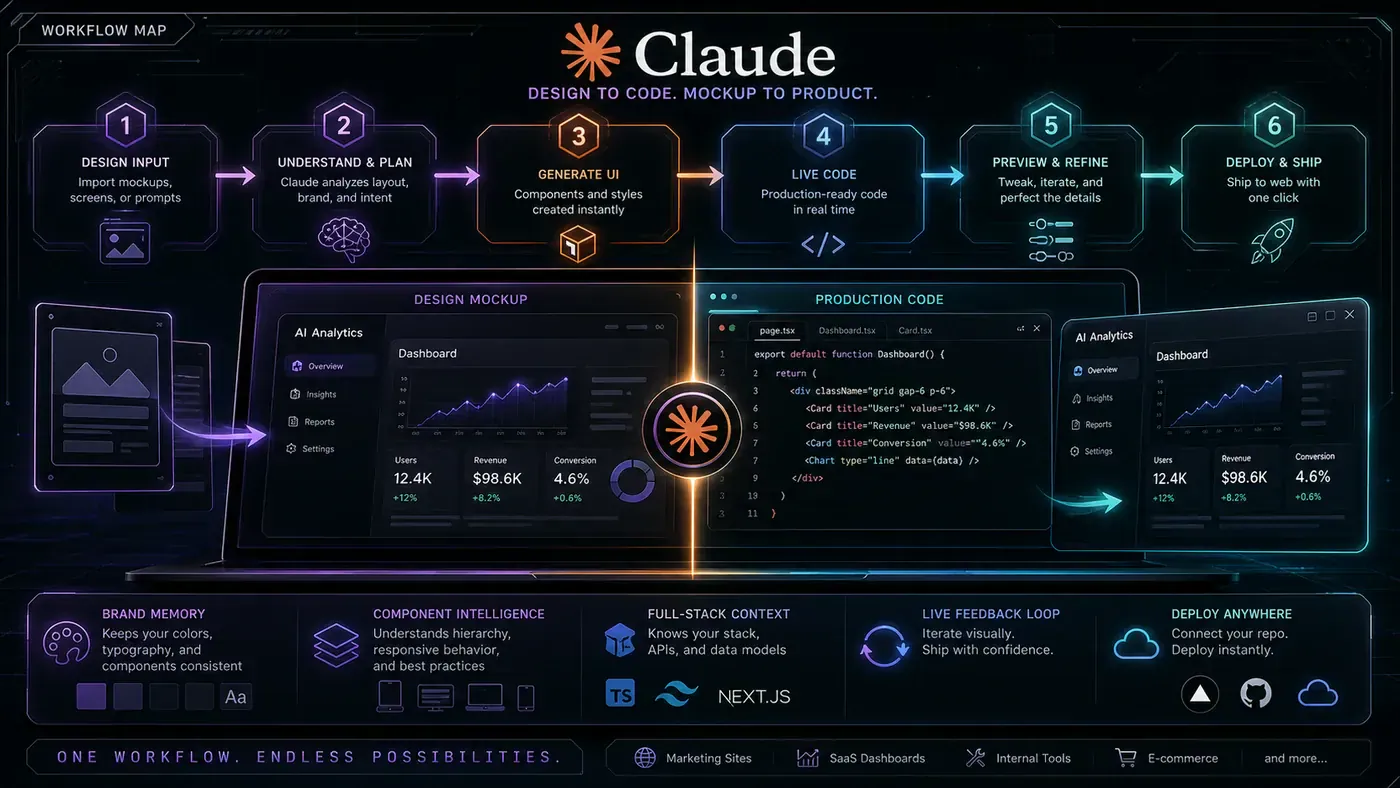
Claude Design is Anthropic's visual creation layer, built on top of its powerful Claude large language model. At its core, it is an AI tool that translates natural language prompts into visual output. You describe what you want - a landing page, a mobile app mockup, a slide deck, an internal team tool - and Claude generates it on screen in real time.
The concept is not entirely new. AI design assistants have existed in various forms for several years. But until now, these tools have suffered from a critical limitation: they create static visuals, not functional products. The gap between a beautiful mockup and a working application has remained wide, expensive, and slow to cross.
This update changes that fundamentally. Anthropic has expanded Claude Design into something far more ambitious - a unified environment where design and development are no longer separate disciplines but consecutive phases of the same conversation. The implications for speed, cost, and accessibility are enormous.
Feature 1: Persistent Brand Memory That Never Forgets
The Problem AI Design Tools Could Never Solve
If you have ever used an AI design tool before, you have almost certainly encountered the same frustrating limitation: the AI forgets everything. Every new project starts as a blank slate. Your brand colours, your preferred fonts, your visual tone - all of it has to be re-explained, re-prompted, and re-specified every single time. It is, as Goldie puts it, "like working with someone who has no memory."
For businesses, this is not merely annoying - it is a genuine barrier to adoption. Brand consistency is one of the foundations of professional credibility. When your landing pages, social graphics, and marketing materials all look disjointed, your business looks amateurish. The promise of AI-powered design falls flat if the output cannot maintain a coherent visual identity.
How Claude's Brand Memory Works
The first major upgrade directly solves this problem. Claude now retains your brand specifications across every project you create. Once you have established your visual identity - colours, typography, component styles, spacing preferences - Claude remembers it and applies it automatically to every subsequent request.
As Goldie demonstrates, this means you can create a landing page one week, then request social media graphics the following week, and every single asset will match perfectly. The AI analyses your existing designs, extracts the recurring elements, and reuses them without requiring any manual input.
Why This Matters for Business Owners
The practical impact of this feature is substantial. For small business owners, professional-grade brand consistency has historically been expensive. It typically requires either hiring a designer or investing significant time in learning design tools yourself. Claude's brand memory effectively provides an on-brand design system that works on autopilot.
As Goldie notes, "Being on brand makes you look bigger. It makes you look real. It makes people trust you. And now you get that on autopilot." In an online environment where trust signals determine conversion rates, this is a genuine competitive advantage.
Feature 2: Direct Canvas Editing Without the Chat Ping-Pong
The Old Way: Typing and Waiting
The second major upgrade addresses another fundamental friction point: the edit cycle. In previous-generation tools, making even a minor visual adjustment required typing a description of the change, sending it to the AI, waiting for processing, and then reviewing the result. Want a button slightly larger? Type "make that button bigger," wait, review. Want a section moved up? Type "move that part up," wait, review. It was slow and broke creative flow.
The New Way: Click, Drag, Done
Claude's updated canvas interface now supports direct visual editing. You can click any element and modify it immediately. Drag to resize. Grab and reposition. Adjust colours, spacing, and typography directly. Goldie describes the experience as feeling "just like the big pro design tools, but way easier."
This is a significant improvement because it aligns the tool with how designers and creators actually think. Visual work is spatial and tactile. Translating those impulses into written language and waiting for an AI to interpret them was always an unnatural intermediary step. Direct canvas editing removes that friction entirely.
Staying in Flow
The productivity implications go beyond simple time savings. Creative work depends on flow state - the psychological zone where ideas move smoothly into execution. Every interruption degrades that flow. By making edits instantaneous and visual, Claude's new canvas keeps creators in their zone longer. As Goldie puts it: "You stay in your flow. You don't lose your focus. You just keep building."
Feature 3: From Design to Working Code in One Seamless Handoff
The Traditional Bottleneck
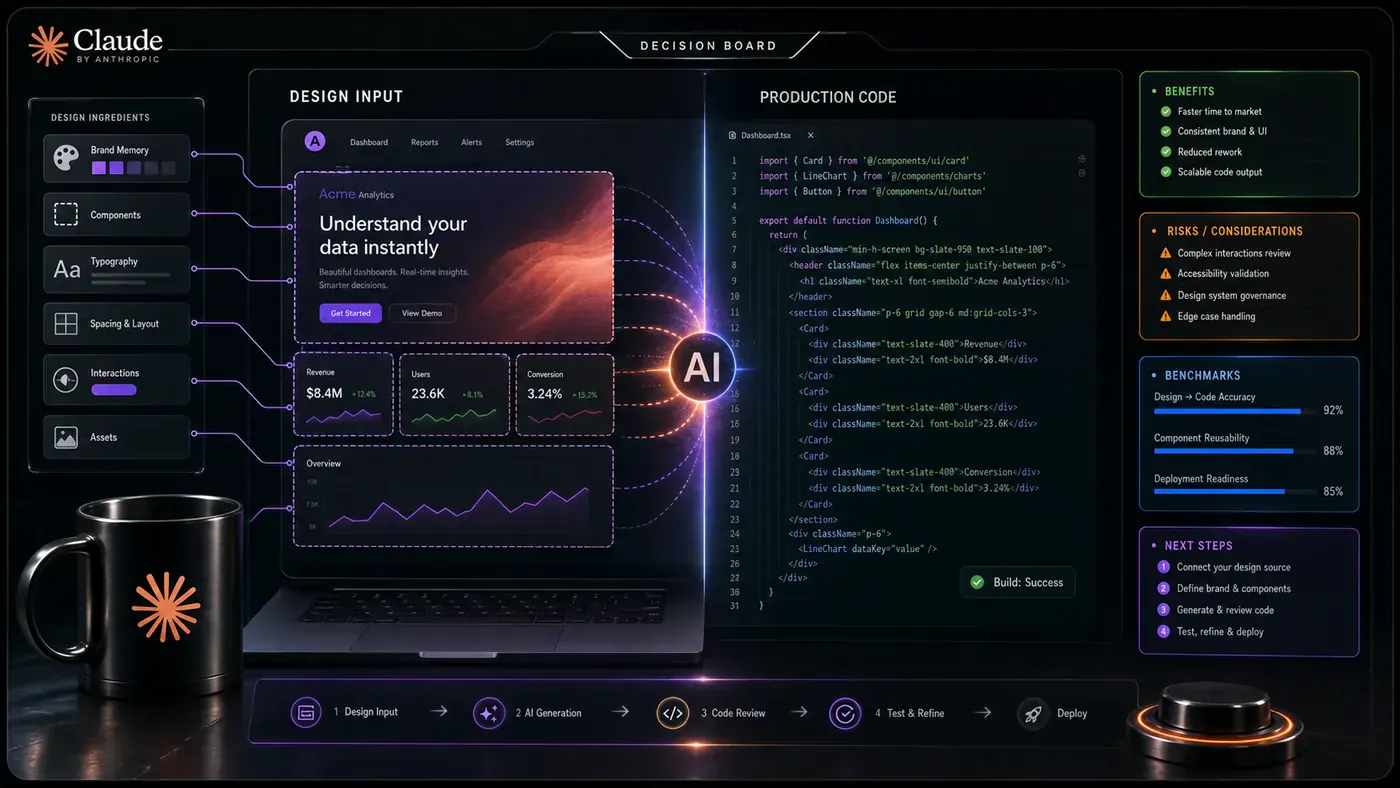
If the first two features represent significant quality-of-life improvements, the third feature is the one that fundamentally restructures the product creation pipeline. Claude Design can now hand projects directly to Claude Code, transforming a visual design into a fully functional application without any human intermediary.
To understand why this matters, consider how software has traditionally been built. A designer creates mockups. Those mockups are then handed to a developer, who must interpret the design and rebuild it from scratch. This handoff is notorious for introducing delays, miscommunications, and inconsistencies. The design-to-development pipeline is where projects slow down and budgets inflate.
The AI-Powered Pipeline
Claude's new integration effectively eliminates that pipeline. When you finish designing, you can instruct Claude to convert the entire project into working code. The AI takes your layout, colour scheme, typography, buttons, navigation, and component structure and generates the actual code that powers a live website or application. The buttons work. The pages connect. The interactions function.
As Goldie puts it: "You go from idea to finished product without ever leaving Claude."
This is not simply exporting static HTML. Claude Code can generate responsive, interactive applications with functional logic, database connections, and user interactions. The design is not approximated in code - it is translated into code.
Removing the Barriers to Creation
The most profound implication of this feature is what it means for non-technical founders and small business owners. You no longer need to hire a development team or learn to code yourself in order to turn a concept into a working product. The barrier between "I have an idea" and "I have a website" has been reduced to a single prompt.
Goldie makes this point explicitly: "You can build faster than ever, even if you've never written a line of code in your life." In an economy where digital presence is non-negotiable, this democratisation of development capability represents a genuine levelling of the playing field.
Feature 4: Enhanced Tool Connections and Ecosystem Integration
The Hub-and-Spoke Vision
The fourth feature is expanded integration with third-party tools and platforms. Claude now connects with a broader ecosystem of creative software, design applications, work platforms, and productivity tools. The strategic intent is clear: Anthropic wants Claude to function as the intelligent orchestration layer that sits above your entire toolkit.
Rather than switching between five or six different applications, Claude aims to become the central hub that coordinates all of them. It pulls assets from your existing tools, pushes completed work to the platforms where it needs to live, and manages the flow of information between systems.
Practical Impact on Workflows
For business owners, this means Claude can become the connective tissue between previously siloed parts of your operation. You might design a landing page in Claude, have it automatically deployed to your web host, generate accompanying social media graphics using your brand memory, and schedule them for posting - all from within the same conversation.
Goldie describes the vision as moving from "10 messy" systems to "one smooth system." That is the promise of an integrated AI workspace: less context switching, fewer manual transfers, fewer opportunities for things to fall through the cracks.
The Bigger Picture: The Race for One-Prompt Products
Where the Industry Is Heading
Zooming out from the specific features, this Claude update is best understood as one move in a much larger industry shift. Every major AI company is racing toward the same goal: enabling users to go from a single natural language prompt to a complete, finished, functional product.
Anthropic is pursuing this through Claude's integrated design-to-code pipeline. OpenAI has been expanding ChatGPT's capabilities with plugins, code execution, and DALL-E integration. Google's Gemini is being woven into Workspace and development tools. The competitive landscape is converging on a shared destination: the AI assistant that does not just generate content, but generates complete solutions.
First-Mover Advantage for Early Adopters
For individual entrepreneurs and small businesses, there is a genuine window of opportunity here. The tools that enable one-prompt product creation are available now, but mass adoption has not yet occurred. Goldie makes the case clearly: "The people who learn this stuff early, they're going to be way ahead. While everyone else is still switching between 10 tools, you'll be building whole products in one chat. That's a real edge. And it's available right now."
This is not merely about efficiency. It is about capability. A solopreneur who can design, build, and deploy a functional web application in an afternoon is operating at a level that would have required a small team and a significant budget just two years ago. The compounding effect of that capability advantage over time is substantial.
Limitations and Honest Assessment
While this update is genuinely impressive, an honest assessment requires acknowledging where the technology currently sits. Claude's design-to-code pipeline is transformative for certain categories of projects, but it is not a universal replacement for professional design and development teams.
Complex applications with sophisticated backend logic, extensive database architecture, advanced security requirements, or highly customised user experiences will still require specialised expertise. The designs Claude generates, while professional-looking, may not achieve the refined aesthetic sensibility of an experienced human designer. And as with all AI-generated code, thorough testing and review remain essential.
The tool is best understood as a dramatic acceleration of the early-to-middle stages of product creation, not as an elimination of human judgment and expertise. The most effective use cases today are marketing sites, internal tools, prototypes, and straightforward applications - exactly the kinds of projects that small businesses most frequently need.
Conclusion: The Future of Building Is Conversational
Anthropic's latest Claude update represents a meaningful milestone in the evolution of AI-assisted creation. By combining persistent brand memory, direct canvas editing, seamless design-to-code handoff, and expanded tool integrations into a single unified experience, Anthropic has created something that genuinely changes the economics of digital product development.
For entrepreneurs, marketers, and small business owners, the practical implication is clear: the barrier between having an idea and having a working product has never been lower. You do not need a design team. You do not need a development team. You need a clear vision and the willingness to experiment with tools that are now remarkably capable.
The broader industry trajectory points in one direction. Design, development, and deployment are collapsing into single conversational interfaces. The gap between mockup and product is disappearing. And the individuals who learn to work with these tools now will possess capabilities that their competitors are still scrambling to understand.
As Goldie encourages his viewers: go try it. Build something for your business. The tools are available, the learning curve is gentler than ever, and the potential payoff is substantial. The future of building is conversational - and that future has already arrived.
Helpful Resources
- [Anthropic – Claude AI](https://www.anthropic.com) - The official homepage for Claude, where you can access Claude Design, Claude Code, and explore the full range of Anthropic's AI assistant capabilities.
- [AI Profit Lab](https://www.skool.com/ai-profit-lab-7462/about) - Julian Goldie's community featuring a Claude Masterclass, video notes, tool recommendations, and step-by-step guides for using AI tools to grow your business. *(Via Skool)*
- [AI SEO with Julian Goldie](https://www.skool.com/ai-seo-with-julian-goldie-1553/about) - A free AI course and community with over 38,000 members, offering more than 100 AI use cases and regular updates on emerging tools. *(Via Skool)*
- [Free AI SEO Strategy Session](https://go.juliangoldie.com/strategy-session?utm=julian) - Book a complimentary strategy session with Goldie Agency to explore how AI and SEO can drive growth for your specific business.
- [200+ Free AI SEO Prompts](https://go.juliangoldie.com/chat-gpt-prompts) - A curated collection of over 200 ready-to-use prompts for AI-powered SEO workflows. *(Available via Goldie Agency)*
- [SEO Link Building Book](https://go.juliangoldie.com/opt-in?utm=julian) - Julian Goldie's guide to building authoritative backlinks and improving search rankings. *(Via Goldie Agency)*