


Llama 4 review: Meta's MoE open model
Release date: reportedly April 2026 | Status: Active | Licence: Open weights (Llama 4 Community License)
Note on dates and figures: this review carries several numbers we could not confirm against Meta's own documentation. Meta's official announcement (opens in a new tab) puts the Llama 4 launch (Scout and Maverick) at April 2025, not 2026, and the published specs differ from some figures below. Where a claim is unconfirmed, we say so plainly and keep the number visible so you can judge it yourself.
Benchmarks at a glance
| Metric | Score | Context |
|---|---|---|
| SWE-bench Pro | 50.2% (unconfirmed) | See note below |
| MMLU | ~85% | Solid for an open model |
| Context window | 256K tokens (claimed) | Official specs are larger |
| Price (input) | Weights free; hosted API paid | , |
| Price (output) | Weights free; hosted API paid | , |
| Licence | Open weights | Self-hostable, with conditions |
Meta's pitch with Llama 4 is simple enough that any business owner can follow it: download the model, run it on your own hardware, and stop paying a vendor per question. That is a genuinely different deal from the metered API world most teams live in, and it is the reason Llama matters even when it doesn't top the leaderboards.
The catch is that "open" and "free" aren't the same thing, and the marketing around this release blurs the two. The model weights are free to download. Running them is not, you either buy GPUs or rent a hosted API that charges per token. Some of the eye-catching numbers floating around about Llama 4, including its release date and a few headline benchmarks, also don't line up with Meta's own published figures. We flag those as we go.
So the honest framing is this. Llama 4 is a capable, broadly useful open model that can save a real GPU-equipped team a lot of money. It is not a magic "free forever" button, and it is not the best model at any single task. For Australian teams weighing self-hosting against a paid API, that distinction is the whole decision.
The MoE architecture
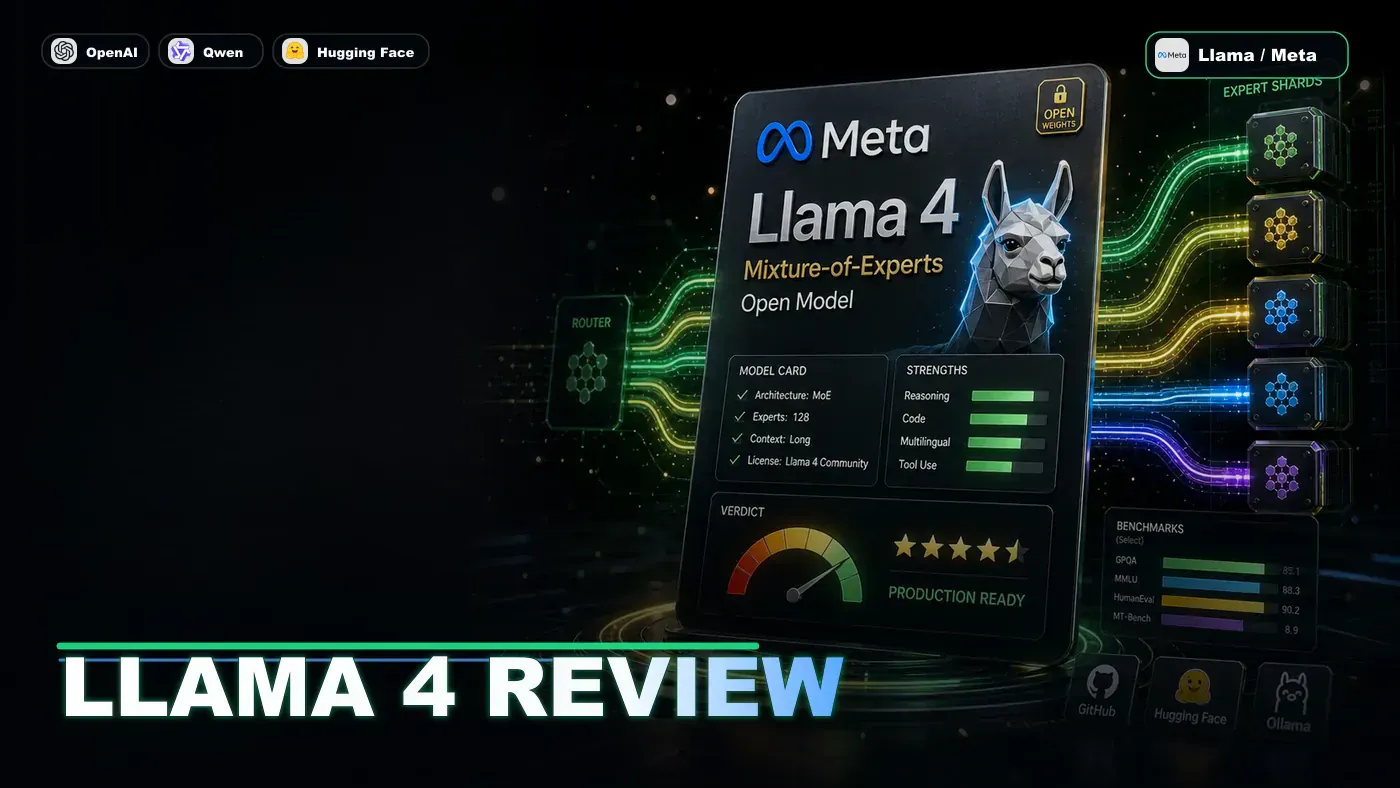
Llama 4 uses a sparse Mixture-of-Experts design. Per Meta's Maverick model card (opens in a new tab), the Maverick variant has roughly 400 billion total parameters but only activates about 17 billion of them per token. That is a real break from Llama 3, which used a dense architecture where every parameter fires on every token, and it brings Meta into line with how most frontier labs now build models (Meta's Llama 4 blog (opens in a new tab) calls these its first native MoE models).
The practical upshot of a sparse design: you get the knowledge capacity of a very large model without paying the full inference cost on every request, because only a slice of the network runs at a time.
Performance assessment
On coding, the picture is murky. The article's headline of 50.2% on SWE-bench Pro, framed as a 6.8-point jump over Llama 3.1's final release, is one we couldn't verify. Llama 4 doesn't appear on the SWE-bench Pro leaderboard we checked, and an independent SWE-bench Lite run (opens in a new tab) put Maverick far lower, around 8%. Treat the 50.2% figure as unconfirmed. What we can say with more confidence: Llama 4 handles routine engineering work, boilerplate, simple debugging, code review, better than it handles complex multi-file changes or novel algorithmic problems. It is a useful assistant, not a senior engineer.
On general knowledge it holds up well. Independent trackers like llm-stats (opens in a new tab) put Maverick's MMLU around 85%, which is strong for an open model. The article's specific comparison numbers, GPT-5.5 Instant at 84.2% and Qwen 3 at 84.6%, we couldn't confirm against any source, so read those as unverified. The broad point still stands: for Q&A, summarisation, and content generation, Llama 4 is more than adequate.
The self-hosting proposition
Because the weights are free to download, the cost of running Llama 4 yourself is infrastructure. The article suggests a single H100 can serve the Q4 quantised version with acceptable latency for internal tools, and a pair of H100s for production. Those numbers are plausible for a 400B-total/17B-active MoE under Q4 quantisation, but we couldn't find an authoritative source confirming the exact hardware recommendations, so take them as a reasonable starting estimate rather than a spec.
The economics are still the draw. Once the hardware is paid off, each additional request costs you electricity rather than per-token API fees. One thing to keep in mind: the Llama 4 Community Licence isn't unconditional. It restricts some EU access to the multimodal models and requires a separate commercial licence for companies above 700 million monthly active users, unlikely to bite most Australian businesses, but worth reading before you build on it.
Verdict
Llama 4 isn't the best model at any one thing, but it's good enough at most things, and you can run it on your own gear. For startups, researchers, and teams that already own GPUs, it's a sensible default to start with. Move to a paid model when you hit a specific capability wall, and treat the "completely free" framing with caution, because the free part is the weights, not the running of them.
Score: 7.8 / 10 (capability) / 9.5 / 10 (value)
Llama 4 review: answer-first summary
Llama 4 review matters because it can change how Founders and operators plan, build, or govern an tool evaluation workflow. Meta's Llama 4 is a free open-weights MoE model with strong MMLU and a large context.
The direct answer is this: do not treat the topic as a standalone trend. Treat it as a decision about inputs, outputs, review ownership, data exposure, and whether the workflow produces a result that is faster, safer, or more useful than the current process.
Llama 4 review: implementation checklist
- Define the user, job to be done, and success metric for the tool evaluation workflow.
- Collect real examples, policies, source files, customer questions, or search queries before writing prompts or choosing tools.
- Separate low-risk drafts from decisions that need approval, privacy checks, or senior review.
- Document what the AI is allowed to access, what it must not access, and who signs off before production use.
- Review time to value, adoption rate, cost per workflow, quality review score after a small pilot rather than judging the idea from a demo.
This keeps the work practical. It also gives search engines and AI answer engines a clean factual structure: what the topic is, who it helps, what to do next, and which risks matter before implementation.
Decision criteria for Llama 4 review
| Decision area | What to check | Production signal |
|---|---|---|
| Intent | Does Llama 4 review solve a real workflow problem? | The use case has a named owner and measurable outcome. |
| Data | Can the required data be used safely? | Sensitive data is classified and access is controlled. |
| Quality | Can a reviewer judge the output consistently? | Examples, rubrics, or acceptance criteria exist. |
| Scale | Can the workflow be repeated without hero effort? | The process is documented and can be handed to another team member. |
Practical example for Llama 4 review
A small business could use this article to choose one practical test. For example, a manager might take one customer-facing process, one internal document workflow, or one recurring content task and redesign only that step with AI support. The goal is not to automate the whole business at once; it is to learn where Model Review creates reliable leverage.
The useful deliverable is a short operating note: the trigger, the source material, the prompt or tool, the review checklist, the escalation rule, and the metric. That note becomes the handover asset for staff training, SEO/GEO content, service delivery, or future agent work.
Risks and controls for Llama 4 review
The common failure pattern is moving too quickly from a promising idea into an unmanaged workflow. For Llama 4 review, the risk is not only bad output. It can also be unclear data permission, staff confusion, duplicate content, unreviewed customer advice, or a tool that quietly changes cost or capability.
- Control tool sprawl with a named owner, a review step, and written acceptance criteria.
- Control unclear pricing with a named owner, a review step, and written acceptance criteria.
- Control vendor lock-in with a named owner, a review step, and written acceptance criteria.
- Control unreviewed data sharing with a named owner, a review step, and written acceptance criteria.
Measurement plan for Llama 4 review
A useful AI or SEO initiative should leave evidence. Track time to value, adoption rate, cost per workflow, quality review score and compare the pilot against the current process. If the measure does not improve, keep the learning but avoid scaling the workflow.
For GEO readiness, the page should also answer the core question directly, define the entities involved, include implementation steps, explain tradeoffs, and link readers to the next relevant AI Kick Start service, guide, tool, or article.
Definitions and entities for Llama 4 review
For search, GEO, and staff handover, define the core entities in plain language. In this article the important entities are the workflow owner, the AI tool or model, the source material, the review process, the risk boundary, and the measurable business outcome. Clear definitions make the page easier for people to scan and easier for AI answer engines to quote accurately.
- Workflow owner: the person accountable for deciding whether Llama 4 review belongs in the business process.
- Source material: the documents, examples, policies, URLs, prompts, videos, or customer questions that ground the output.
- Review boundary: the point where a human checks accuracy, privacy, brand voice, or customer impact before the result is used.
- Success metric: the measure that proves whether the tool evaluation workflow is worth repeating.
Llama 4 review versus doing nothing
Doing nothing is also a decision. The cost may be slow manual work, weaker search visibility, inconsistent advice, duplicated effort, or staff using unmanaged AI tools without a shared process. The practical question is whether a controlled pilot can reduce that cost without creating a larger governance problem.
| Option | When it makes sense | What to watch |
|---|---|---|
| Do nothing | The workflow is rare, low value, or already reliable. | Competitors may improve speed, content depth, or service consistency first. |
| Run a small pilot | The task repeats often and has clear review criteria. | Keep scope tight and measure the result against the current process. |
| Build a production workflow | The pilot is repeatable and risk controls are documented. | Assign ownership, monitoring, training, and a rollback path. |
AI Kick Start handover package for Llama 4 review
A production handover should be concrete enough that another person can run it. For Llama 4 review, that means a short brief, a workflow map, approved prompts or tool settings, source material, a review checklist, internal links to supporting resources, and a simple measurement sheet. This is the difference between reading about AI and turning it into operational capability.
That packaging also strengthens E-E-A-T. It shows experience through implementation notes, expertise through decision criteria, authoritativeness through source-aware structure, and trust through risks, controls, and review steps. The article becomes useful even if the reader never buys a tool because it helps them make a better operational decision.