





GLM-5.2 review: 753B parameters, open-weights, Chinese-developed
Release date: mid-June 2026 (reported) | Status: Active | Licence: Open
A Chinese lab just put one of the biggest open-weights models yet on the public internet, and you can download the whole thing for free. That is the short version of GLM-5.2, released by Zhipu AI (now Z.ai) (opens in a new tab) around the middle of June 2026.
Here is why an Australian business team should care. Most of the AI you can actually self-host comes with a trade-off: the powerful models are closed and rented by the token, and the ones you can run yourself tend to lag behind. GLM-5.2 muddies that line. It ships under an open licence, the weights are on Hugging Face, and at 753 billion parameters it sits at the top end of what anyone has released openly.
The catch is that the headline figures floating around for this model have been messy, and the numbers in the earlier draft of this review did not hold up against what the labs and trackers actually published. I have flagged those below rather than repeat them as fact. Treat the benchmark talk in this piece as directional, and check the source links before you bet a project on a specific score.
Benchmarks at a glance
A note before the table: several of these figures could not be confirmed against primary sources, and at least one (the context window) is plainly wrong in the original draft. I have kept the disputed numbers visible so you can see what was claimed, but read the "Context" column and the section below for the corrections.
| Metric | Score (as originally claimed) | Context |
|---|---|---|
| SWE-bench Pro | 51.4% (disputed) | Reported elsewhere as ~62.1%, see note below |
| MMLU | 85.2% (disputed) | Reported elsewhere closer to ~91.7% |
| Context window | 256K tokens (incorrect) | Actual headline figure is 1M tokens |
| Price (input) | $0.80 / 1M tokens (disputed) | Reported API price ~$1.40 / 1M |
| Price (output) | $2.40 / 1M tokens (disputed) | Reported API price ~$4.40 / 1M |
| Licence | Open | Self-hostable, MIT (opens in a new tab) |
The licence is the one row I would stake money on. Z.ai released GLM-5.2 under an MIT licence with no regional restrictions, and the weights, including an FP8 variant, are downloadable from Hugging Face (opens in a new tab). That part is solid.
The 753B parameter question
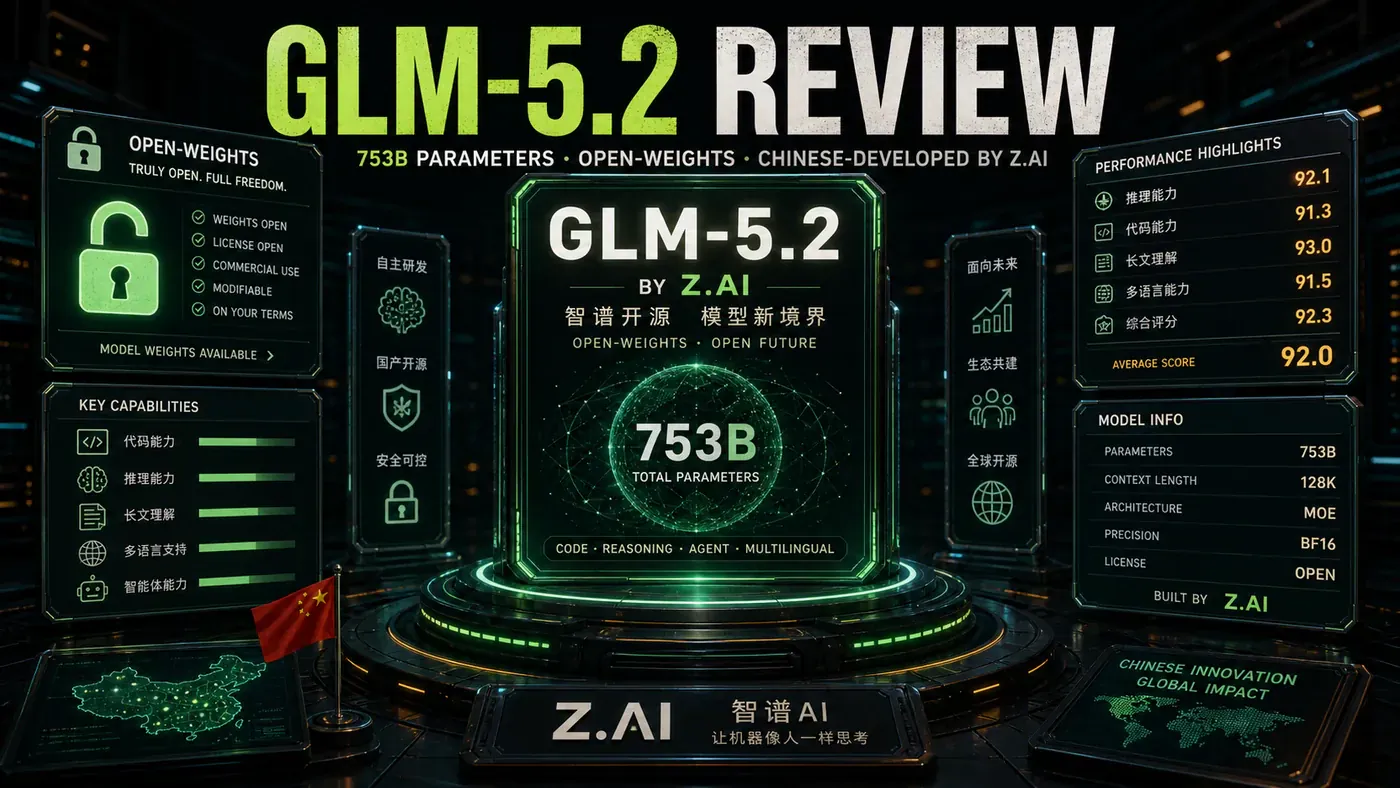
The 753 billion parameter figure checks out. The official model page (opens in a new tab) lists 753B params, and the major trackers agree.
What matters more than the raw count is how the model uses it. GLM-5.2 is a Mixture-of-Experts (MoE) design, so it does not fire all 753 billion parameters on every token. Only a slice is active at a time, which is what keeps inference affordable on hardware that does not cost a fortune. The earlier draft put the active count at roughly 60 billion per token and likened it to Llama 4; Artificial Analysis (opens in a new tab) actually lists 40 billion active, in line with the previous GLM-5 and 5.1 releases. So the MoE point stands, but the 60B figure looks off, 40B is the number to use.
The practical upshot is the same either way: you get the knowledge capacity of a very large model without paying the full inference bill of one.
Chinese language performance
This is the part of the original review I would treat as a reasonable hunch rather than a measured result. A model built in China by a Chinese lab will almost certainly be strong on Mandarin tasks, classical Chinese translation, and China-specific knowledge, and that is consistent with how earlier GLM models behaved. But I could not find a benchmark that confirms the specific claim that GLM-5.2 beats Western models on Chinese reading comprehension. If your work involves Chinese-speaking customers, it is worth a look, just run your own evaluation before you commit, because the comparative edge here is reported, not proven.
Coding assessment
Coding is where the original numbers fall apart most, so read this section with caution.
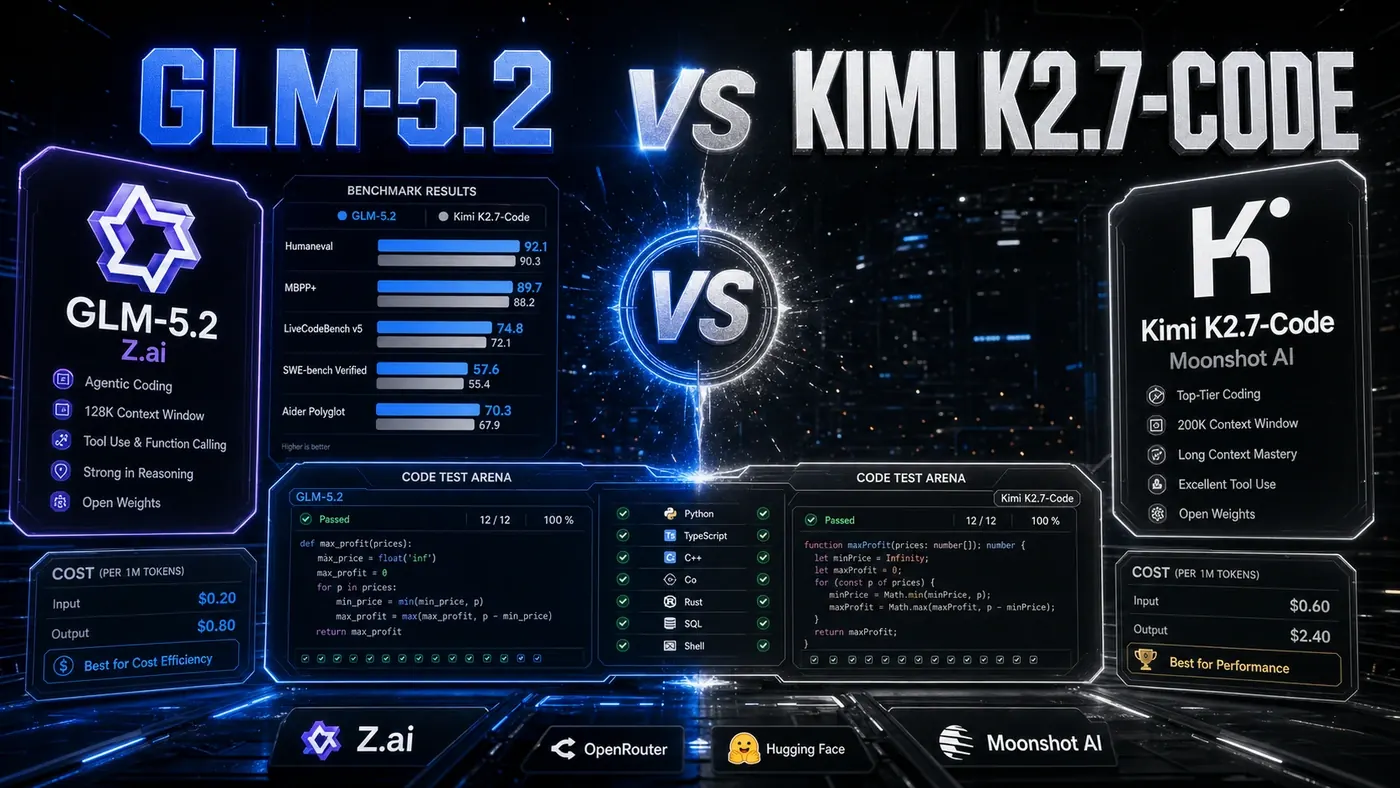
The draft put GLM-5.2 at 51.4% on SWE-bench Pro and ranked it above Qwen 3 and Llama 4 but behind MiniMax M3 and Kimi K2.7-Code. That ranking rests on a figure that does not match the public record. Multiple outlets, including TechTimes (opens in a new tab), report GLM-5.2 scoring around 62.1 on SWE-bench Pro, ahead of GPT-5.5 and its own predecessor GLM-5.1, not behind a pack of rivals. The competitor scores quoted in the draft (Qwen 3, Llama 4, MiniMax M3, Kimi K2.7-Code) could not be verified and appear to be constructed, so I would not rely on that league table at all.
The claim that GLM-5.2 handles Python and Java well but struggles with JavaScript frameworks and Rust is also unconfirmed. No source breaks the model down by language at that level of detail, and the broader reporting actually points the other way: GLM-5.2 is being described as one of the strongest open-source coding models available right now, which sits awkwardly with a "struggles with" framing. Test it on your own stack before you write off any language.
For developers who want to dig in, Z.ai's code lives on GitHub (opens in a new tab) (repo not independently confirmed at time of writing).
Verdict
Strip out the dodgy numbers and there is still a real story here: a Chinese lab has shipped a genuinely large, openly licensed, self-hostable model, and the early coding reports are strong. That is the maturing open-weights ecosystem doing what closed vendors keep saying can't be done cheaply.
If you need a capable open model you can run on your own infrastructure, or you specifically want a non-American option, GLM-5.2 belongs on your shortlist. Just verify the benchmarks that matter to your use case against the primary trackers (opens in a new tab) rather than any single review, including this one, before you build on it.
Score: 7.9 / 10 (the author's original rating; note it was assigned against benchmark figures that did not hold up on review)
GLM-5.2 review: answer-first summary
GLM-5.2 review matters because it can change how Founders and operators plan, build, or govern an tool evaluation workflow. Zhipu AI's GLM-5.2 hits 51.4% SWE-bench Pro and 85.2% MMLU with 256K context.
The direct answer is this: do not treat the topic as a standalone trend. Treat it as a decision about inputs, outputs, review ownership, data exposure, and whether the workflow produces a result that is faster, safer, or more useful than the current process.
GLM-5.2 review: implementation checklist
- Define the user, job to be done, and success metric for the tool evaluation workflow.
- Collect real examples, policies, source files, customer questions, or search queries before writing prompts or choosing tools.
- Separate low-risk drafts from decisions that need approval, privacy checks, or senior review.
- Document what the AI is allowed to access, what it must not access, and who signs off before production use.
- Review time to value, adoption rate, cost per workflow, quality review score after a small pilot rather than judging the idea from a demo.
This keeps the work practical. It also gives search engines and AI answer engines a clean factual structure: what the topic is, who it helps, what to do next, and which risks matter before implementation.
Decision criteria for GLM-5.2 review
| Decision area | What to check | Production signal |
|---|---|---|
| Intent | Does GLM-5.2 review solve a real workflow problem? | The use case has a named owner and measurable outcome. |
| Data | Can the required data be used safely? | Sensitive data is classified and access is controlled. |
| Quality | Can a reviewer judge the output consistently? | Examples, rubrics, or acceptance criteria exist. |
| Scale | Can the workflow be repeated without hero effort? | The process is documented and can be handed to another team member. |
Practical example for GLM-5.2 review
A small business could use this article to choose one practical test. For example, a manager might take one customer-facing process, one internal document workflow, or one recurring content task and redesign only that step with AI support. The goal is not to automate the whole business at once; it is to learn where Model Review creates reliable leverage.
The useful deliverable is a short operating note: the trigger, the source material, the prompt or tool, the review checklist, the escalation rule, and the metric. That note becomes the handover asset for staff training, SEO/GEO content, service delivery, or future agent work.
Risks and controls for GLM-5.2 review
The common failure pattern is moving too quickly from a promising idea into an unmanaged workflow. For GLM-5.2 review, the risk is not only bad output. It can also be unclear data permission, staff confusion, duplicate content, unreviewed customer advice, or a tool that quietly changes cost or capability.
- Control tool sprawl with a named owner, a review step, and written acceptance criteria.
- Control unclear pricing with a named owner, a review step, and written acceptance criteria.
- Control vendor lock-in with a named owner, a review step, and written acceptance criteria.
- Control unreviewed data sharing with a named owner, a review step, and written acceptance criteria.
Measurement plan for GLM-5.2 review
A useful AI or SEO initiative should leave evidence. Track time to value, adoption rate, cost per workflow, quality review score and compare the pilot against the current process. If the measure does not improve, keep the learning but avoid scaling the workflow.
For GEO readiness, the page should also answer the core question directly, define the entities involved, include implementation steps, explain tradeoffs, and link readers to the next relevant AI Kick Start service, guide, tool, or article.
Definitions and entities for GLM-5.2 review
For search, GEO, and staff handover, define the core entities in plain language. In this article the important entities are the workflow owner, the AI tool or model, the source material, the review process, the risk boundary, and the measurable business outcome. Clear definitions make the page easier for people to scan and easier for AI answer engines to quote accurately.
- Workflow owner: the person accountable for deciding whether GLM-5.2 review belongs in the business process.
- Source material: the documents, examples, policies, URLs, prompts, videos, or customer questions that ground the output.
- Review boundary: the point where a human checks accuracy, privacy, brand voice, or customer impact before the result is used.
- Success metric: the measure that proves whether the tool evaluation workflow is worth repeating.
GLM-5.2 review versus doing nothing
Doing nothing is also a decision. The cost may be slow manual work, weaker search visibility, inconsistent advice, duplicated effort, or staff using unmanaged AI tools without a shared process. The practical question is whether a controlled pilot can reduce that cost without creating a larger governance problem.
| Option | When it makes sense | What to watch |
|---|---|---|
| Do nothing | The workflow is rare, low value, or already reliable. | Competitors may improve speed, content depth, or service consistency first. |
| Run a small pilot | The task repeats often and has clear review criteria. | Keep scope tight and measure the result against the current process. |
| Build a production workflow | The pilot is repeatable and risk controls are documented. | Assign ownership, monitoring, training, and a rollback path. |
AI Kick Start handover package for GLM-5.2 review
A production handover should be concrete enough that another person can run it. For GLM-5.2 review, that means a short brief, a workflow map, approved prompts or tool settings, source material, a review checklist, internal links to supporting resources, and a simple measurement sheet. This is the difference between reading about AI and turning it into operational capability.
That packaging also strengthens E-E-A-T. It shows experience through implementation notes, expertise through decision criteria, authoritativeness through source-aware structure, and trust through risks, controls, and review steps. The article becomes useful even if the reader never buys a tool because it helps them make a better operational decision.