



Briefing
The Secret Loophole to Use Claude Opus 4.8 For FREE!

How GitLab's 30-Day Ultimate Trial Unlocks Enterprise-Grade AI Access for Creators and Developers Alike
In an era where artificial intelligence capabilities are expanding at a breathtaking pace, the cost of entry has become one of the most significant barriers facing individual creators, small development teams, and independent entrepreneurs. The subscription fees for premium AI models have climbed steadily, with enterprise-grade access to the most powerful systems often running into hundreds of pounds per month. For many, this creates a frustrating digital divide: those who can afford cutting-edge AI tools gain a substantial competitive advantage, whilst everyone else is left making do with more limited alternatives.
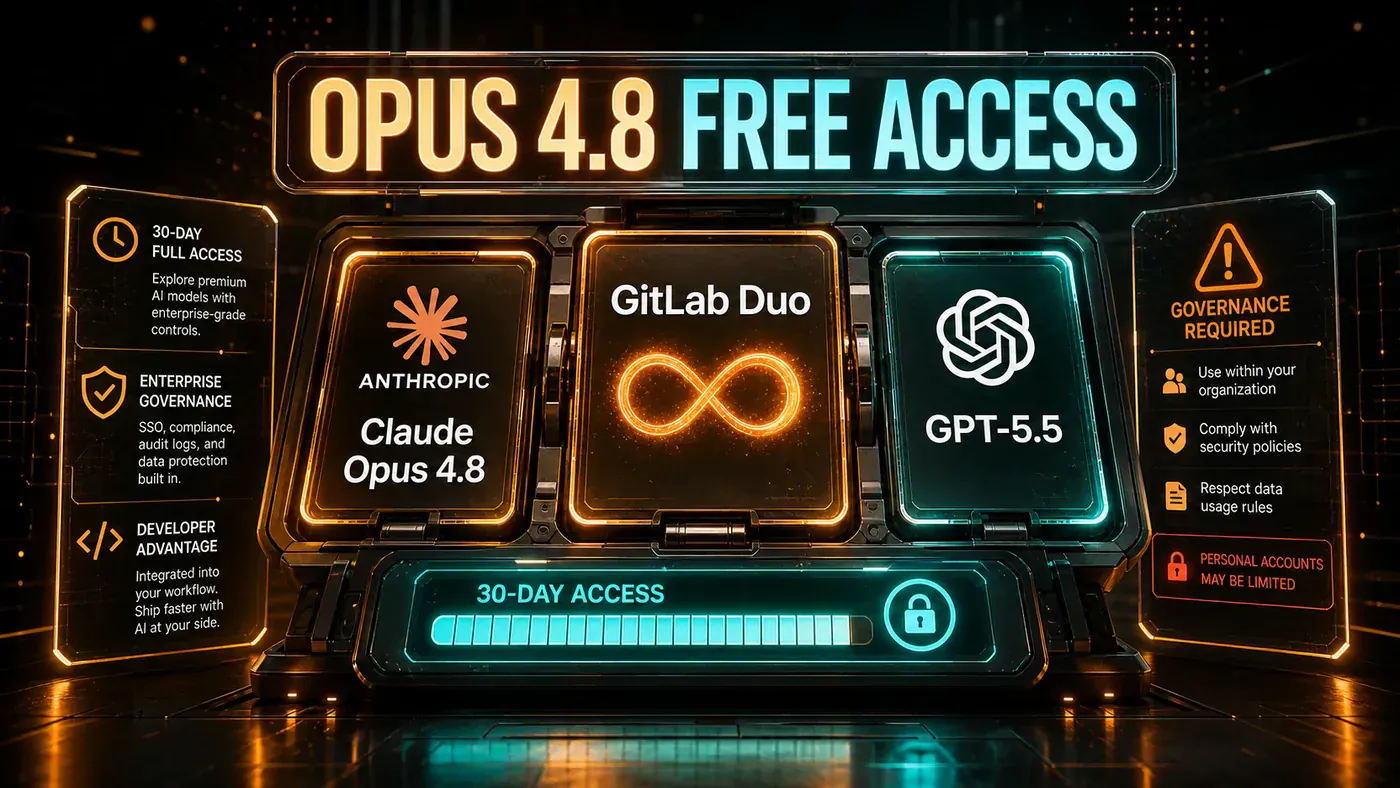
A recent video from the Esmile Ai YouTube channel claims to offer a solution to this exact problem. The presenter asserts he has discovered a legitimate pathway to access two of the most advanced AI models - Anthropic's Claude Opus 4.8 and OpenAI's GPT 5.5 - entirely free of charge, without requiring credit card details or resorting to questionable third-party services. The method, he claims, leverages GitLab's 30-day Ultimate trial and its integrated Duo AI assistant. This article provides a comprehensive breakdown of the method demonstrated, analyses its validity, explores the broader implications for AI accessibility, and examines the practical realities of using platform trials as a long-term strategy.
The AI Affordability Crisis Facing Small Creators
The video opens with a candid admission from the presenter. He shares a viewer comment accusing him of having "changed" - of abandoning small creators in favour of showcasing expensive, paid AI tools. This critique reflects a genuine frustration within the creator community. The AI landscape has undeniably shifted towards premium, subscription-based models, with the most capable systems increasingly locked behind paywalls that price out independent users.
The presenter uses this moment to reframe his content mission, arguing that his coverage of paid tools illustrates where the technology is heading, whilst his commitment to finding free alternatives remains intact. He promises not merely a limited free trial, but what he describes as "full enterprise level access" to both Claude Opus 4.8 and GPT 5.5, framing it as a genuine bypass of typical paywall restrictions.
Whether one views this framing as sincere advocacy or effective clickbait marketing, it undoubtedly taps into a real market need. The demand for affordable, high-quality AI access is immense. The critical question is whether the method actually delivers on these ambitious promises.
Understanding GitLab Duo and the Ultimate Trial
The foundation of this method rests upon GitLab Duo, the platform's integrated AI-powered coding assistant. GitLab, primarily known as a web-based DevOps lifecycle tool providing Git repository management, CI/CD pipelines, and collaborative development workflows, has increasingly positioned itself as an AI-enhanced development platform. GitLab Duo represents the company's strategic investment in artificial intelligence, embedding machine learning capabilities directly into the development workflow to assist with code generation, explanation, refactoring, and security vulnerability identification.
The presenter directs viewers to GitLab's official website, emphasising the importance of following exact steps to avoid a "much longer, complicated process." Modern SaaS platforms are carefully designed with multiple onboarding pathways, and the user journey varies dramatically depending on which buttons are clicked. The video instructs viewers to avoid the prominent "Try it for free" button and instead click "Sign in" in the top-right corner - a counterintuitive approach that apparently finds the path of least resistance. Viewers are then told to use Google authentication, streamlining the process significantly.
The account creation continues with a brief email verification step. Once verified, the platform presents a short onboarding questionnaire. The presenter recommends selecting "software developer" as the role, choosing "create a new project," and selecting "just me." For the group and project names, he suggests using a brand name - in his case, "Esmile AI" - noting the specific names are irrelevant to AI access. After clicking "Create project," the user lands inside GitLab's main developer dashboard.
Activating the GitLab Ultimate Trial
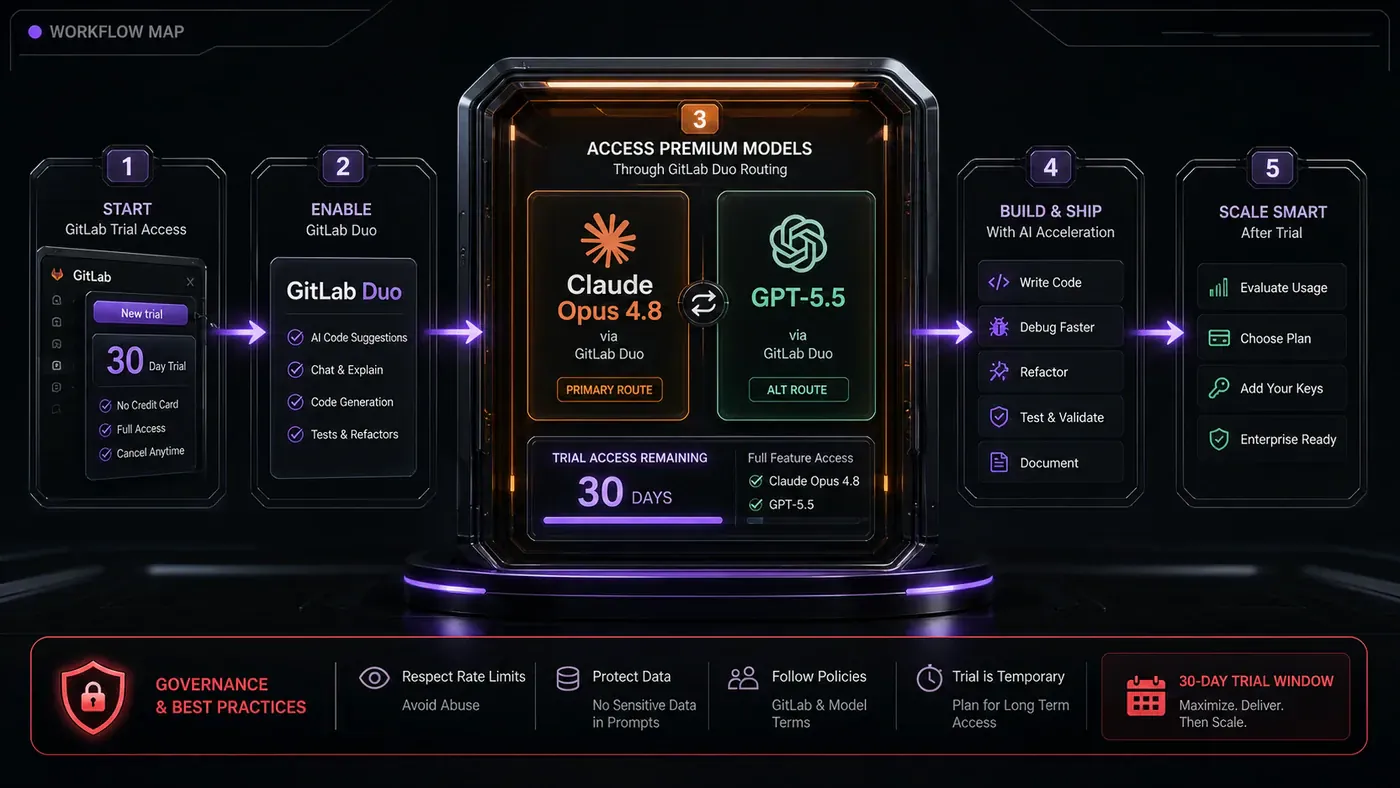
This is where the method transitions from standard account setup to the core of the claimed loophole. On the right-hand side of the developer dashboard, a dedicated chat panel appears with a blue button inviting the user to "Start a free trial." Clicking this opens an activation form requesting a company name and country selection. The presenter again emphasises a critical detail: the text on the right side of the activation window explicitly states "No credit card required." This zero-financial-risk aspect is central to the method's appeal and distinguishes it from trials that require payment details upfront.
Upon activation, a progress tracker appears at the bottom-left of the interface, confirming that the user now has 30 days remaining in their GitLab Ultimate trial. This is the first concrete evidence that the method has delivered something of tangible value - a full month of access to GitLab's highest-tier subscription plan, which includes the Duo AI assistant with its most advanced capabilities.
The presenter then maximises the chat panel to create a more spacious working environment, revealing the full AI interface. Above the message input field, a dropdown menu allows the user to select which AI model they wish to use. According to the video, this dropdown includes both Anthropic's Claude Opus 4.8 and OpenAI's GPT 5.5 - two of the most powerful language models purportedly available at the time of the video's publication.
Testing the AI Models: A Live Demonstration
To substantiate the claim that this method provides genuine, unrestricted access to premium AI capabilities, the presenter conducts a live demonstration. He selects GPT 5.5 from the dropdown menu and issues a complex task: building a complete website featuring the brand name "E-Smile AI." The video shows the model generating a full HTML and CSS code structure for a professional landing page in real-time.
The presenter draws attention to several key indicators of quality access: the generation speed is fast, with no artificial rate limits slowing the output; there are no paywall interruptions or upgrade prompts; and the generated code is described as "complete" and "flawless." He claims to be running two separate accounts using this method simultaneously, reporting flawless performance without any error messages or limit warnings.
The use cases he suggests extend well beyond simple website generation. According to the presenter, this setup can be leveraged to generate high-converting viral video scripts, analyse large data spreadsheets, build fully functional video games from scratch, and write professional marketing copy. The implication is that the 30-day trial provides genuinely unlimited access to enterprise-grade AI compute, without the artificial constraints that often cripple free-tier offerings.
The "Infinite Loop" Pro Tip: Extending Access Beyond 30 Days
The most controversial and arguably most valuable component of the video comes in its closing section, where the presenter reveals what he describes as a "secret loophole" to extend this access indefinitely. He acknowledges that the enterprise trial provides 30 full days of unlimited high-tier access, but then poses the logical question: what happens when those 30 days expire?
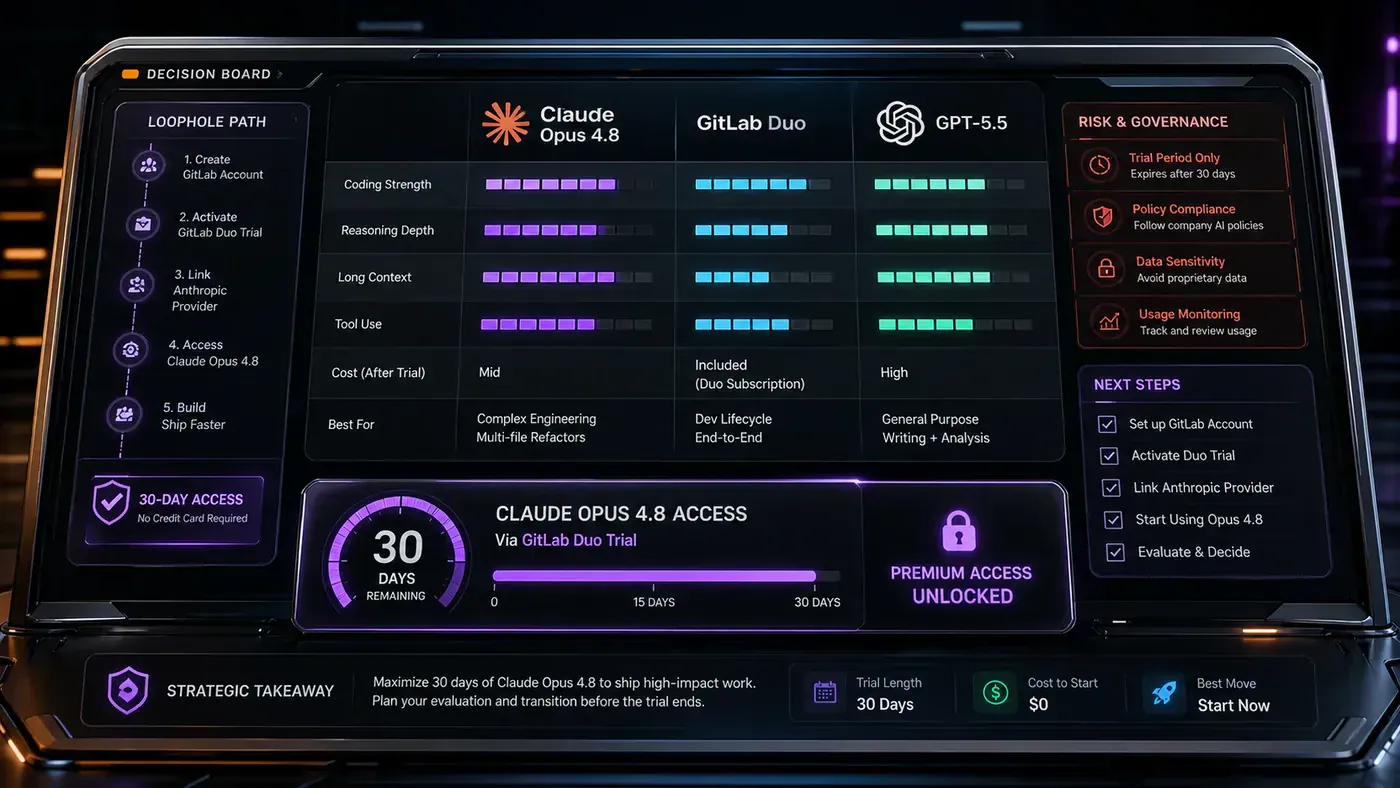
Here, the video becomes notably more circumspect. The presenter explicitly states that he cannot demonstrate the exact step-by-step process for creating an "infinite loop" of trial access due to YouTube's strict community guidelines regarding account bypassing and platform exploits. He cites the risk of receiving a severe community guideline strike as the reason for this omission. However, he provides what he describes as "hints" that make the method clear to anyone paying attention: a temporary email address, a fresh phone number, and logging out of the old session before starting a new registration.
This suggestion of cyclical trial registration - creating new accounts with fresh credentials each time the 30-day period expires - touches upon a morally and legally grey area. Most platforms explicitly prohibit this practice in their terms of service, classifying it as trial abuse or circumvention of paid subscription requirements. GitLab, like virtually all SaaS companies, operates on a business model that relies on a certain percentage of trial users converting to paid subscribers. Systematic exploitation of free trials undermines this model and could potentially constitute a violation of the platform's terms of service.
The presenter's decision to allude to this method without explicitly demonstrating it represents a calculated risk. It provides enough information for motivated viewers to infer the technique whilst maintaining a degree of plausible deniability regarding the video's intent. Whether this balance satisfies YouTube's content policies is debatable, and it undoubtedly raises ethical questions about the sustainability of such practices.
Critical Analysis: Does This Method Actually Work?
Evaluating the claims made in this video requires separating what is demonstrably true from what may be exaggerated or misleading. Let us examine each component of the method with a critical eye.
What is verifiably accurate: GitLab does offer a 30-day Ultimate trial, and this trial genuinely includes access to GitLab Duo, the platform's AI assistant. The signup process described in the video - using Google authentication, completing the onboarding flow, and activating the trial - appears to be a legitimate, officially supported pathway. The "no credit card required" aspect is also accurate for GitLab's trial offering, distinguishing it from many competitors who require payment information upfront.
What is difficult to verify: The specific model versions mentioned - Claude Opus 4.8 and GPT 5.5 - are not recognisable as standard product names from Anthropic or OpenAI as of the video's claimed publication context. This raises questions about whether the video uses hypothetical or speculative model designations, whether these represent specific GitLab-branded integrations rather than direct API access to the underlying models, or whether the video contains factual inaccuracies. GitLab Duo historically has integrated with various AI models including Google's Vertex AI and potentially OpenAI's models through partnerships, but the exact versions and capabilities available at any given time are subject to change and may not match the video's claims.
The trial-stacking loophole: The suggestion to repeatedly create new accounts to maintain continuous free access is, from a technical perspective, likely feasible. Most platform security measures designed to prevent trial abuse rely on detecting duplicate email addresses, phone numbers, payment methods, or IP addresses. By using temporary email services, fresh phone numbers (available through various virtual number providers), and potentially VPNs to vary IP addresses, a determined user could likely circumvent these protections. However, doing so would almost certainly violate GitLab's Terms of Service, and platforms are constantly improving their detection mechanisms for exactly this type of behaviour.
The practical reality: Even setting aside the ethical and legal considerations, this method is inherently fragile. GitLab could modify its trial offering, require credit cards, implement stricter verification, or reduce the trial period at any time. Relying on trial-stacking as a foundational component of one's workflow introduces significant operational risk. For professional use - where reliability and consistency are paramount - this approach is far from ideal.
The Broader Implications for AI Accessibility
This video, regardless of its specific accuracy, highlights a genuine tension in the AI industry. The most capable models are becoming increasingly expensive to develop and operate, necessitating premium pricing for access. Yet the democratisation of AI has been one of the technology's most celebrated narratives, promising to level the playing field between large corporations and individual creators.
Methods like the one described in this video represent a form of grassroots resistance to the commercialisation of AI capabilities. They exploit gaps in platform business models to redistribute access more broadly. Proponents argue that this accelerates innovation and prevents AI from becoming an elite-only technology. Critics counter that it undermines the economic sustainability of the very platforms providing these tools, ultimately reducing investment in future development.
The more sustainable solution likely lies in the direction that many AI companies are already moving: offering genuinely capable free tiers subsidised by paid enterprise subscriptions, providing educational access programmes, and developing more efficient models that reduce the cost of inference. OpenAI's GPT-4o mini, Anthropic's Claude Haiku, and similar offerings represent attempts to make high-quality AI accessible without charge. However, the gap between these free-tier models and the absolute state-of-the-art remains significant, and it is this gap that methods like the GitLab trial exploit seek to bridge.
Conclusion
The method presented in Esmile Ai's video represents a clever exploitation of GitLab's generous 30-day Ultimate trial offering, which legitimately includes access to the GitLab Duo AI assistant with integration to powerful language models. For users seeking temporary, no-cost access to enterprise-grade AI capabilities, following the demonstrated signup process will likely deliver genuine value - provided one has realistic expectations about the nature of the access being provided.
However, the suggestion to extend this access indefinitely through cyclical account creation raises serious ethical concerns and likely violates platform terms of service. For professional creators and developers who rely on consistent, reliable access to AI tools, this approach carries unacceptable risks and fragility. The 30-day trial is best viewed as exactly what it claims to be: a legitimate, time-limited opportunity to evaluate premium capabilities with zero financial commitment.
The underlying issue that this video addresses - the prohibitive cost of premium AI access for small creators - remains a real and pressing problem. Rather than relying on potentially exploitative loopholes, creators should advocate for more sustainable models of AI accessibility, explore the increasingly capable free tiers offered by major platforms, and consider whether the productivity gains from paid AI subscriptions might justify the investment in their specific use cases. The future of AI likely depends not on who can find the cleverest workaround, but on building an ecosystem where high-quality AI tools are genuinely accessible to all who can benefit from them.
Helpful Resources
Official Platforms
- GitLab Official Website - The primary platform for accessing GitLab Duo and the Ultimate trial: https://gitlab.com/
- GitLab Duo Documentation - Official documentation for GitLab's AI-powered coding assistant and its capabilities
- GitLab Pricing - Detailed breakdown of GitLab's subscription tiers, including what is included in the Ultimate plan
AI Model Providers
- Anthropic - Developer of the Claude family of language models: https://www.anthropic.com/
- OpenAI - Developer of the GPT family of language models: https://openai.com/
- Claude Documentation - Official documentation for Anthropic's Claude models
- OpenAI Platform - API documentation and access options for OpenAI models
Related Tools and Alternatives
- GitHub Copilot - Microsoft's AI coding assistant with free tier options for students and open-source maintainers
- Codeium - A free AI coding assistant alternative with broad IDE support
- Amazon CodeWhisperer (now part of Amazon Q) - AWS's AI-powered code generator with free individual tier
- Tabnine - AI code completion tool with a free basic plan
- Sourcegraph Cody - AI coding assistant with free tier for individual developers
Temporary Communication Services (for Trial Registration)
- TempMail - Temporary email address services for registration purposes
- Google Voice - Free secondary phone numbers for verification
- ProtonMail - Privacy-focused email service for additional account creation
Related Reading
- GitLab's official blog posts on Duo AI integration and partnerships
- Platform terms of service regarding trial abuse and account policies
- Industry analysis on AI model pricing democratisation trends