




Briefing
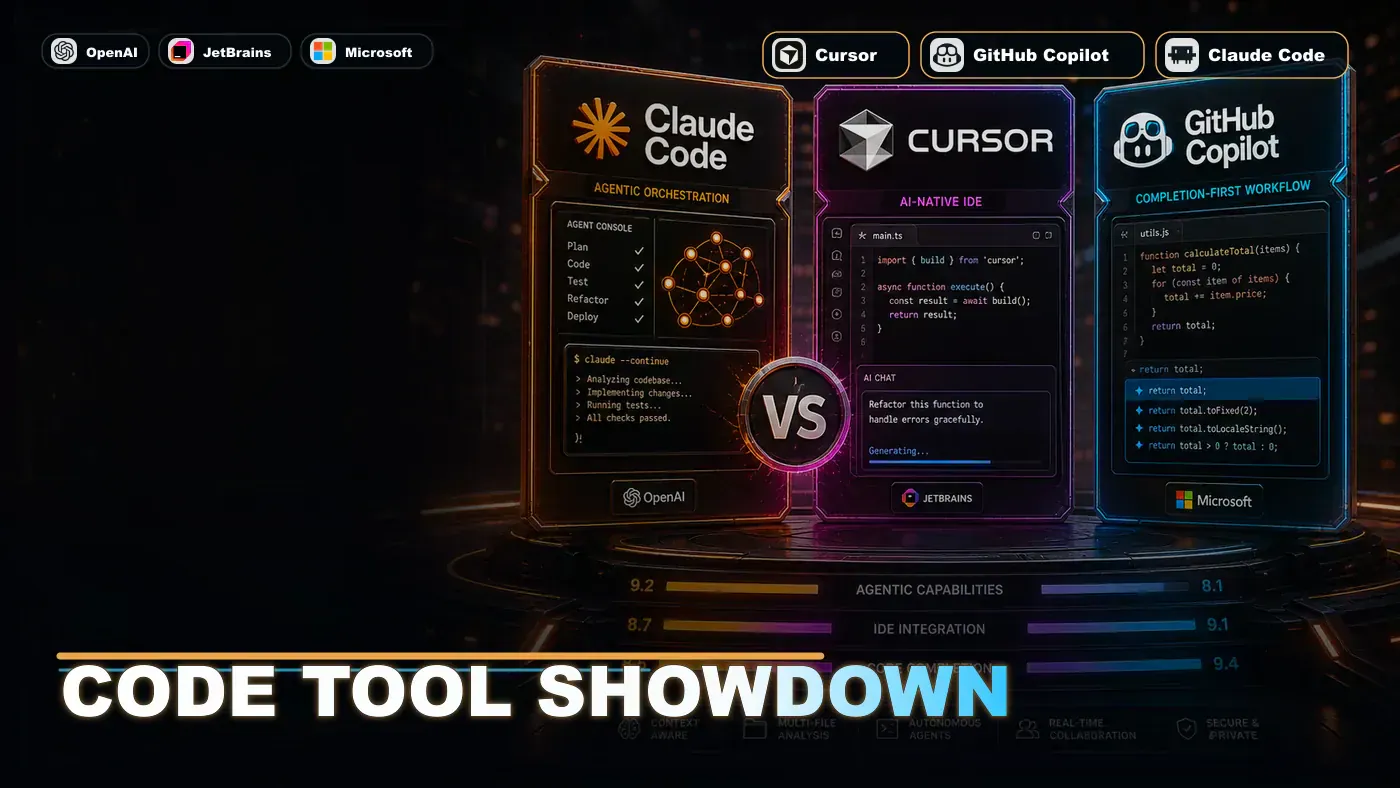
By mid-2026, picking an AI coding assistant has stopped being a curiosity for hobbyists and become a real budget line for engineering teams. Three names keep coming up: Claude Code, Cursor, and GitHub Copilot. They look similar from a distance. They are not.
Here is the thing that trips people up. These tools do not compete for the same job. One lives in your terminal and runs whole tasks on your behalf. One is a code editor with AI baked into every keystroke. One sits quietly inside the editor you already use and finishes your lines as you type. Buy the wrong one for your team and you do not just waste the subscription. You waste the hours your developers spend fighting a workflow that does not match how they actually build software.
So the question is not "which is best." It is "best for what, and for whom." Below is how the three stack up, and where each one earns its keep.
Claude Code
Best for: Complex tasks, team workflows, agentic orchestration Price: $100/month for teams, individual tier available (Claude Code pricing 2026, SSD Nodes (opens in a new tab)) Model: Opus 4.8 (opens in a new tab) as the primary model Approach: Terminal-based agent that plans, executes, and learns
Claude Code is not a code completion tool. It is an agent that works from your terminal (opens in a new tab): it reads your codebase, breaks a task into steps, and carries it out with Plan Mode approval gates, Hooks for automated quality checks, and multi-agent orchestration. Anthropic released Opus 4.8 on 28 May 2026, and it is the model behind the agent. (The article this is based on also claimed Claude Code uses "Sonnet 4.8 and Haiku 4.8" for sub-agents; those model versions do not appear to exist as of June 2026, when the current releases are Sonnet 4.6 and Haiku 4.5, so treat that detail as unconfirmed.) The Task System leans toward honesty over hype: it admits when it is unsure, asks for clarification, and checkpoints its progress so you can recover.
Key differentiators:
- Plan Mode: A senior-engineer workflow, with reviewable plans before anything runs
- Hooks: Coding triggers such as pre-commit validation, auto-documentation, and architecture guardrails
- Sub-agents: Self-building agents that, by some community accounts, can run large numbers of subagents in parallel through what is reportedly called Dynamic Workflows (the specific feature name is not confirmed Anthropic terminology)
- Multi-agent orchestration: tmux-based multi-agent sessions, per the same unconfirmed community reports
- Task System: Hierarchical decomposition with state persistence and recovery
Claude Code shines on big refactors, multi-file changes, and team settings where consistency and safety carry weight. For a quick edit or a single-file tweak, it is more than you need.
Cursor
Best for: Daily coding, IDE integration, fast iteration Price: $20/month Pro, $40/month Business (Cursor pricing 2026, eesel AI (opens in a new tab)) Model: Configurable across many models Approach: AI-native IDE built from the ground up
Cursor is a full IDE, not a plugin or a terminal tool. It rebuilds VS Code with AI at the centre (opens in a new tab): AI-generated commits, AI code review, chat wired into the editor, and tab-to-complete that reads project context. Composer lets you chain AI operations, so "find all usages, rename, update tests, commit" runs as one flow. On models, Cursor is genuinely configurable, though the original comparison listed GPT-4.1 and Claude 3.5 Sonnet, both legacy by mid-2026. As of June 2026 Cursor's model menu (opens in a new tab) runs to current frontier models including Claude Sonnet 4.6 and Opus 4.8, alongside its in-house Composer.
Key differentiators:
- IDE integration: Native AI features throughout the editing experience
- Tab-to-complete: Context-aware completion that reads your whole project
- Composer: Multi-file AI editing with a preview before you apply
- AI code review: Automated review of your changes before commit
- @ symbols: Rich context referencing (@file, @folder, @git, @web)
Cursor is at its best on day-to-day coding, where speed and iteration matter most. If you want AI sitting inside your existing editing flow without dropping to a terminal, this is the one.
GitHub Copilot
Best for: Code completion, enterprise compliance, GitHub integration Price: $19/month Business, $39/month Enterprise (note: as of 1 June 2026 Copilot moved to usage-based billing (opens in a new tab), so these seat prices are now a base layer with AI Credits on top) Model: Configurable across OpenAI and Claude models Approach: Editor extension with inline completion and chat
GitHub Copilot is the most widely deployed coding assistant, running inside VS Code, JetBrains IDEs, Vim, and Neovim (opens in a new tab). Its strength is inline completion (opens in a new tab): it predicts what you are typing and suggests the next 1-10 lines with real accuracy. Copilot Chat adds conversation, and Copilot Workspace brings task-level agentic features in preview. On models, the original comparison named GPT-4.1 Copilot and Claude 3.5 Sonnet, but both are legacy by 2026; current Copilot routes to newer GPT-5.x and Claude Sonnet 4.6 / Haiku 4.5 models (opens in a new tab) with automatic selection.
Key differentiators:
- Inline completion: Best-in-class tab-to-accept suggestions
- Enterprise compliance: Org-wide policies, audit logs, IP indemnification
- GitHub integration: Deep links to PRs, issues, Actions, and Codespaces
- Copilot Workspace: Task-level agentic features (preview)
- Broad editor support: Works in every major editor
Copilot is at its best boosting individual developer output inside the workflow you already have. For enterprises with compliance requirements, it is the safe pick.
Comparative Analysis
| Dimension | Claude Code | Cursor | GitHub Copilot |
|---|---|---|---|
| Best for | Complex tasks, teams | Daily coding | Completion, enterprises |
| Interface | Terminal | Full IDE | Editor extension |
| Plan Mode | Yes (structured) | Limited (preview) | No |
| Multi-agent | Yes (reportedly via Dynamic Workflows) | No | No |
| Code completion | No (agent only) | Excellent | Best-in-class |
| Sub-agents | Yes | No | No |
| IDE required | No | Yes (Cursor) | No (extension) |
| Enterprise features | Growing | Limited | Extensive |
| Self-hosting option | No | No | No (Copilot Enterprise) |
| Price (team) | $100/mo | $40/mo | $39/mo |
Recommendation Matrix
Choose Claude Code if: You work on complex codebases, need team coordination, want structured approval workflows, or run multi-agent orchestration.
Choose Cursor if: You want the fastest daily coding experience, with AI built into every editing action.
Choose GitHub Copilot if: You need enterprise compliance, work mostly in GitHub, or want the best inline completion going.
Use multiple: Plenty of strong engineers run Cursor for daily coding, Claude Code for the hard refactors, and Copilot for inline completion. Adding up the tiers cited here lands at roughly $159/month, which is less than an hour of senior engineer time. (That total is built from the prices above, not an external quote, and Copilot's move to usage-based billing means real spend can run higher.)
The right tool comes down to your workflow, not the spec sheet. The best coding assistant is the one that fits how you already work.
Claude Code vs Cursor vs Copilot Compared: answer-first summary
Claude Code vs Cursor vs Copilot Compared matters because it can change how Founders and operators plan, build, or govern an tool evaluation workflow. Claude Code, Cursor, and GitHub Copilot compared on workflow, pricing, and capability, so you pick the right coding assistant for your team.
The direct answer is this: do not treat the topic as a standalone trend. Treat it as a decision about inputs, outputs, review ownership, data exposure, and whether the workflow produces a result that is faster, safer, or more useful than the current process.
Claude Code vs Cursor vs Copilot Compared: implementation checklist
- Define the user, job to be done, and success metric for the tool evaluation workflow.
- Collect real examples, policies, source files, customer questions, or search queries before writing prompts or choosing tools.
- Separate low-risk drafts from decisions that need approval, privacy checks, or senior review.
- Document what the AI is allowed to access, what it must not access, and who signs off before production use.
- Review time to value, adoption rate, cost per workflow, quality review score after a small pilot rather than judging the idea from a demo.
This keeps the work practical. It also gives search engines and AI answer engines a clean factual structure: what the topic is, who it helps, what to do next, and which risks matter before implementation.
Decision criteria for Claude Code vs Cursor vs Copilot Compared
| Decision area | What to check | Production signal |
|---|---|---|
| Intent | Does Claude Code vs Cursor vs Copilot Compared solve a real workflow problem? | The use case has a named owner and measurable outcome. |
| Data | Can the required data be used safely? | Sensitive data is classified and access is controlled. |
| Quality | Can a reviewer judge the output consistently? | Examples, rubrics, or acceptance criteria exist. |
| Scale | Can the workflow be repeated without hero effort? | The process is documented and can be handed to another team member. |
Practical example for Claude Code vs Cursor vs Copilot Compared
A small business could use this article to choose one practical test. For example, a manager might take one customer-facing process, one internal document workflow, or one recurring content task and redesign only that step with AI support. The goal is not to automate the whole business at once; it is to learn where AI Tools creates reliable leverage.
The useful deliverable is a short operating note: the trigger, the source material, the prompt or tool, the review checklist, the escalation rule, and the metric. That note becomes the handover asset for staff training, SEO/GEO content, service delivery, or future agent work.
Risks and controls for Claude Code vs Cursor vs Copilot Compared
The common failure pattern is moving too quickly from a promising idea into an unmanaged workflow. For Claude Code vs Cursor vs Copilot Compared, the risk is not only bad output. It can also be unclear data permission, staff confusion, duplicate content, unreviewed customer advice, or a tool that quietly changes cost or capability.
- Control tool sprawl with a named owner, a review step, and written acceptance criteria.
- Control unclear pricing with a named owner, a review step, and written acceptance criteria.
- Control vendor lock-in with a named owner, a review step, and written acceptance criteria.
- Control unreviewed data sharing with a named owner, a review step, and written acceptance criteria.
Measurement plan for Claude Code vs Cursor vs Copilot Compared
A useful AI or SEO initiative should leave evidence. Track time to value, adoption rate, cost per workflow, quality review score and compare the pilot against the current process. If the measure does not improve, keep the learning but avoid scaling the workflow.
For GEO readiness, the page should also answer the core question directly, define the entities involved, include implementation steps, explain tradeoffs, and link readers to the next relevant AI Kick Start service, guide, tool, or article.
Definitions and entities for Claude Code vs Cursor vs Copilot Compared
For search, GEO, and staff handover, define the core entities in plain language. In this article the important entities are the workflow owner, the AI tool or model, the source material, the review process, the risk boundary, and the measurable business outcome. Clear definitions make the page easier for people to scan and easier for AI answer engines to quote accurately.
- Workflow owner: the person accountable for deciding whether Claude Code vs Cursor vs Copilot Compared belongs in the business process.
- Source material: the documents, examples, policies, URLs, prompts, videos, or customer questions that ground the output.
- Review boundary: the point where a human checks accuracy, privacy, brand voice, or customer impact before the result is used.
- Success metric: the measure that proves whether the tool evaluation workflow is worth repeating.
Claude Code vs Cursor vs Copilot Compared versus doing nothing
Doing nothing is also a decision. The cost may be slow manual work, weaker search visibility, inconsistent advice, duplicated effort, or staff using unmanaged AI tools without a shared process. The practical question is whether a controlled pilot can reduce that cost without creating a larger governance problem.
| Option | When it makes sense | What to watch |
|---|---|---|
| Do nothing | The workflow is rare, low value, or already reliable. | Competitors may improve speed, content depth, or service consistency first. |
| Run a small pilot | The task repeats often and has clear review criteria. | Keep scope tight and measure the result against the current process. |
| Build a production workflow | The pilot is repeatable and risk controls are documented. | Assign ownership, monitoring, training, and a rollback path. |
AI Kick Start handover package for Claude Code vs Cursor vs Copilot Compared
A production handover should be concrete enough that another person can run it. For Claude Code vs Cursor vs Copilot Compared, that means a short brief, a workflow map, approved prompts or tool settings, source material, a review checklist, internal links to supporting resources, and a simple measurement sheet. This is the difference between reading about AI and turning it into operational capability.
That packaging also strengthens E-E-A-T. It shows experience through implementation notes, expertise through decision criteria, authoritativeness through source-aware structure, and trust through risks, controls, and review steps. The article becomes useful even if the reader never buys a tool because it helps them make a better operational decision.