
PII risk mapping
We identify where personal information appears, who can access it, which tools process it, where it leaves the business, and what records are needed.
AI Kick Start
AI Kick Start designs PII protection layers for AI workflows that touch customer records, employee data, finance files, case notes, or private documents. The goal is to detect, redact, replace, or constrain sensitive information before a model or automation step can mishandle it.
We identify where personal information appears, who can access it, which tools process it, where it leaves the business, and what records are needed.
Names, emails, phone numbers, addresses, identifiers, account details, dates, and sensitive context can be detected and masked.
Sensitive fields can be replaced with consistent placeholders so the workflow still makes sense without exposing real people.
Some workflows should run detection, redaction, and review inside your boundary before any cloud model or external API is involved.
A defensible privacy layer records what was detected, redacted, processed, reviewed, and actioned.
PII protection can sit in front of document AI, RAG, automations, support triage, CRM updates, email drafting, and reporting.
Cloak software
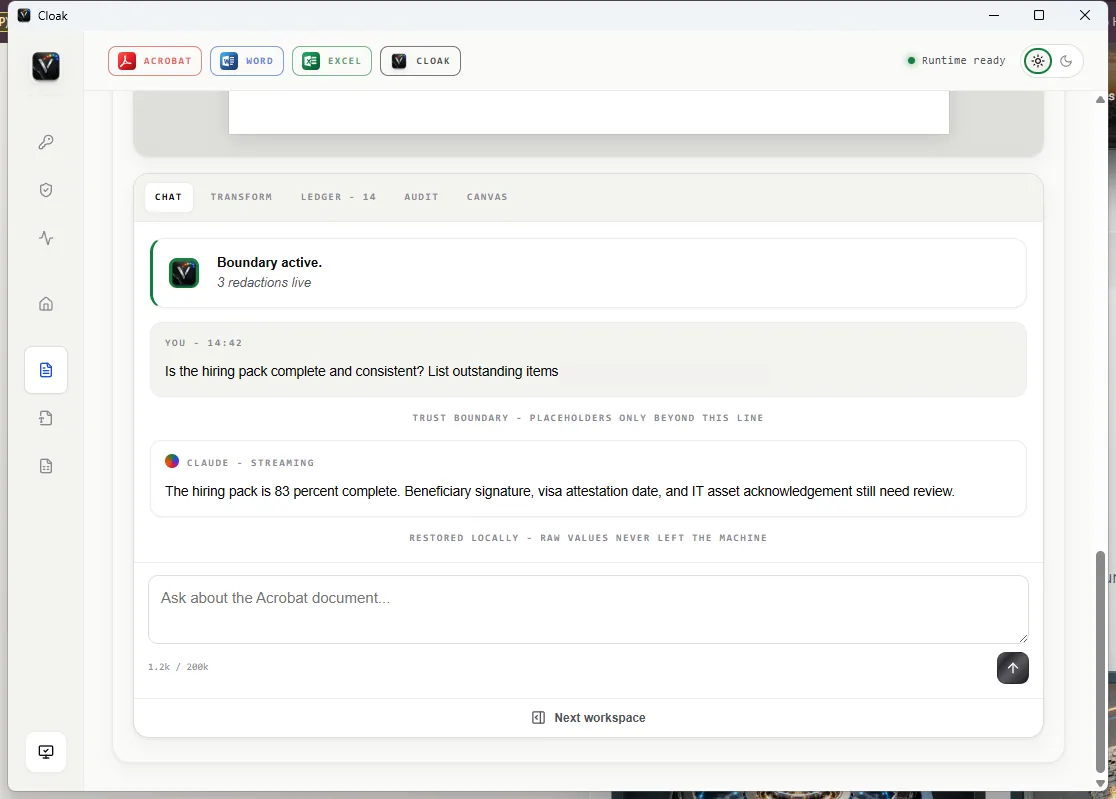
The desktop app runs the protected workspace locally. A user can open a document, inspect the transformed view, review the ledger, ask questions, and receive restored answers while the raw mapping stays on the machine.
How Cloak works
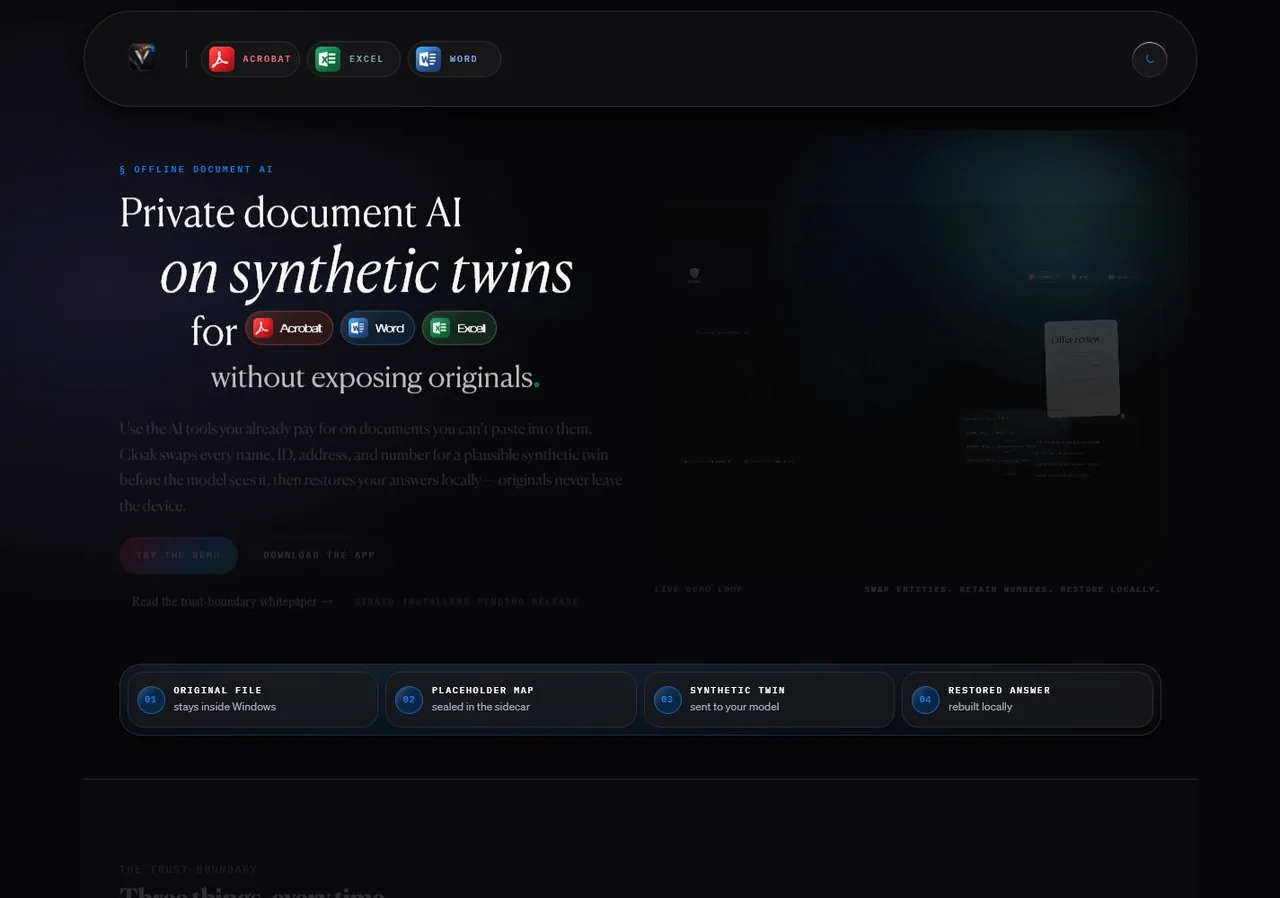
The screenshots show the public landing page, the local processing pipeline, and the native workspace surface that explains the trust boundary.
The public web surface explains that original files stay inside the local boundary while synthetic twins are used for model reasoning.
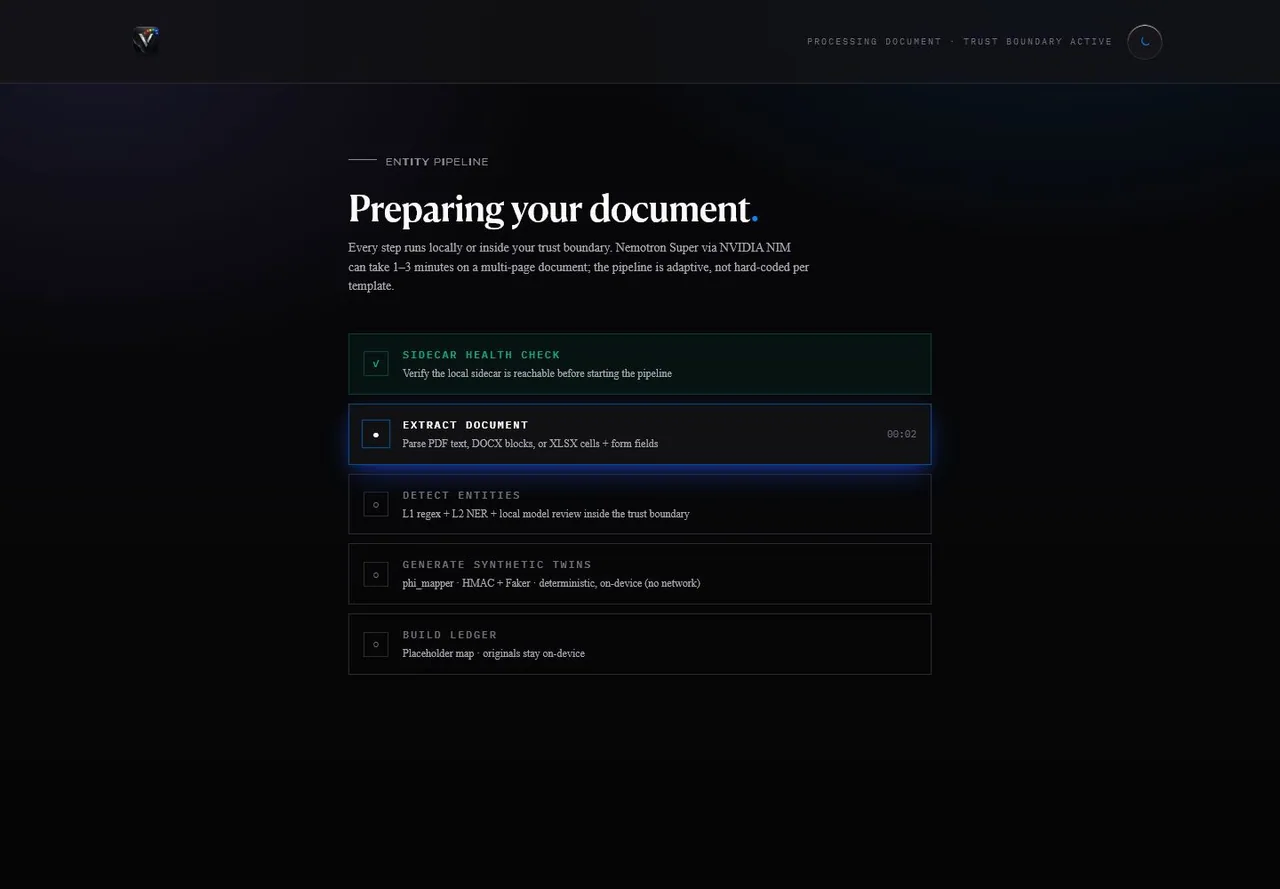
The pipeline verifies the sidecar, extracts the document, detects entities, generates synthetic twins, and builds the restoration ledger.
The workspace shows chat, transform, ledger, audit, and canvas surfaces for a document session, with restored answers rebuilt locally.
Implementation pattern
AI Kick Start uses this pattern for privacy-sensitive teams that want AI assistance without casually pasting customer, patient, staff, or financial data into a public model.
Decide what must stay on-device, what can be transformed, and which systems or users are allowed to see raw values.
Run deterministic rules, entity detectors, and domain-specific checks before the model call, then replace sensitive spans with stable placeholders.
Use the transformed projection for chat, summarisation, RAG, extraction, or workflow automation while keeping the mapping ledger local.
Restore answers locally, log what changed, and keep a review trail for compliance, privacy, and operational trust.
Related services
Most useful AI projects connect more than one service. These are the next pages worth comparing before you scope the first build.
Use PII protection inside sensitive document workflows.
View serviceProtect private source material before building knowledge AI.
View serviceRun sensitive AI workloads inside a controlled local environment.
View serviceTeach teams what not to upload and how to review AI output.
View serviceFAQ
It is a set of controls that detects, redacts, replaces, or limits personal information before AI tools process sensitive business data.
PII can include names, addresses, phone numbers, emails, account numbers, identifiers, health details, financial records, and information that can identify a person.
Yes. A safer workflow can create a redacted working copy before any cloud AI tool sees the content.
No. It supports governance, but the business still needs approved tools, access rules, retention rules, review owners, and staff training.
Start here
Bring one workflow, one growth problem, or one team that needs to get moving. We will map the first useful system.
or send a message