

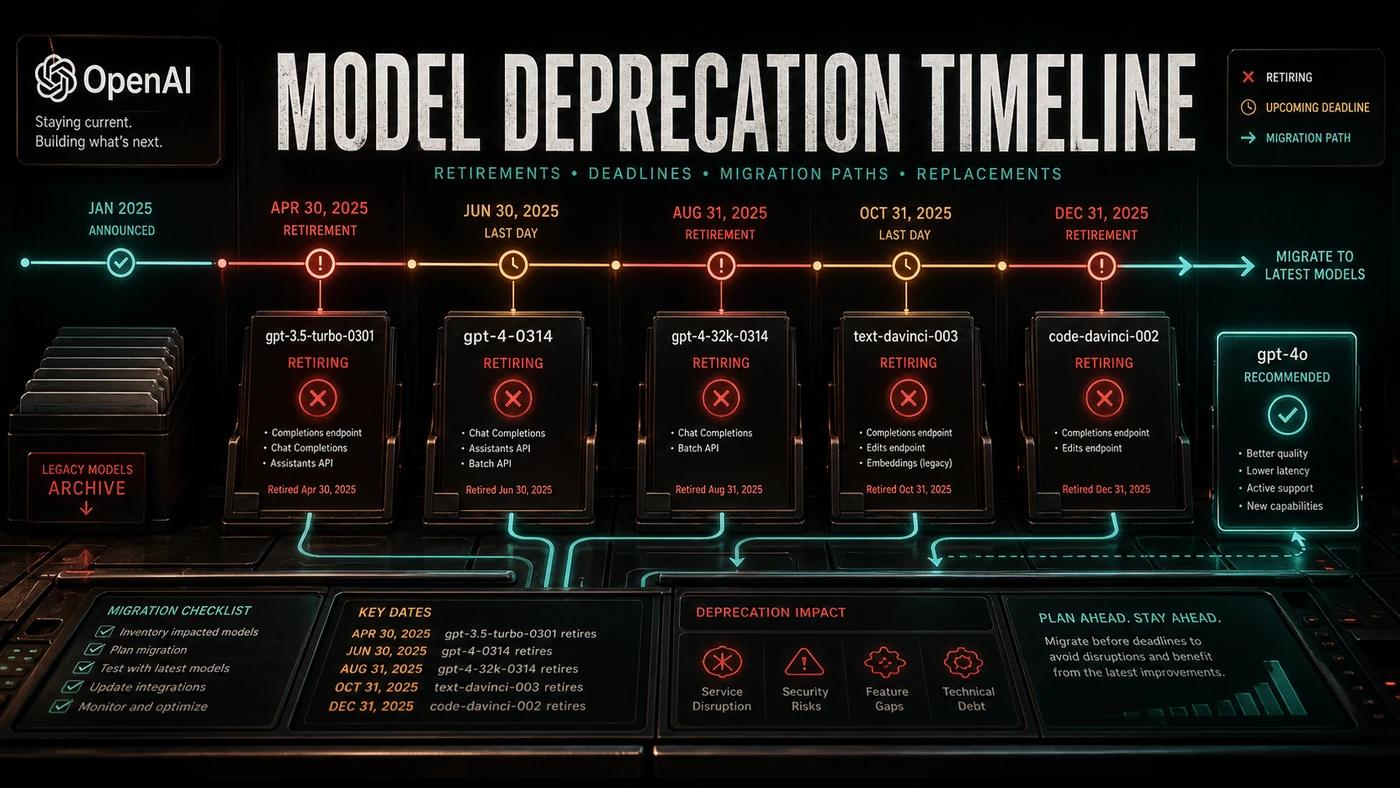


Model deprecation timeline: What's being phased out
If you locked in an AI model six months ago and assumed it would still be the smart choice today, 2026 has news for you. The model you picked is probably already a generation behind, and in a few cases it has been switched off entirely.
This is the quiet cost of the AI race that nobody warns you about when you sign up. Vendors keep shipping faster, cheaper, better models, then retire the old ones out from under you. For a business team, that means the tool you wired into your workflow can stop responding on a date you didn't choose, or quietly become the worst-value option in its own lineup.
The good news: most of these moves are easy to plan around if you know what's coming. Below is the current state of play across Anthropic, OpenAI and Google, plus a plain migration path for each model that's on the way out.
Officially deprecated
Claude Opus 4.7 (Release: 16 Apr 2026)
Status: Technically active, effectively obsolete Reason: Superseded by Opus 4.8 (reported 63.8% vs 69.2% on SWE-bench Pro) at identical pricing ($5/$25) Migrate to: Claude Opus 4.8 (immediate upgrade, same price, better performance) Timeline: Anthropic hasn't announced a retirement date; an announcement is plausibly a Q3 2026 thing, but that's a projection, not a published schedule
Opus 4.7 launched on 16 April 2026. Worth noting on the benchmark gap: independent leaderboards put Opus 4.7 closer to 64.3% on SWE-bench Pro rather than the 63.8% often quoted, which makes the lead held by Opus 4.8 about 4.9 points instead of 5.4. Either way, 4.8 is ahead at the same $5/$25 pricing.
GPT-4o and GPT-4o-mini
Status: Deprecated by OpenAI Reason: Superseded by the GPT-5.5 series (GPT-5.5 at 58.6%; GPT-5.5 Pro reportedly 62.4%; Instant in the low-40s) Migrate to: GPT-5.5 for premium use, GPT-5.5 Instant for budget use Timeline: OpenAI retired GPT-4o in ChatGPT in February 2026 with full removal across plans by 3 April 2026; API windows are still being phased, and any specific Q3-Q4 cutoff is a forecast, not a confirmed date
The GPT-5.5 numbers are uneven on how well they hold up. GPT-5.5 at 58.6% on SWE-bench Pro is well documented. The GPT-5.5 Pro figure of 62.4% is harder to pin down and should be treated as unconfirmed for now.
Claude 3.5 Sonnet / Claude 3 Opus
Status: Fully deprecated Reason: Several generations behind current Sonnet 4.6 and Opus 4.8 Migrate to: Claude Sonnet 4.6 ($3/$15) or Opus 4.8 ($5/$25) Timeline: Anthropic retired both on 5 January 2026; Opus 3 is now available by request only
Effectively obsolete (still available, not recommended)
Claude Opus 4.7
Technically it's still "active," but Opus 4.7 stops making sense the moment you look at the price tag. Anthropic charges $5/$25 for it. That's the exact same price as Opus 4.8, which scores higher on SWE-bench Pro. You're paying premium money for a weaker model. Unless something in your stack is hard-wired to 4.7, switch now.
GPT-5 (base, not 5.5)
OpenAI hasn't formally deprecated GPT-5, but there's no longer a good reason to reach for it. GPT-5.5 (58.6% on SWE-bench) covers the same ground with better results, and GPT-5.5 Instant covers the budget end. On Instant: it's a real model that became the new ChatGPT default in May 2026, but the cheap-and-cheerful figures sometimes attached to it (around $0.50/$1.50 pricing and a 42.1% SWE-bench score) don't match published data, which prices Instant nearer $5/$30. Treat those specific Instant numbers as unconfirmed.
Gemini 1.5 Pro / Gemini 1.5 Flash
Google's 1.5 series has been overtaken by the 3.x line. You'll see figures quoted like Gemini 3.1 Pro at 54.2% and 3.5 Flash at 48.2% on SWE-bench, but those don't line up cleanly with published benchmarks, where the real numbers run materially higher. The takeaway is sturdier than the exact figures: the 1.5 models still work, but they're not where you'd start new development.
Migration recommendations
| From | To | Effort | Benefit |
|---|---|---|---|
| Opus 4.7 | Opus 4.8 | Minimal (same API) | ~5 pts SWE-bench |
| GPT-4o | GPT-5.5 | Minimal (OpenAI API) | +15+ pts SWE-bench |
| GPT-4o-mini | GPT-5.5 Instant | Minimal (OpenAI API) | +10 pts SWE-bench, cheaper |
| Gemini 1.5 Pro | Gemini 3.1 Pro | Minimal (Google API) | +5 pts SWE-bench |
| Gemini 1.5 Flash | Gemini 3.5 Flash | Minimal (Google API) | +3 pts SWE-bench, cheaper |
| Claude 3.5 Sonnet | Sonnet 4.6 | Minimal (Anthropic API) | +8 pts SWE-bench, 1M context |
The Fable 5 question
Claude Fable 5's suspension (9-12 June 2026) left users in an odd spot: the most capable model yet released became unavailable, with no like-for-like replacement. Fable 5 went GA on 9 June at 80.3% on SWE-bench Pro, then a US export-control directive forced it offline three days later, with access expected back around 1 July. If you'd already started building on Fable 5, the move is to fall back to Opus 4.8 (69.2% vs 80.3%) and plan to reassess once Fable 5 is reinstated.
Verdict
Deprecation is speeding up. A six-month model lifecycle was remarkable in 2024; now it's just the rhythm. Build for it: put your LLM calls behind an interface so you can swap models without rewriting half your app. Whatever you deploy today will be yesterday's model by year's end. The teams that handle this well are the ones that assumed it from the start.