

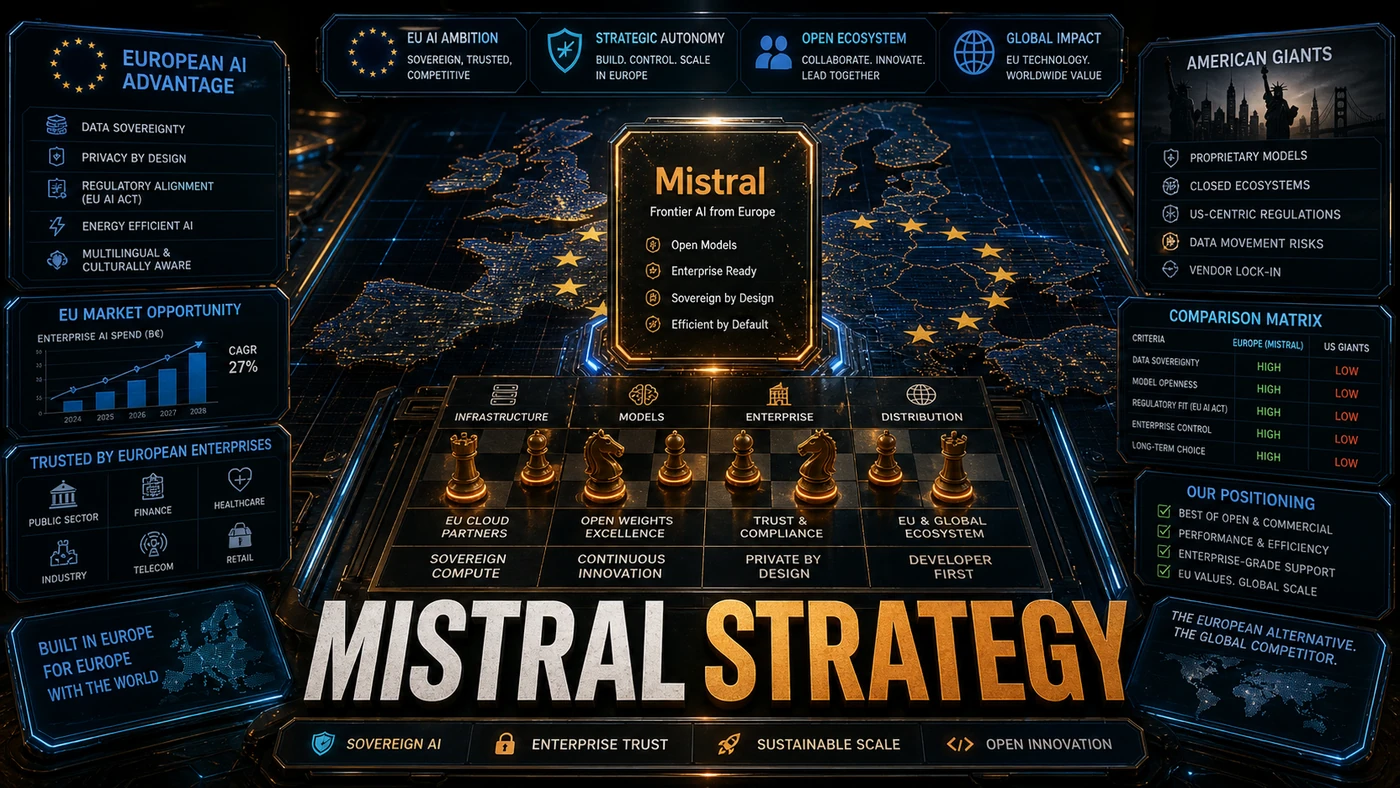






European AI: Mistral's strategy vs American giants
Analysis
Europe has spent the better part of three years watching the generative AI race play out as an American story, with a few Chinese labs crashing the party. The frontier models that get talked about in boardrooms, GPT, Claude, Gemini, are all built on the other side of the Atlantic. For a continent that writes some of the strictest data rules on the planet, that has been an awkward position.
One Paris company has become Europe's standard-bearer here. Mistral is widely described as the most prominent European frontier-model lab (TechFundingNews), and its pitch is unusual. It isn't claiming to have the smartest model. It's claiming to have the model European companies can actually deploy without a compliance team flagging it.
For an Australian business, the lesson travels. The question Mistral keeps forcing isn't "which model scores highest?" It's "which model can I run given where my data has to live and who I answer to?" Those are different questions, and the gap between them is where Mistral makes its case.
Mistral's approach: Open-weights with European values
OpenAI and Anthropic keep their model weights locked up. Google offers closed APIs with a narrow slice of openness. Mistral goes the other way and ships open-weights models under permissive licences, nearly everything it releases sits under Apache 2.0 (Serenities AI).
That isn't charity. It's a wager. Mistral is betting that openness becomes a selling point as more buyers grow nervous about vendor lock-in and about where their data ends up. If you can download the weights and run them yourself, you're not handcuffed to one provider's pricing, uptime, or roadmap.
The European angle is the other half of the bet. Mistral is based in Paris and answers to EU regulation (Euronews), and the models are built with European data residency in mind. For a bank, a hospital, or a government department inside the EU, that's a real practical edge over an American vendor, the kind of thing that decides a procurement, not a benchmark.
Benchmark reality check
Mistral Large 2's numbers are respectable rather than chart-topping. A few of the figures that have circulated for it don't hold up against published sources, so treat the scorecard with some care:
- SWE-bench Pro: reportedly around 48.6%, though this figure is unconfirmed, Mistral's published coding results are for its Devstral line, not Large 2
- MMLU: roughly 84% in Mistral's own announcement (some trackers have cited a slightly higher 85.1%, which doesn't match the primary source)
- Context window: documented at 128K tokens per Artificial Analysis (a 256K figure has been floated but isn't supported)
- Price: $2 / $6 per million tokens, mid-range, not bargain-basement
These scores won't top a leaderboard. They don't have to. They're enough for most enterprise work, and once you fold in open weights, European governance, and genuinely strong multilingual handling, the combination starts to look like its own category.
The American competition
On raw capability, the Americans still set the pace. Anthropic's Opus 4.8 leads SWE-bench Pro at 69.2% and prices at $5/$25. OpenAI's GPT-5.5 sits behind it (reported figures of "62.4% SWE-bench, $8/$40" for a "GPT-5.5 Pro" tier are unconfirmed and don't line up with published pricing). On value, Google's Gemini line is the usual pick, though some quoted Gemini 3.5 Flash prices ($0.35/$0.70) are well below the rates actually listed, so take cheap-Gemini claims with a grain of salt.
On the open-weights side, MiniMax M3 is the one to watch, it tops open-weight SWE-bench Pro at 59.0% and ships with a technical report, reportedly at a fraction of the cost of the big closed models (VentureBeat). Comparisons that pin Mistral against an open Chinese model called "DeepSeek V3.5" or a "Qwen 3" at 46.2% should be read cautiously: no DeepSeek V3.5 was released, and the current Qwen flagship scores far higher than that older number suggests.
Mistral leads on none of these single metrics. Its strength is the bundle: open weights, plus European governance, plus multilingual quality. For an EU outfit with data residency obligations, that bundle is hard to ignore, and for an Australian firm with similar concerns about where data sits and who controls the model, it's worth understanding why.
Verdict
Mistral Large 2 is a sound choice for EU-based organisations, and Mistral remains Europe's leading model lab, though note the company has shipped newer releases since, so Large 2 is no longer the freshest thing it offers (Serenities AI). It won't unseat the American frontier models on capability, and it doesn't try to. The bet is that openness and governance matter more than benchmark supremacy. For a meaningful slice of the market, that bet pays.